Mike Jones recalled that in the 1980s, his development company, Tricord Inc., sold a home in the Fredericksburg area for $79,900. That price included the land, as well.
Those days are, of course, a distant memory.
“Affordable housing has become a thing of the past here,” Jones said. “And, so, we’ve been very interested in addressing that topic for a long time. We’ve been considering ways to do that.”
Jones discussed one of those ways during the Regional Housing Assembly’s third annual Regional Housing Summit, which was held this past Thursday at the Fredericksburg Convention Center.
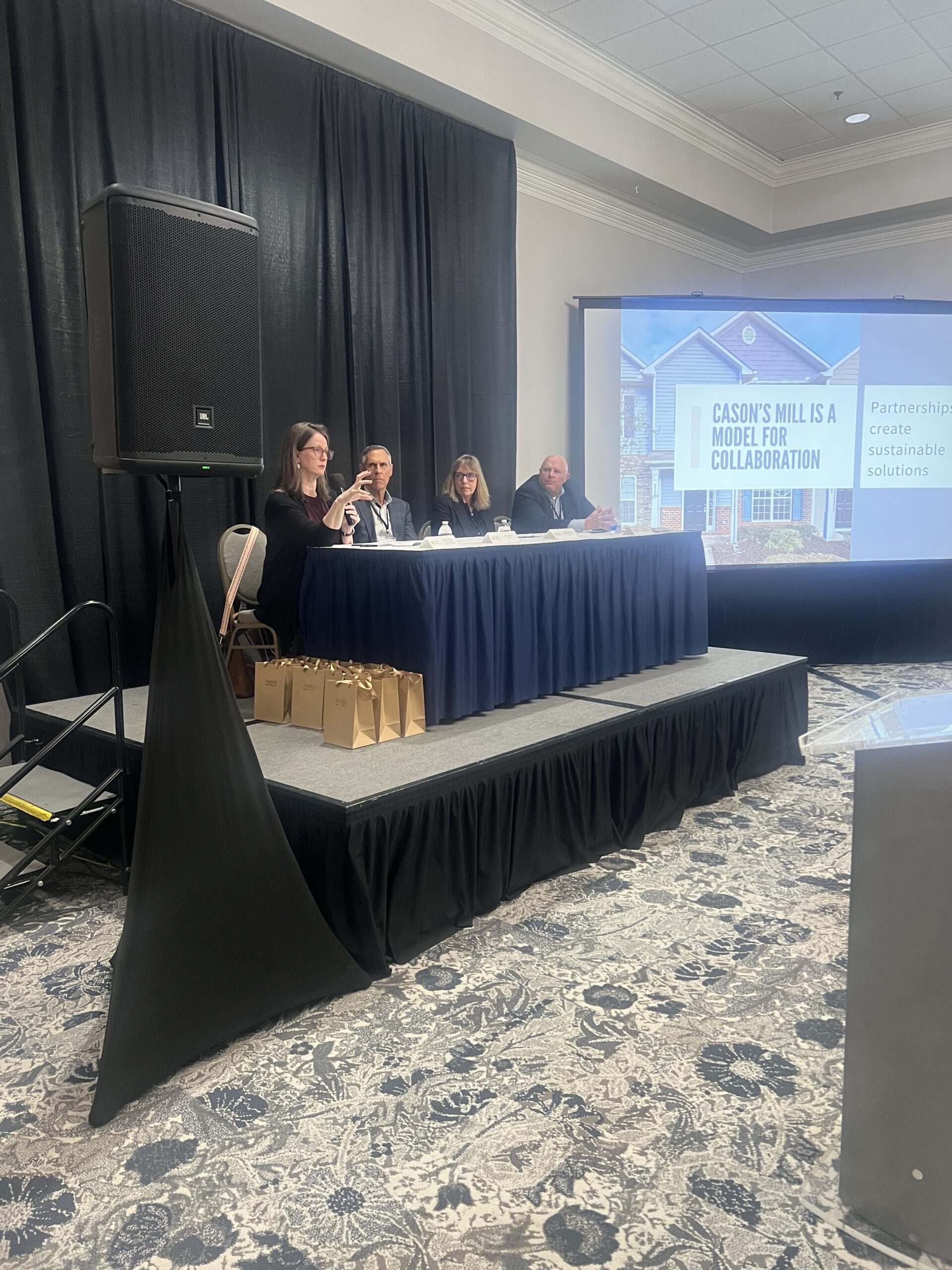
In front of a collection of local government officials and community resource partners, Jones described an affordable housing project called Cason’s Mill that is currently in the planning stages. Tricord is collaborating with Central Virginia Housing, Greater Fredericksburg Habitat for Humanity and Virginia Statewide Community Land Trust on the endeavor.
Representatives from those organizations participated in the forum’s breakout session called “Solving Affordable Housing through Local Partnerships.”
“The key word you’ll hear over and over is collaboration,” said Carl Bardy, executive director of Central Virginia Housing.
The collaboration starts with Jones’ company. Tricord donated a 6.6-acre tract off Courthouse Road in Spotsylvania County, just across from Courthouse Elementary School before Foster Road.
The plan calls for constructing 66 one-over-one condos on 33 lots at a cost of between $250,000 and $300,000. County employees and first responders will have the first crack at the two-bedroom, two-bathroom homes, which will be approximately 1,000 square feet.
Jones noted that the project is still in the planning stages, and a rezoning application has yet to be submitted to the county. He said engineering and traffic studies will be included in the package to ensure county officials have all the relevant information before the project goes forward to the planning commission for a recommendation and to the board of supervisors for final approval.
“We’re hoping this project is a model not only for this community, but other places in the region and around the state,” said Michelle Winters, of the Virginia Statewide Community Land Trust.
Winters said the role of her agency in the partnership is to ensure the homes remain affordable “in perpetuity” even after they go on the resale market. She also noted that the future homeowners will only be taxed at the baseline rate for affordable housing, and rising assessments won’t impact their tax bills.
Jayne Johnson, executive director of the Greater Fredericksburg Habitat for Humanity, stressed that because Fredericksburg, Stafford and Spotsylvania are in the Washington Metro region for housing purposes, the median family income to determine eligibility for affordable housing is $163,900. Caroline County is in the Richmond region, while King George is considered non-metro.
“What that [$163,900] really means is that includes a lot of the people we rely on daily in our communities — our teachers, our law enforcement personnel, nurses, county employees, retail managers and so on,” Johnson said … “Those families simply cannot buy a home in Spotsylvania County.”
Johnson said Cason’s Mill is “not about a handout, but a hand up.” The neighborhood won’t include any rental units.
“This isn’t about subsidized apartments,” Johnson said. “It’s about assuring our workforce can afford to live in our community.”
Presenters during the breakout session noted that by 2040, Planning District 16, which includes Spotsylvania, Stafford, Fredericksburg, King George and Caroline, will be home to more than 500,000 people, but with a limited amount of housing.
Jones said one challenge in presenting the project to county officials will be residents, who are often exasperated by population growth.
“There’s always going to be voices not wanting anything regardless of who it helps because, ‘I don’t want more kids in the classroom … We don’t want more cars on the road,’” Jones said. “So, the voice that says, ‘Affordability is important,’ needs to be heard because it will be challenged by the voice that says, ‘No more people, no more cars, no more school kids.’ That’s the hard part.”
Sen. Tim Kaine (D-Virginia) addressed forum attendees via video conference. Kaine was scheduled to be in attendance but had to be in Washington, D.C. for a failed vote to end the ongoing government shutdown.
Kaine noted that the Fredericksburg area is one of the fastest-growing regions in Virginia and said that creative solutions will be required to address the shortage of affordable housing.
“Having worked as a fair-housing attorney in my past life and having worked on affordable housing as mayor and governor, this is a priority I deeply support,” Kaine said. “I look forward to working with you to take some of the ideas that come from today and put them into action.”
Kaine highlighted the Road to Housing Act, a bipartisan bill that aims to expand housing supply, reduce costs and grow home ownership across the nation with federal support. The bill passed the U.S. Senate, but still must get through the U.S. House of Representatives. Progress stalled with the government shutdown.
Kaine also mentioned a project at his church — Richmond’s St. Elizabeth of Hungary Catholic Parish — that will convert two-thirds of its property into 56 affordable housing units.
“This is exciting … we feel like a pioneer,” Kaine said. “Church leaders, including in Fredericksburg, said, ‘We have land we could use for workforce [development] and affordable housing, and we’d like to do it.’ I’m hoping to spread the story of what we’ve done at St. Elizabeth’s so other churches and communities around Virginia can do the same thing.”