Even after leaving the Fredericksburg Area Museum (FAM) this summer, Gaila Sims has remained at the center of efforts to transform the downtown site where enslaved people were once bought and sold on an auction block.
Sims, who now teaches at Germanna Community College in Fredericksburg, guided the selection process for the person who would design a monument honoring enslaved people.
Eto Otitigbe is described in his biography as a polymedia artist whose work spans sculpture, performance, installation, and public art. His public projects combine history, community, and biophilic design to transform historical and cultural references into nature-inspired, biomorphic forms and patterns.
Otitgbe also contributed to the design team for the Memorial to Enslaved Laborers at the University of Virginia where he helped shape the memorial’s exterior creative expression.
Over the past several months, the pair has held a series of gatherings during which community members have had the opportunity to offer input on the project. Otitigbe and Sims also held their second visual presentation this past Thursday at the Fredericksburg Visitor Center.
Otitigbe reported that he and Sims have been working with city officials to raise the intersection (William and Charles Streets) where the new monument will be placed.
“There will be more space for gatherings with the area being raised. It’s the transformation concept that is being used to reshape the area where the auction block used to be,” he said.
Once the project is completed, the memorial will feature a historical timeline. Facts about the former slave auction block date back to 1846 and continue until the block was removed in June 2020, following a city council vote to relocate it.
Vice Mayor Charlie “Chuck” Frye, who represents Ward 4, was a driving force in seeking the block’s removal, and Sims said in a past interview that the decision ultimately led to the creation of her position at FAM.
“Dates may not be in order, brick by brick, but the public will have the opportunity to connect the dots every time they engage with the monument,” Otitigbe said, while unveiling the visuals in the PowerPoint presentation.
In the past, Otitigbe has created and installed monuments ranging from 15 to 30 feet tall.
“A monument doesn’t have to be massive to make an impact,” Otitigbe said. “I just finished an 11-foot piece in Philadelphia, where lights in the ground were aimed at it.”
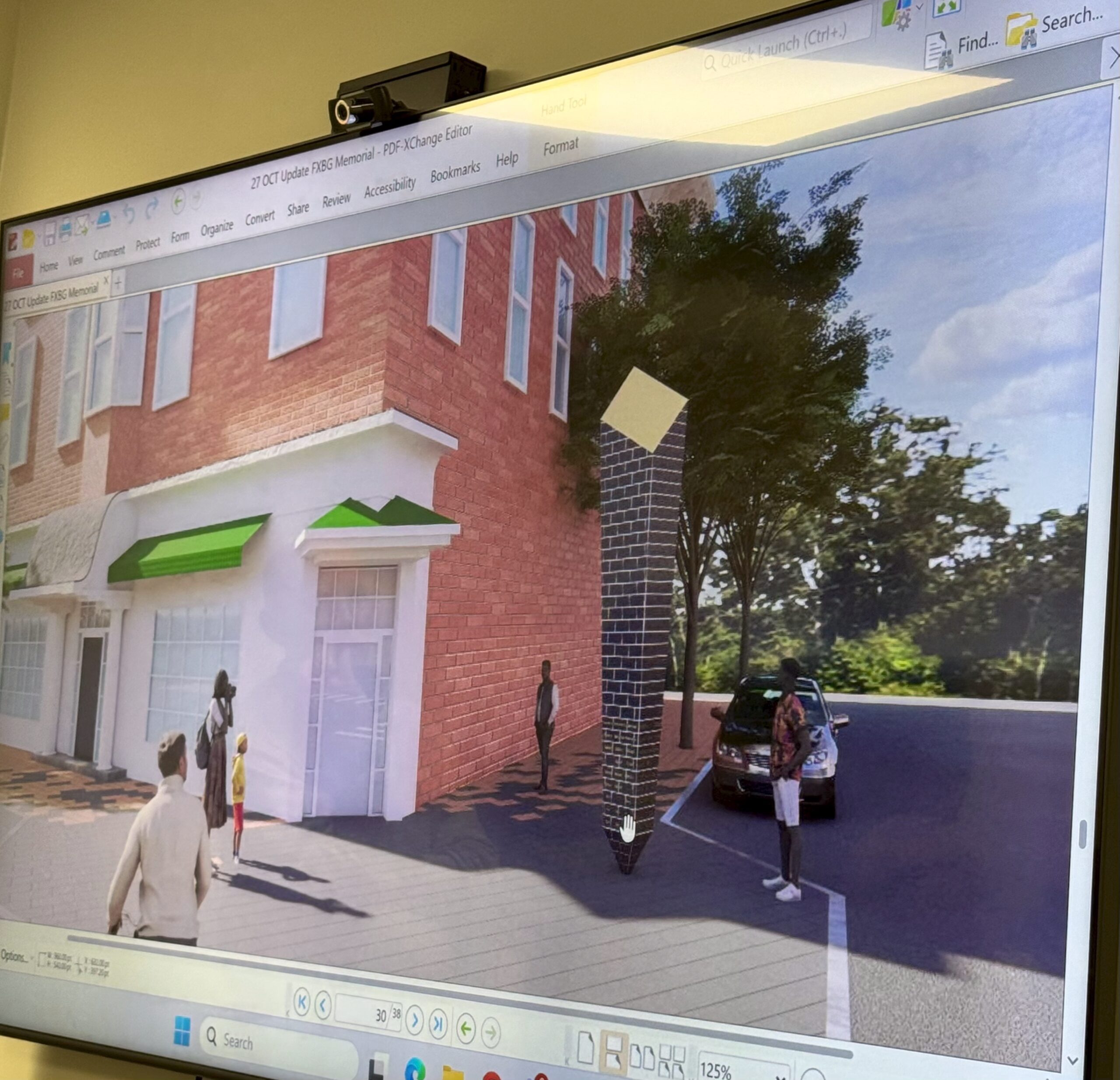
The monument will be layered with bronze bricks, Otitigbe said, and will feature text detailing the memorial and the site. Black bricks will extend to the ground, which will also be finished in black.
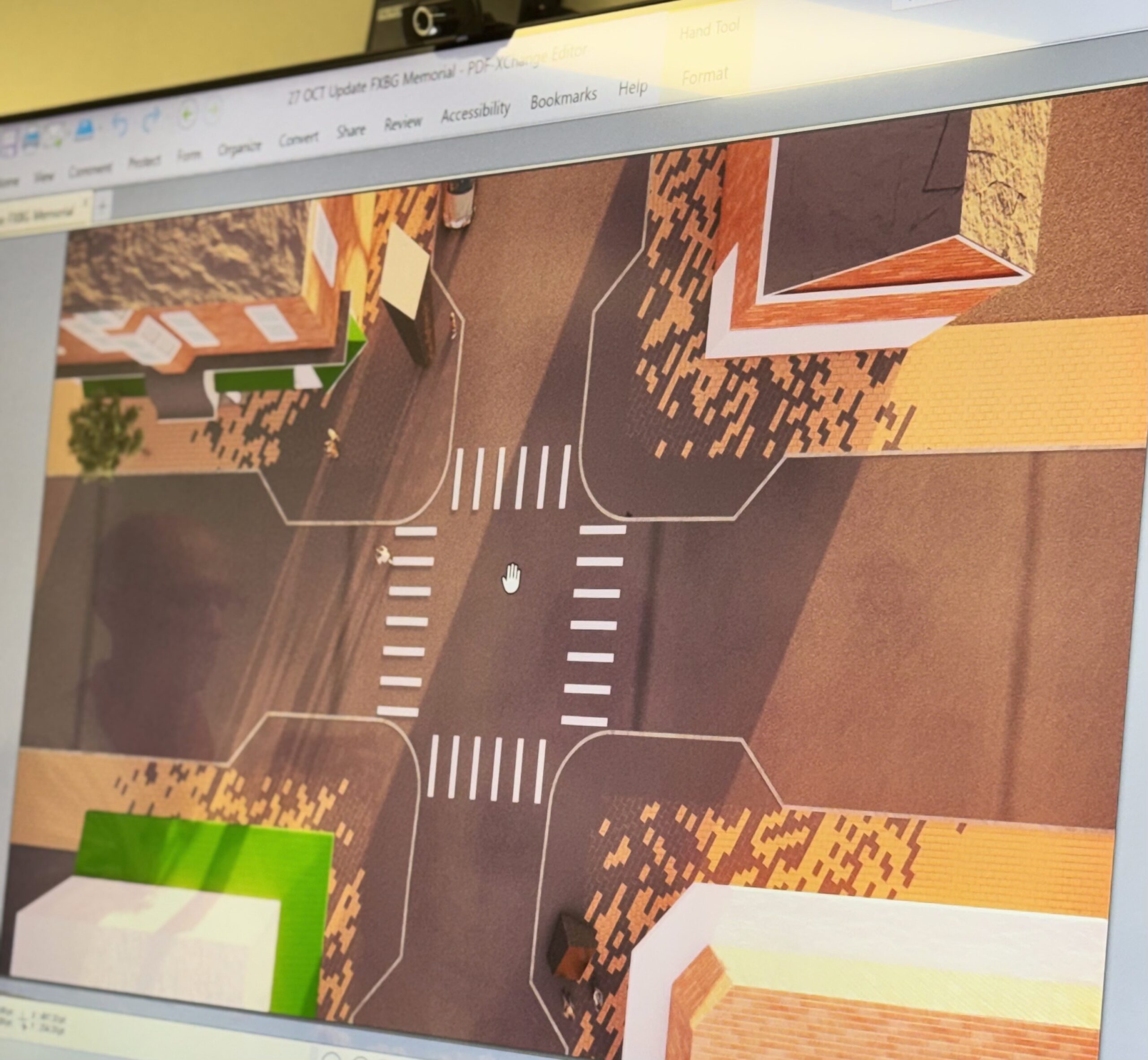
The design will take advantage of planned improvements to the intersection at William and Charles Streets. (Photo courtesy of Eunice Haigler)
During a comment window following the presentation, several residents expressed concern about people attempting to stand on the monument.
Although Sims and Otitigbe are making progress in the design process, the monument is not yet finalized. Spectators shared their opinions on what they liked and didn’t like about the visuals, with one person opining: “The additional ideas given today will probably cost a substantial amount more if taken into consideration.”
Scale studies and archival research were conducted to gather the names of enslaved individuals that will be inscribed on the bricks on the ground.
“The idea behind all of this is for the monument to serve as a vessel for those who were sold at the auction block,” said Otitigbe, “and we want to include more names. Any names we don’t have can be submitted by the public.”
Some attendees also expressed a wish that the entire building on the corner where the memorial will be located, could be incorporated into the project. “Can’t we just buy the building?” one person asked. “I’m sure the butcher shop would negotiate letting us have it.”
More suggestions included questions about how the monument will be lit at night and concerns about vandalism.
Otitigbe has been conducting research on Fawohodie, a symbol from the Akan people of West Africa that represents freedom, independence, and self-determination. He believes the concept fits well with the history of the auction block, reflecting both the struggle and the resilience of those who were enslaved.
Everyone discussed how enslaved African Americans were prohibited from learning to read or write, often signing their names with an “X.” Bricks marked with only an “X” will be used to represent the names Sims was unable to identify during her research on those sold at the auction block.
Sims noted some irony tied to the auction block and the future monument.
“I really love the materials we are using,” she said. “Bricks make up many buildings in this town, and research shows that African American brick masons were sold at the auction block.”
Eunice Haigler, a local community activist who organizes the city’s annual Juneteenth celebrations echoed Sims, saying: “That big monument will be skinny at the bottom, and I feel it signifies the weight that enslaved people and African Americans have had to carry.”
Added Otitigbe: “The idea of a monument going into the ground means it won’t be moved. Think about it — doesn’t the base of a house go into the ground?”
Simms can be reached at auctionblockmemorial@gmail.com. The next community meeting about the memorial will take place virtually at Shiloh Baptist Church (New Site) on Jan. 7.