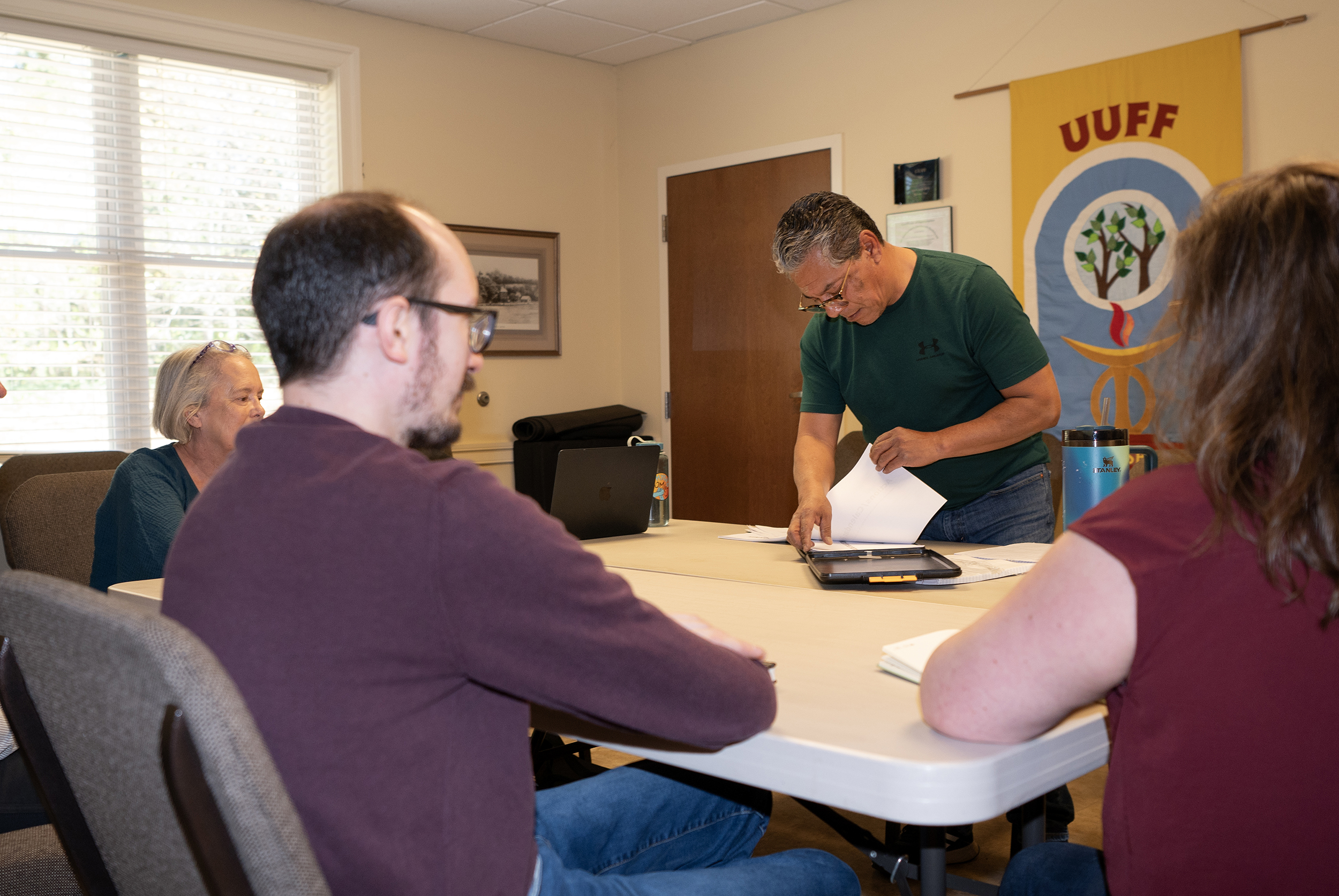
The man Jorge Mendez has come to meet pulls up a few minutes late. He is apologetic; he has just returned from visiting his wife in a hospital out of town, where doctors have not yet diagnosed her symptoms.
He moves a bit unsteadily, recovering from health crises of his own — heart surgery and operations on his legs. He hopes to regain enough strength soon to return to work as a cleaner.
He offers Mendez and the others joining him a seat on a bench in the shade beside his home. He would invite them inside, he tells Mendez in Spanish, but worries the house may not be tidy enough for guests.
Mendez is co-director of Virginia Organizing, a nonpartisan group that challenges injustice by helping people organize around issues affecting quality of life, particularly those who have traditionally had little or no voice.
Today, Mendez is trying to take the pulse of a Stafford County community that’s home to many immigrants. ICE has stepped up enforcement in cities across the country, sweeping in those with no criminal convictions and drawing criticism over aggressive arrest tactics. Reports of wrongful detentions — including some involving U.S. citizens — have added to those fears. Meanwhile, rumors of a possible immigration detention facility in Stafford have circulated for weeks, though a carefully worded statement from the Board of Supervisors suggests no formal discussion has taken place.
Mendez wants to know how people are feeling. And he wants to make sure there is a plan in place to protect this vulnerable population.
Change, Mendez has learned, begins at the grassroots level — with conversations like this one, with connections, with relationships.
He knows what can happen when communities are isolated and fearful. He knows what can happen when people stay silent.
A loss and a calling
It was 1981 in San Salvador, the capital city of El Salvador. Mendez was 13 years old. His sister was 12. The country was two years into a civil war.
Months earlier, in December 1980, four American churchwomen, including three Catholic nuns, were abducted from the San Salvador airport and sexually assaulted, shot and buried in a shallow grave by the Salvadoran National Guard, which was targeting humanitarian and aid groups for their work with poor and displaced Salvadorians.
Mendez and his sister, Elena, lived in a three-level building within walking distance of their school. A year before, their mother fled to the United States after armed soldiers came looking for her at the hospital where she worked. She’d belonged to a union, and belonging to a union could be a death sentence. By providence or sheer luck, they’d come to the hospital on her day off.
Not long after, Elena witnessed a man shot to death just around the corner from their home. Mendez heard the blasts and came out just in time to see the shooters running away. The victim, he learned later, was helping investigate the murders of the American churchwomen.
“We saw a lot of really, really awful things happen,” he said. A neighbor vanished one day, reappearing two weeks later. She’d been tortured.
Still, Mendez told himself these were not his problems to solve. Elena, though, begged to differ.
“She told me I needed to be concerned about what was happening in the country,” he said.
I’m a kid. I don’t care about that, he recalled telling her. You’re a kid. Why do you care about it? They are going to kill you if they know you are organizing.
“She had a lot of friends. Some of them were friends of mine as well, and they started to talk to me, tell me I need to participate in this,” Mendez said. “I really didn’t know at that moment that I was recruited by my sister. It started right there.”
He began to organize other students. Later, he organized workers, farmers and others in El Salvador.
Elena, though, was the catalyst, a vital player in the student movement. On Nov. 12, 1989, she was killed during a military offensive in San Salvador.
“She was 19 years old,” Mendez said. “Every time I see my children, I wonder what would have happened if she were here.”
It was a loss from which he has never recovered, not even after more than three decades.
Instead, grief folded itself into the person he would become.
‘I hadn’t any other choice’
In 2013, two decades after a truce that ended the El Salvadoran civil war, peace in the country remained fragile. The country had one of the highest homicide rates in the world, and gang violence was part of daily life.
A decade earlier, Mendez’s mother had begun a 10-year process for immigrant visas that would bring the rest of her family to the U.S. Mendez was not so sure he wanted to leave his country.
He was a husband and father of four. He loved his job overseeing social responsibility for an energy company. The work took him into communities with new development projects; he would meet with residents and municipal government officials about investment projects such as schools, healthcare programs, potable water. The local people would decide what was most important to them.
“It was really hard for me to make up my mind to live in the United States,” he said. “But there was a lot of danger in my country. My wife was telling me we need to go.”
The family settled in Stafford with a family friend, and Mendez worked “punch out construction,” fixing minor flaws and imperfections and other incomplete tasks before homeowners moved in. In his free time, he took courses to become a DirecTV subcontractor installing satellite systems. In 2015, he said, a big-box warehouse club stiffed him $2,500 for a big installation job.
“I was looking for a lawyer to help me recuperate that money,” Mendez recalled. He ended up with a card with a name that sounded familiar. “His name is rare, even in my country. I never knew anyone with that name. I told my wife, ‘I know him. I’m going to call him.’ A week later, I called him.”
Turns out, they had studied together at a university in El Salvador, and both had been part of the student movement. Now, his old friend was working as the director for an organization focused on immigration issues. They spoke on the phone for a long time.
“I met with him, had a conversation. We went for dinner. We were laughing and talking about old times,” Mendez recalled.
Then one day he called and told Mendez he was leaving for another organization and wanted Mendez to take over his role.
He’d been in his new country for two years. He didn’t want the job, at least not at first.
“It took some time for me to convince myself that I hadn’t any other choice,” he said.
Bringing people together, bringing about change
Mendez joined Virginia Organizing in 2019 as its Fredericksburg organizer. In 2024, he was named co-director of organizing.
For his lifetime of advocacy, particularly his work with persons of color, low-income individuals and the Latino community in Stafford and Northern Virginia, Micah Ecumenical Ministries recently awarded Mendez the Drum Major for Justice Award. The award recognizes local individuals who exemplify Dr. Martin Luther King Jr.’s call to servant leadership, justice and mercy in the Fredericksburg community, said Meghann Cotter, Micah’s executive servant-leader.
His work includes immigration reform and other social justice issues such as raising the minimum wage, increasing access to healthcare, promoting affordable housing and aiding individuals to get driver’s licenses.
“Jorge is a quiet, gentle leader in our community,” Cotter said. “He sees the brokenness in ways that are often not identified. He is a fervent gatherer of people for the sake of social justice.”
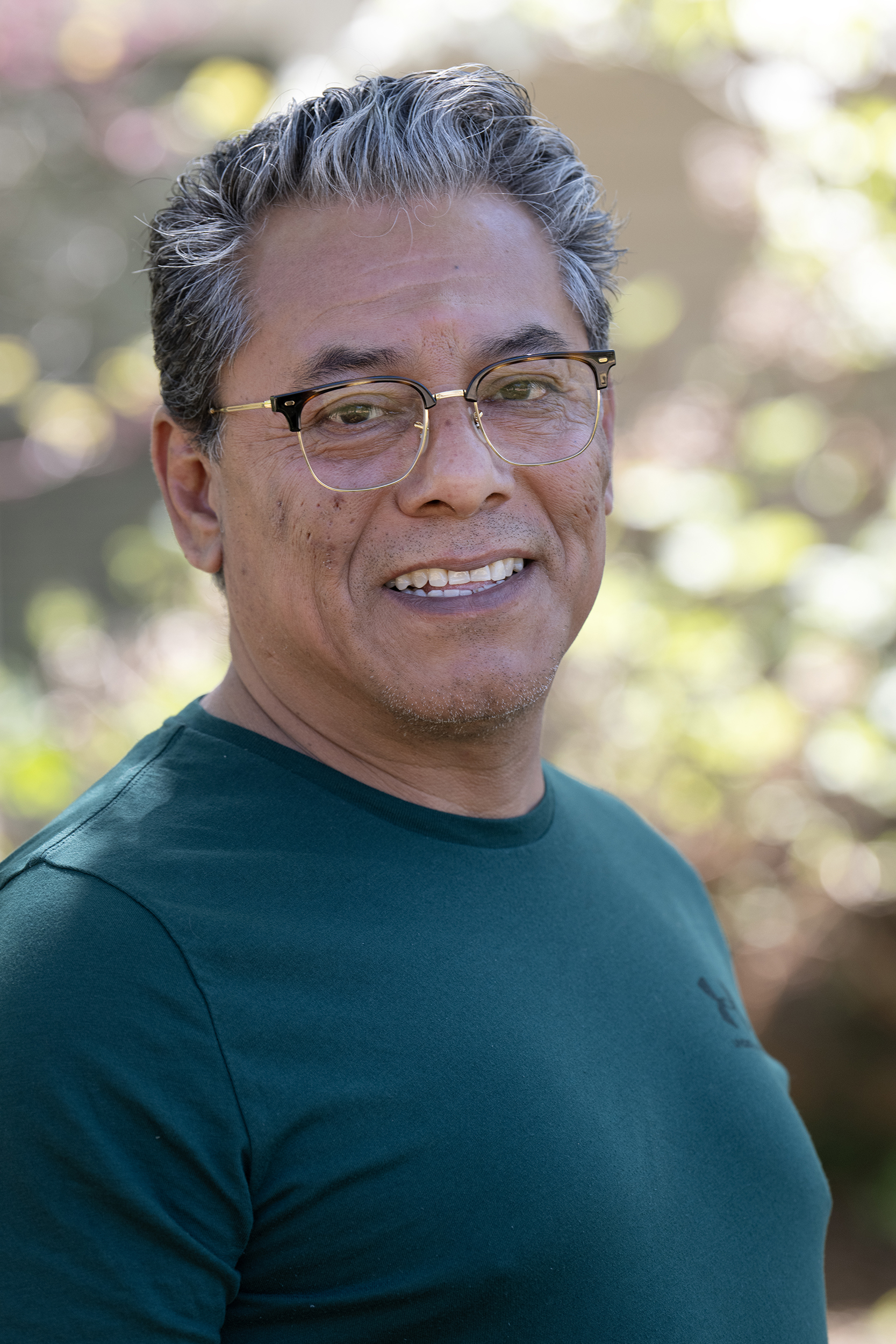
Jorge Mendez’s passion for organization began as a student activist in El Salvador. (Photo by Jeff Kearney)
The work he does today is not so different from what first drew him in as a 13-year-old in El Salvador.
People gather. They name what is wrong. They decide what must change. He asks the same questions each time: Who is affected? Who holds power? Who is missing from the room? What are the solutions? Is there enough momentum behind an issue to make change? If not, how do they bring more people to the table?
Today, those conversations are about affordable housing, access to healthcare, the impact of federal cuts on local budgets. They are about fear spreading through immigrant communities.
The man he meets in the small yard of a home in Stafford on a sunny Saturday talks about that fear, how many people he knows are staying indoors. He is worried about his wife’s health. He is worried about recovering from his surgeries soon so he can return to work.
He says there is a lot of distrust; the only reason he has taken this meeting with Mendez is because of a mutual connection. Mendez listens. Then he tells them about the power of organizing.
Fear isolates. Organizing does the opposite.