by Markus Schmidt
Virginians will head to the polls Tuesday to approve or reject a closely watched constitutional amendment that could reshape the state’s congressional map ahead of the 2026 elections. The standalone spring referendum will cap months of legal battles, political messaging and unusually high early voting interest.
The vote follows a fast-moving and contentious push by Democratic lawmakers to authorize mid-decade redistricting, a move framed as a response to similar efforts in other states but sharply criticized by Republicans and some reform advocates. The proposal has drawn national attention and prompted multiple court challenges, including disputes over whether the measure should appear on the ballot at all.
Early voting, which began March 6, ended Saturday after turnout showed notable engagement across parts of the state, particularly in GOP-leaning areas initially and in Democrat-rich Northern Virginia in the final days before the referendum. Now, election officials are preparing for in-person voting Tuesday, when polls will be open from 6 a.m. to 7 p.m.
The outcome could have far-reaching implications not only for Virginia’s political landscape, but also for the broader national fight over congressional maps, as both parties look to gain an edge ahead of the next round of federal elections.
With the vote just hours away, many Virginians are still sorting through what the amendment would do, how it came together and what could happen next. Here are 10 key questions — and answers — to help make sense of Tuesday’s referendum.
What exactly are Virginians voting on April 21?
Virginians are weighing a proposed constitutional amendment that would allow the state to redraw its congressional districts ahead of the 2026 elections. The measure creates a one-time exception to Virginia’s current redistricting framework, which typically relies on a bipartisan commission and court involvement following the census.
The amendment would give the General Assembly retroactive authority to approve new maps mid-decade under specific conditions tied to redistricting actions in other states. Democrats have emphasized that the change is temporary and designed to address shifting national political dynamics rather than permanently alter the state’s redistricting system.
Why is this referendum happening now?
The referendum comes in response to aggressive mid-decade redistricting efforts in other states, particularly by Republican-led legislatures, who took action after President Donald Trump called for partisan gerrymandering in Texas to secure GOP victory in this fall’s midterm elections. Virginia Democrats argue the state risks weakening balance in Congress if it does not respond in kind.
Lawmakers first advanced the amendment on a party-line vote during a special session in late 2025, framing it as a defensive move in an “unprecedented” national redistricting environment. Supporters say the timing reflects a need to act before the 2026 elections, while critics argue the push was rushed and politically motivated.
What exactly does the ballot question say and why has its wording been controversial?
The ballot question asks voters whether to approve a constitutional amendment allowing Virginia to redraw its congressional districts before the next census under certain conditions. But critics have taken issue with how the measure is described to voters, particularly language suggesting it would “restore fairness” to the process.
“Should the Constitution of Virginia be amended to allow the General Assembly to temporarily adopt new congressional districts to restore fairness in the upcoming elections, while ensuring Virginia’s standard redistricting process resumes for all future redistricting after the 2030 census?” the ballot question asks.
Republican lawmakers and national party groups argue that wording is not neutral and could mislead voters about the amendment’s intent. Those concerns fueled legal challenges seeking to block or revise the ballot language ahead of the vote. Despite those objections, courts allowed the wording to stand.
Is mid-decade redistricting even allowed under Virginia’s constitution?
Not under current rules. Virginia’s constitution, as amended in 2020, established a bipartisan redistricting commission and tied map-drawing to the decennial census. The proposed amendment would carve out a narrow exception, allowing mid-decade redistricting only under specific circumstances.
Legal challenges have already tested the limits of that authority. A lower court initially struck down the amendment earlier this year, but the Supreme Court of Virginia ultimately allowed the referendum to proceed, signaling that voters — not courts — should decide whether to authorize the change.
Would new congressional maps take effect immediately if voters approve it?
Yes. Lawmakers have already passed revised district lines, contingent on the constitutional change. Because Republican-led states have already enacted mid-decade redistricting plans, the “trigger” outlined in the amendment has effectively been met, meaning the referendum would make Virginia’s response legal retroactively, and no further legislative action would be required.
Several Democrats have already launched campaigns in some of the proposed districts, underscoring expectations that the new map would be used for the 2026 midterm elections, even as legal challenges remain possible.
What happens if voters reject the amendment?
If voters reject the amendment, Virginia will continue using its current redistricting system, and the existing congressional maps will remain in place until the next census cycle. That means no mid-decade redraw would occur before 2030.
Opponents of the amendment view this outcome as preserving the bipartisan framework voters approved in 2020. Supporters, however, warn that rejecting the measure could leave Virginia at a disadvantage if other states continue to redraw districts for political gain.
Would the new district lines remain in effect past the 2026 election if the amendment passes?
Yes. If voters approve the amendment, the newly adopted congressional districts would remain in place through the end of the decade, including the 2028 elections. The maps are intended to govern Virginia’s U.S. House races until the next round of redistricting following the 2030 census.
At that point, the state would return to its standard process, with the bipartisan redistricting commission drawing new lines based on updated population data. The amendment does not permanently replace the current system but temporarily overrides it for the remainder of the decade.
How could this change Virginia’s congressional delegation?
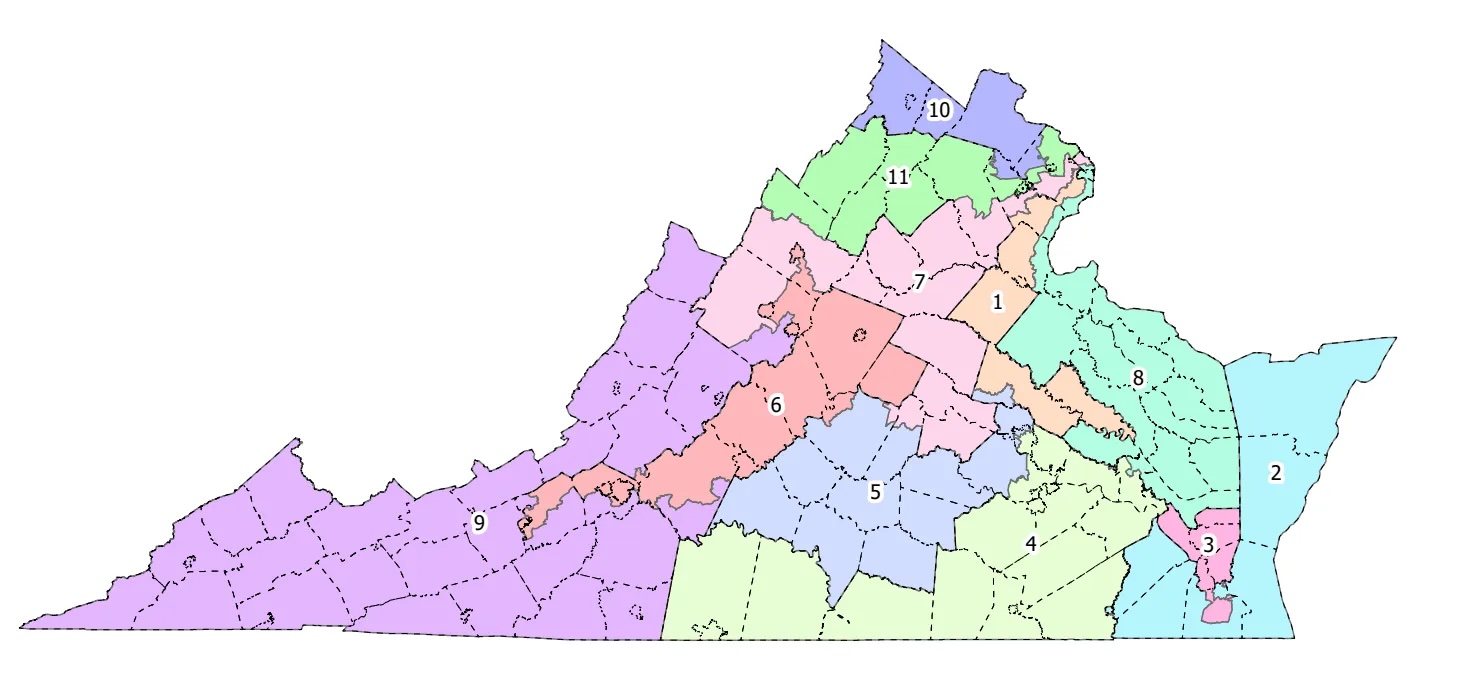
The amendment could dramatically reshape Virginia’s congressional delegation by enabling a new map that shifts the current balance from a closely divided 6-5 split to a heavily Democratic-leaning 10-1 advantage.
The proposed districts would consolidate Republican voters into a single, heavily GOP-leaning seat anchored in Southwest Virginia while redistributing Democratic-leaning voters across the remaining districts. If implemented, the shift would represent one of the most significant changes to Virginia’s congressional landscape in decades.
If the referendum passes, could the Supreme Court of Virginia still strike it down?
Yes, but that outcome appears unlikely. The Supreme Court of Virginia has already allowed the referendum to move forward, even after a lower court struck it down, signaling reluctance to block the vote before voters weigh in.
However, legal challenges to the amendment and the underlying process remain unresolved and are still before the court. Legal observers say the justices could review those claims after the election, but it is widely seen as unlikely the court would overturn the expressed will of voters if the amendment is approved.
What are supporters saying, and what are opponents warning about?
Supporters argue the amendment is a necessary response to partisan redistricting in other states, framing it as a way to protect Virginia’s political balance. Some Democrats have described the moment as “unprecedented,” urging voters to act defensively. High-profile backers, including former President Barack Obama and former U.S. Attorney General Eric Holder, have supported the measure.
Opponents, including Republican lawmakers, warn that the amendment undermines the bipartisan system voters approved in 2020 and opens the door to politically driven map-drawing. Former Gov. Glenn Youngkin has also called for the measure to be struck down, arguing it risks eroding public trust in the redistricting process.
(This story originally appeared in Virginia Mercury and is being republished here with permission.)