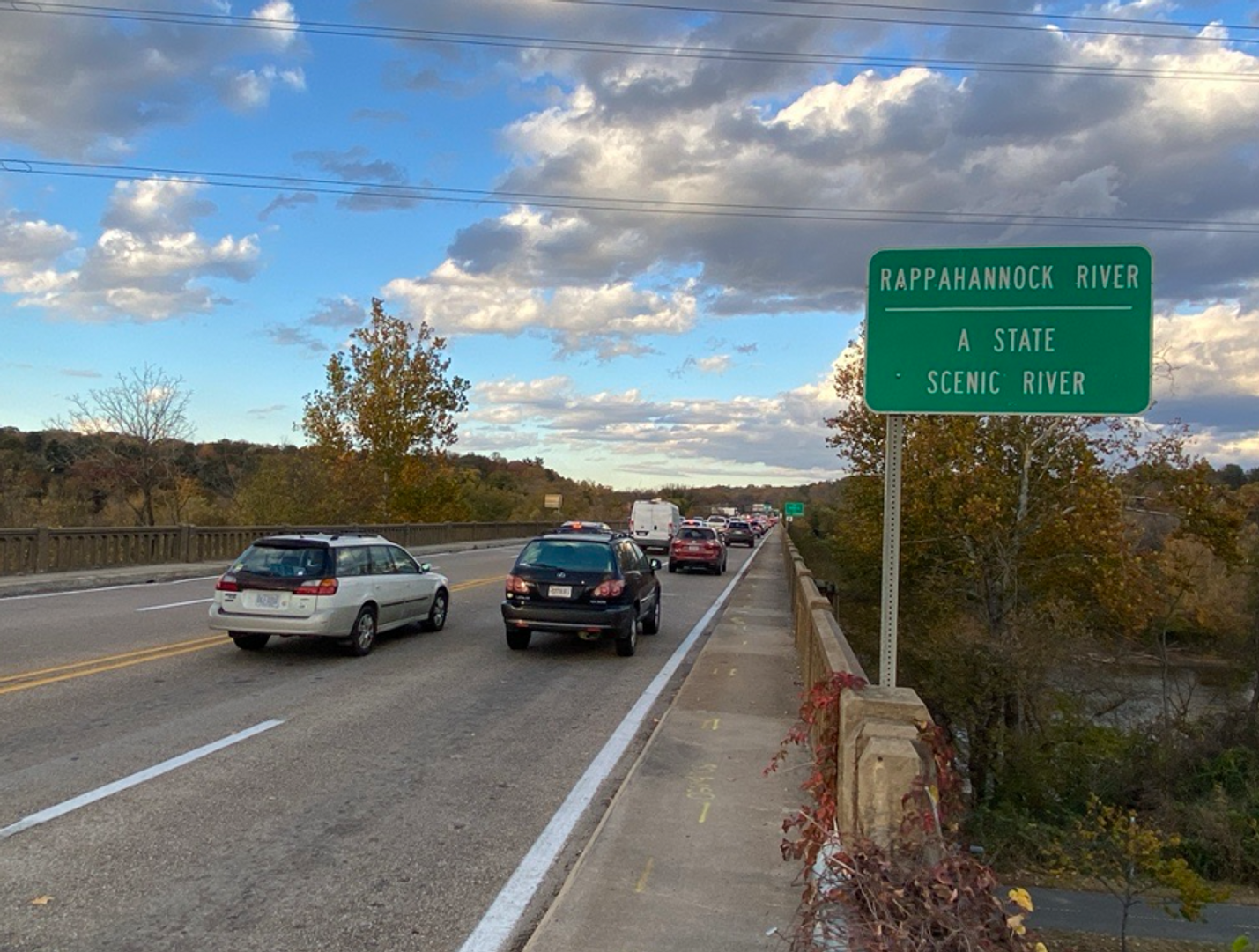
Fredericksburg-area commuters will have to endure three years of construction on the Falmouth Bridge once repair work starts in 2030.
But, as Virginia Department of Transportation (VDOT) engineer Greg Henion told the Fredericksburg City Council Tuesday night, their patience will be rewarded with a wider, sounder structure that includes a shared-use path.
The cost to repair the bridge, which spans the Rappahannock River and connects the city and southern Stafford County, increased to $160 million, with $73 million added from the state’s Priority Transportation Fund.
“That allows us to expand from a fairly straightforward traditional deck replacement to a full superstructure replacement,” Henion said of the increased budget.
The project now includes not only bridge deck replacement, but also replacement of the bridge girder and rails, Henion said. The scope of the project will be similar to the recent Chatham Bridge project, he added.
The bridge, which was built in 1943, underwent emergency repairs last year, with work wrapping up in March. According to a presentation at Tuesday’s work session, in 2023, the bridge saw an average of 40,000 vehicles per day.
The new structure will include a 14-foot-wide shared-use path with a barrier along the southbound lanes, with a six-foot sidewalk along the northbound lanes. Each of the four travel lanes will measure 11 feet wide.
The bridge will remain open throughout construction, with two southbound travel lanes and one northbound travel lane, Henion said.
Mayor Kerry Devine asked whether it would be possible to toggle which travel direction has two lanes based on changing traffic patterns. She noted that, on Sundays during the summer, northbound traffic is already at a standstill.
“On a good day, you can’t cross Route 1 because everybody’s backed up for miles. So,” she said, “this is gonna hurt.”
Henion responded that switching like that would be difficult, both logistically and from a cost standpoint. For one thing, certain work zones can’t be shifted from behind a static barrier.
“It’s something that would add complexity significantly to the project,” he said. “It might require additional width and would drive up costs relative to the structure and right-of-way costs. So, right now, that’s not the plan.”
In response to a question from Councilor Will Mackintosh (at-large), Henion confirmed that Caroline Street to Riverside Drive, a local route that passes underneath the bridge, should remain open throughout construction.
According to a timeline included in Henion’s presentation, the project is currently in the first of four planned stages, with design public hearings set for 2026-27. Construction is scheduled to begin in 2030.
“If I had to throw a dart at it today, three years,” Henion said of the project’s duration.
Devine noted that while the Chatham Bridge project required closure, the fact that the brunt of the work took place during the COVID shutdown meant residents didn’t feel the sort of prolonged disruption to their commutes that she anticipates here.
“We need to get it done,” Devine said. “No one is disputing that… But it’s going to be painful.”