As Jill Payne was packing away materials on her desk in the Rappahannock Court Appointed Special Advocates office in Fredericksburg earlier this week, she pondered whether to leave up a photograph that served as a reminder of her passion for the non-profit agency.
CASA advocates for children in the court system who were abused or neglected, and, after being a part of the agency for 35 years, Payne can easily recall her fair share of dark stories in the region that haunted her at night.
But as she heads into retirement on Jan. 30, Payne prefers to remember the success stories — like the one involving the little boy in the picture wearing swim goggles who was adopted into a loving home.
“He looked like such a normal little boy, just a normal child,” Payne said of the photo. “I thought, ‘That’s what we want, right? We want every little kid to just have what every kid should have. He’s taking swimming lessons, wearing little goggles, like a normal boy.
“You start feeling like every kid has endured something really awful, and just to see the face of a little one who’s getting what he should get is inspiring … I was going to leave [the picture] up, but then I thought, ‘No he’s mine. He was my little motivation.’”
Payne’s mother, Beverly Evans, started CASA and served as its executive director in the early 1990s. Payne assisted at the office, but her full-time job was as the clerk of Spotsylvania Juvenile and Domestic Relations Court.
After her mother retired, Payne took over as CASA’s executive director, a position she held for 15 years before a cancer diagnosis.
“I thought I was going to die like all people do,” Payne said. “I thought I better find somebody to replace me.”

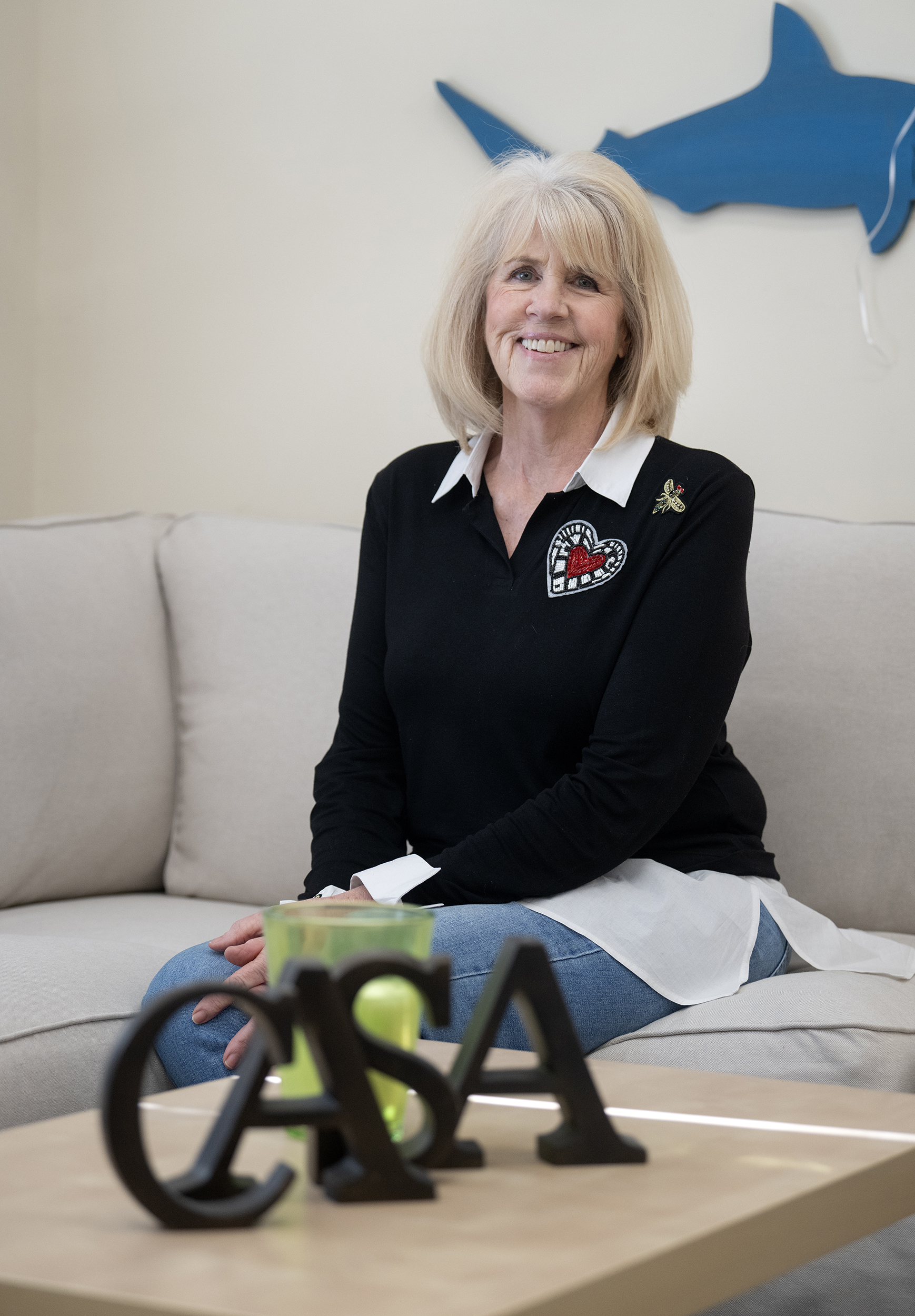
Retiring CASA Case Manager Jill Payne (left) and Executive Director Edie Evans chat in the non-profit’s office in Fredericksburg earlier this month. (Photo by Jeff Kearney)
Payne sought out Janet Watkins, whose husband Steve was one of the CASA volunteers assisting children in their time of need. Janet Watkins had also written grants for CASA.
“When I was getting ready to retire, it was really important to me that I got to pick who was going to follow,” Payne said. “It was my mother’s baby and then my baby. I knew and respected Janet, but I had no idea how smart she really was when she came on.”
After Watkins was hired in 2013 and Payne survived her bout with cancer, the latter became a case manager for CASA. While Watkins said it could’ve been awkward having her former boss work under her, the transition was seamless.
“I learned so much from her, and it’s a testament to her focus on the mission — and not on her ego — that she trained me and worked side-by-side with me when I became her boss, always supportive and committed to doing what’s best for kids,” Watkins said. “I doubt many people could shift from being the boss to having a boss without any issues, but we truly worked well together, and CASA benefited from her institutional knowledge and passion.”
Watkins remembers sitting in a small room at the CASA office with Payne and a potential volunteer they were interviewing to see if she’d be a good fit for the program. The volunteer worried that, if she began advocating for abused and neglected children, it could become emotionally overwhelming; that she would care too much, lose sleep and cry.
“Jill said some version of what I heard her say time and again over the years: ‘We want you to sleep, but please don’t worry about caring too much. Too many people don’t care enough,’” Watkins said.
Watkins lauded Payne for protecting thousands of kids in Fredericksburg, as well as King George, Spotsylvania and Stafford counties, from further abuse and neglect. Caroline County is served by a CASA office in Hanover County.
Payne’s job as executive director and then case manager included speaking up in meetings with social workers, guidance counselors and Guardian ad Litems. She visited kids at home, gathered medical, court and school records, and trained hundreds of volunteers to conduct detailed investigations into children’s lives and make influential recommendations to judges about where it’s safe for the kids to live.
Payne said her experience as the court clerk proved extremely beneficial at CASA.
“I think it helps me even today, to be honest,” Payne said … “I became familiar with judges and lots of attorneys, so when I came to CASA, it was an easy segue for attorneys. They knew who I was, and they had a little bit of confidence in me and my ability.”
After Watkins’ tenure ended, Edie Evans was hired as executive director in 2023, following several years as a case manager. Evans said Payne hinted at retirement for the past 10 years, but when she finally submitted a letter stating her intentions, Evans placed a sticker with the word “nope” on the paperwork.
For Evans, having Jill at the office is a “godsend” because of her memory and knowledge of trends. Cases have arisen in which Payne served the now-parent when they were a child. Evans said since its inception, CASA, with Payne’s guidance, is the “community’s conscience.”
She’s questioned Payne continuously with hopes that she’s covered all topics before all that experience is no longer within hollering distance in the office. Evans is sure she’ll call many more times in the future.
“She better not block my phone number because we’re not done having conversations,” Evans said with a laugh.
Payne said the best part of her run at CASA is that she went to work every day with a distinct purpose. However, it was sometimes tough to carry the weight of knowing her decisions would make a direct impact on another person.
Watkins said because juvenile cases are confidential, Payne’s impact may be largely invisible in the region.
“Jill will retire as many non-profit directors do: Without any of the perks or financial benefits of a corporate or government job,” Watkins said. “But I hope she retires with the satisfaction of knowing she did vastly more than most to better the lives of children in our community. She cared — more than enough — and so many children are better off for it.”