The opening backdrop for the Super Bowl LX halftime show proved more familiar to Will Negron than to most viewers.
Both of Negron’s parents were born in Puerto Rico, and sugarcane fields were a common sight in Ingenio, a suburb of about 2,500 residents where his father grew up.
“I talk about the sugarcane fields a lot,” said Negron, who, along with his wife, Maria, owns Hit the Spot Kitchen, a Fredericksburg-area food truck that serves Puerto Rican fusion cuisine. “My father grew up in the barrio, and so sugarcane was very prominent where he grew up at. As a kid going to where my father grew up, I remember seeing these fields. But each time the older I got, these fields started disappearing because sugarcane was a major commodity for Puerto Rico at one point.”
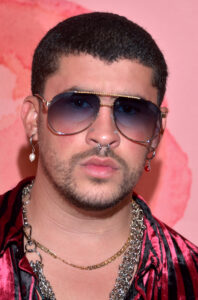
Bad Bunny in 2019 in Los Angeles. (Photo by Glenn Francis/www.PacificProDigital.com)
The expansive symbolism and imagery of Bad Bunny’s performance weren’t lost on Negron and other Fredericksburg-area residents with Puerto Rican heritage. While the Grammy-winning reggaetón artist rapped almost entirely in Spanish, the subtext of the 15-minute show spoke to politics and culture alike.
Negron noted that Bad Bunny walked through an impromptu boxing match and was handed a cup of piragua — a signature Puerto Rican shaved ice drink — from an elderly vendor. He passed both a bodega and a jewelry store; wearable gold is a big draw on the Caribbean island.
Just as diverse as the spectacles were the people themselves, he noted.
“If you watch the show again, you see a big, diverse colorization in the people,” Negron said. “The thing about Puerto Rico is, as small as it is, you had so many different people merging.”
The general party vibe of Bad Bunny’s performance struck Isha Renta Lopez, who teaches the Puerto Rican dance traditions of bomba and plena for Semilla Cultural, a nonprofit organization based in Fredericksburg.
Renta Lopez, who was born in Ponce, a city on Puerto Rico’s southern coast, recalled the frequent “marquesinas,” or garage parties, in which neighbors would keep their gates open in a warm and welcoming gesture.
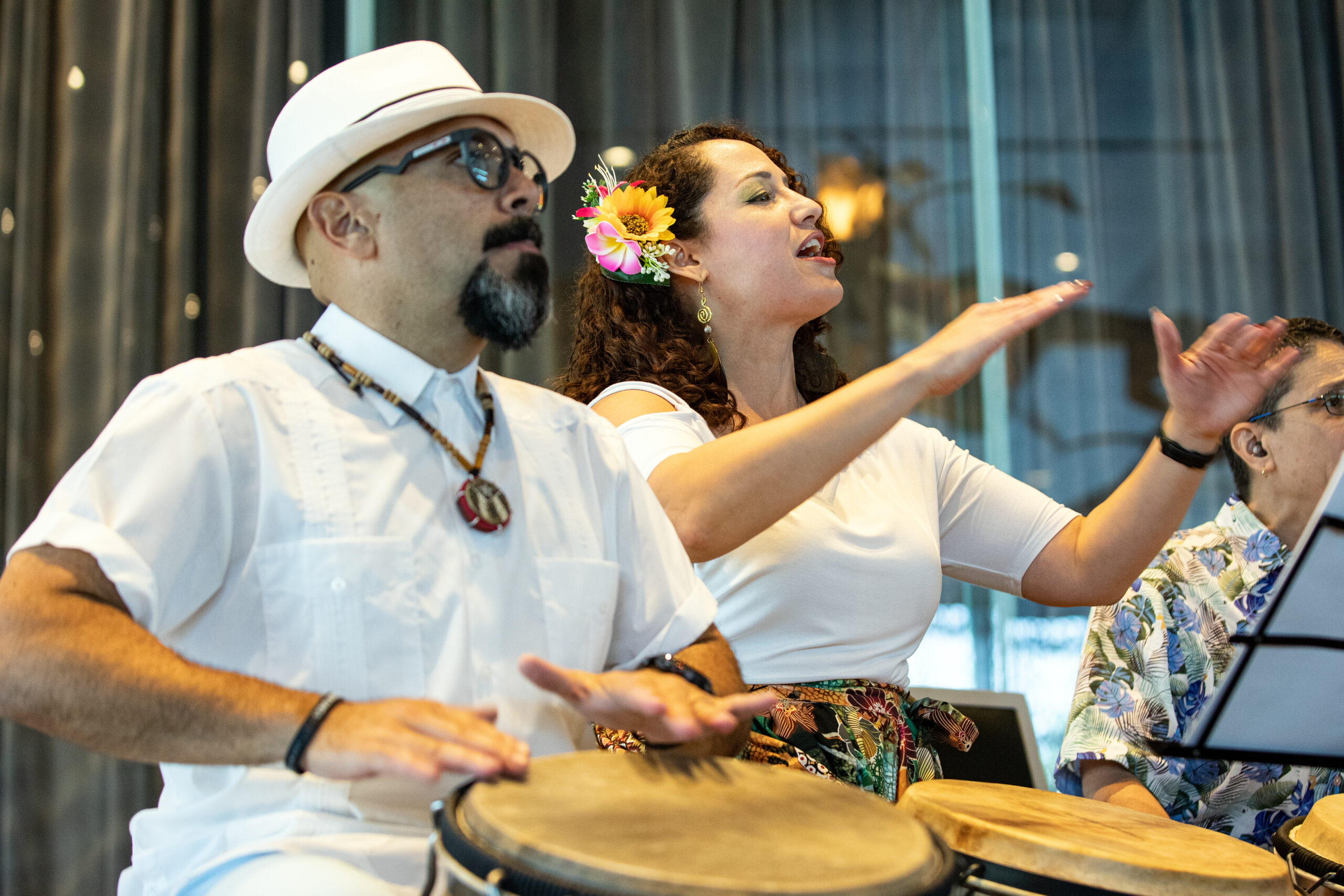
Joel Sanchez and Isha Renta Lopez perform with Semilla Cultural, an organization dedicated to teaching Puerto Rican dance, music and culture. (Photo courtesy Robert Stewart/Smithsonian)
Later on in Bad Bunny’s performance, she and many of the Puerto Ricans at the watch party she attended erupted in laughter when the artist woke a boy who’d fallen asleep in a chair amid all the merriment.
“I thought that was hilarious because we all can relate to this house party,” she said. “We’re all going all night. I think from my perspective, we usually have a start time for a party. We don’t have an ending time… So you actually will have kids sleeping in chairs and sofas.”
Not every element was so light-hearted, however. Renta Lopez noted that Bad Bunny’s rendition of “El Apagon,” sung atop an elevated stage resembling electrical lines, served as a serious critique of the power grid issues on the island.
“I feel like that was kind of like a political statement to the government of Puerto Rico because they have had all this congressional money to fix the grid and they haven’t done it,” she said.
She also noted his choice to include all the Americas — from Puerto Rico to Canada — and their flags in invoking the familiar “God Bless America.”
Both Negron and Renta Lopez said that Bad Bunny not only put on a good show: he also understood the stage he was afforded.
“It’s like I want to carry my flag right now — like the big one — and just like have it with me as I’m coming to work,” Renta Lopez said. “Because that’s how proud I feel.”