Fredericksburg is usually seen as just a small part of George Washington’s life. People think of it as a place he visited or a town from his childhood, not a place connected to his achievements. But for most of the 18th century, Fredericksburg belonged to his mother, not to George.
Mary Ball Washington spent most of her life here. Today, there are monuments, buildings, and even a university named after her. But why did many biographers paint Mary as a complaining “shrew,” difficult, or even greedy?
IF YOU GO
Mary Washington: George’s Much Maligned Mother by speaker Laura Galke, Monday, March 16, 6 p.m. Central Rappahannock Regional Library, Fredericksburg Branch
Most of what we know about her comes from memories shared by her children and grandchildren. These stories were often written down late in their lives and were likely shaped by the heroic legends that grew around George Washington.
“I think it’s a confluence of, especially in the early 19th century, when we start as a nation to begin building the official mythology of this country, there’s George, right?,” notes Aaron Mastin, a site interpreter for Washington Heritage Museums. “And (his future wife) Martha is young and rich beyond measure and knitting socks for the soldiers in Valley Forge. So she’s perfect. And every hero has to have a villain in their story. So who does that leave? Mary. And I think, you know, certainly male 19th century biographers don’t necessarily give her a fair shake.”
Mary Washington faced many hardships as a young woman. She lost her father, stepfather, and mother before she turned 12. Mary received an inheritance, including land at Little Falls in Lancaster County and enslaved workers, at an age when most girls were learning to become wives, not managers. That inheritance, along with her determination to keep it, shaped the rest of her life.
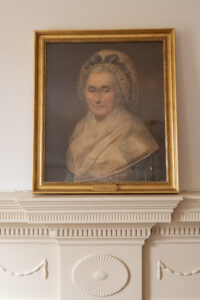
A portrait of Mary Ball Washington by Robert Edge Pine. Photo by Jeff Kearney.
She kept control of this land and managed the family estate at Ferry Farm after her husband Augustine died in 1743. Mary did something few women of her time dared to do: she chose not to remarry. This decision let her keep her legal independence, manage her own property, and made her unusual in colonial Virginia—a woman whose authority did not depend on a man.
“I think 21st-century male biographers also tend to miss the mark a little bit. But to say that she’s influential in the way that George approaches the world, I think, is an understatement,” adds Mastin.
After Augustine died, George did not get a formal education. Instead, he learned at home from his mother’s discipline, her focus on social skills, and her understanding of how to get ahead in Virginia. Mary made sure her children learned the skills that mattered to the elite, like riding, dancing, looking presentable, and making connections. She put her sons in the right places, with the right people, at the right times. George’s comfort among the elite, his careful image, and even his famous self-control all show her influence. The argument seems to be, if George Washington learned how to lead, Mary Washington taught him how to fit in.
Archaeologist Laura Galke worked at Ferry Farm for over a decade. When she started she was given several popular biographies of George Washington. Most were critical of Mary Washington’s parenting.
“I was sympathetic to these narratives: parenting is difficult and not everyone is good at it. However, as I studied the archaeological discoveries of Washington’s childhood home, Ferry Farm, where he lived between the ages of 6 and 21, there was a home that was full of the tools Mary Washington’s children need to thrive in their planter-class world.”
Galke said that household evidence of wig hair maintenance, horse equipage, horse tack ornamentation, elegant dining utensils, fancy needlework tools, fashionable buckles and buttons, teawares, and the latest hair grooming tools all allowed the Washingtons to “practice and exercise the behaviors and customs of their class, often using less expensive surrogates.”

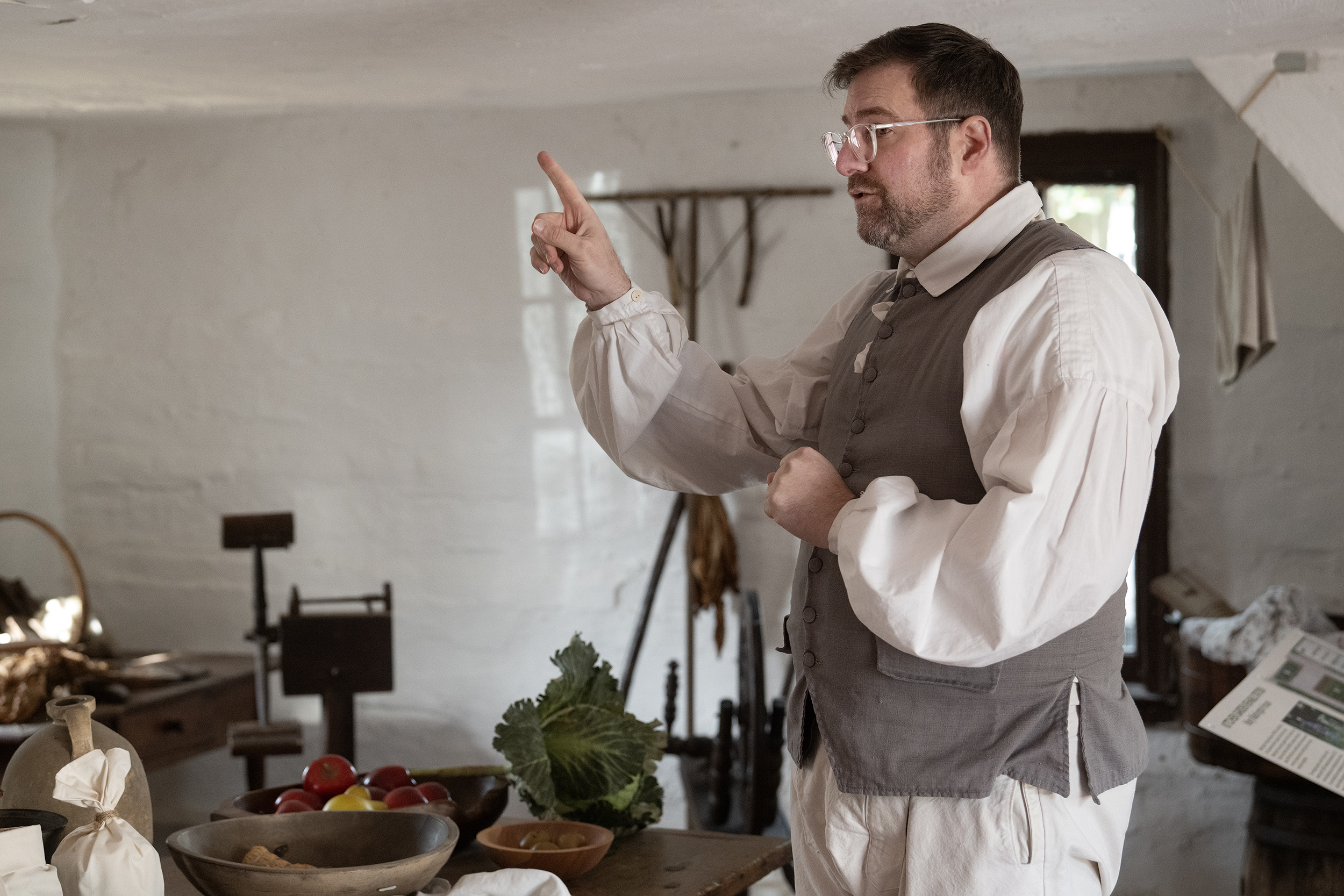
Aaron Mastin talks about Mary’s life on the back porch of the Mary Washington House. Photo by Jeff Kearney.
From Ferry Farm to her home across the river in Fredericksburg, Mary Washington was always in charge. She raised five children, managed enslaved workers, went to court, and handled her finances with care.
In the spring of 1772, Mary moved into a small house at the corner of Charles and Lewis streets, which became her last home. Back then, it was just a simple cottage. Over the next two hundred years, the house grew much larger and eventually included what had once been Mary’s separate kitchen. According to the Virginia Department of Historic Resources, the kitchen building at the Mary Washington House was built in 1804, many years after Mary died.
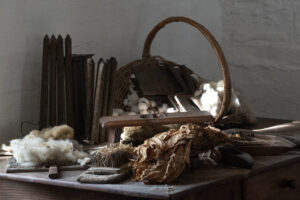
A vignette in the replica outdoor kitchen at the Mary Washington House. Photo by Jeff Kearney.
The archaeological record at Ferry Farm suggests Mary ran a well-equipped household. But it is important to acknowledge that her family’s success—and her independence—relied on enslaved labor, and she managed that system directly. Enslaved people worked on her land, were rented out for extra income, faced harsh punishment, and in at least one case, were executed, with the law paying Mary for the loss of her ‘property.’
“She lives to be almost 82 years old,” Mastin said. “I don’t think it’s bad for today, but incredible for that time period. And George only outlives his mom by 10 years. So she’s a constant force in his life.”
The American Revolution changed life for the Washingtons and others living around Fredericksburg. Living in a major port city, dependent on trade, and surrounded by divided loyalties, Mary left no record of firm political allegiance. Mastin said that many visitors to the Mary Washington House question whether she was a royalist.
Her sons pushed toward rebellion; her livelihood depended on stability. During the war, she became, ironically, someone worth protecting through silence. According to Mastin, George avoided contact with her because he feared his mother could be a potential hostage for his enemies.
Mary Washington died in Fredericksburg in 1789, not long after she blessed George before his inauguration. In the years that followed, biographers often found fault with her controlling and strategic personality. She asked George for money, she was pious and strict.
But she also became a symbol of women’s virtue, national unity, and healing after war. Her house was saved, her name given to hospitals and schools, and her image made more appealing.
Modern biographers,such as Kate Haulman, Martha Saxton and Galke, have penned books outlining a different story of Mary Washington, that of a misunderstood woman who craved independence but also wanted the best for her children.
“Mary Washington has been judged not by her actions, but by a gendered narrative tradition that finds fault with female agency, authority, and aging,” said Galke. “There is a double standard in which Mary Washington’s expressions of independence, authority, and command are criticized yet these same qualities in her son George are celebrated. If any faults are identified in George, they are seen as deriving from his mother.”
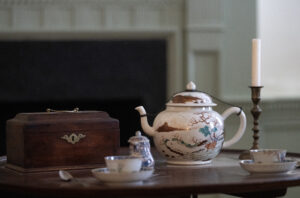
Mary Washington’s teapot on display in her historic home, January 23, 2026. Photo by Jeff Kearney.
Mary Washington’s life raises historical questions about how individuals are remembered, which figures are celebrated, and what aspects of their lives receive attention. Her story illustrates that life in early America frequently involved participation in established social and economic systems, that personal autonomy could coexist with authority over others, and that the choices available to women were shaped by the constraints and expectations of their time.