The sound of finger snaps filled the room as the crowd encouraged or agreed with speakers about the subject of debate — whether or not social media poses a threat to democracy.
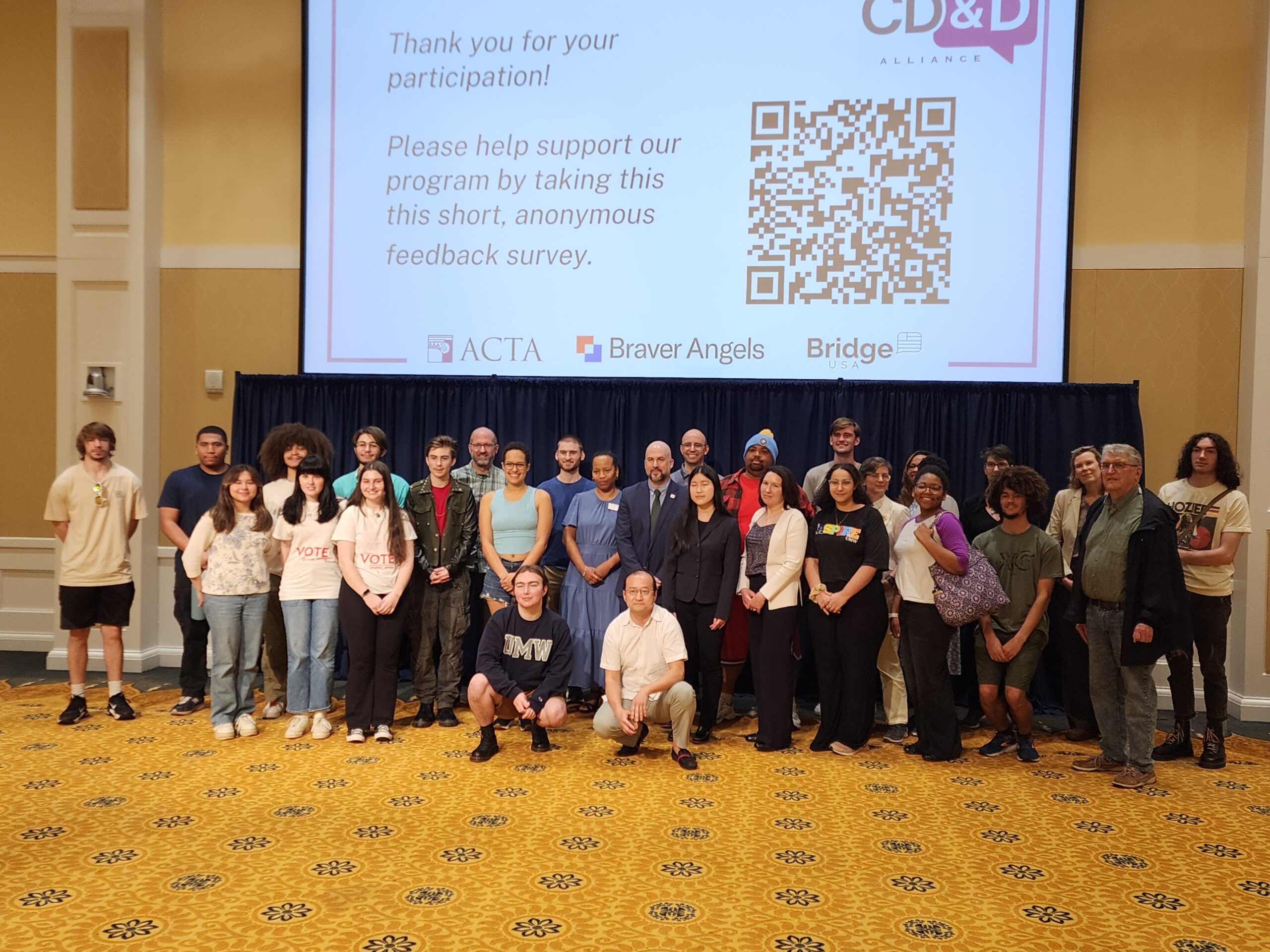
The University of Mary Washington held a Public Square Debate on March 11 at the Cedric Rucker University Center, where students and community members witnessed an event that played out differently than how debates typically go these days.
Hosted by the nonprofit organization Braver Angels, the debate adopted a parliamentary format rather than a head-to-head debate in order to encourage civil discourse and a respectful exchange of ideas. The speakers, mainly students of UMW and Germanna Community College, took the floor and expressed their opinion on the issue and fielded questions from audience members regarding their position.
Speakers were encouraged through audience actions such as snapping fingers or taps. These motions were made whether an onlooker agreed with the speaker, felt they made a good point or if they exhibited intellectual honesty, such as not knowing how to respond to a particular question.
Those who took the position that social media was a threat to democracy brought up issues such as the algorithm, misinformation and disinformation, anonymous posting, bots, prejudice and corporate ownership, among other concerns. Those against this idea brought up how social media has helped the cause of democracy through the proliferation of information, news and the ability to swiftly organize for events such as elections and protests.
After the speakers took turns fielding questions through the moderator, members of the audience were encouraged to follow suit. Some who took the floor had not planned to speak but had been encouraged due to the civility of the debate structure.
Caleb Dahllof was one of the debate speakers who argued that social media wasn’t a threat against democracy in and of itself. He cited its ability to inform and gather people for a cause. Dahllof, a co-president of the UMW chapter of Bridge USA, was pleased with the debate format:
“The vibe is similar to what we do at Bridge, but this was more structured,” he said. “When we have discussions at the end, people who thought they would disagree at the end find that they didn’t disagree as much. They find a lot of common ground that people don’t see because they don’t talk to each other.”
The other co-president of the Bridge chapter, Cameron Spivy, didn’t initially participate but was encouraged to speak due to how the format kept the proceedings civil.
“I thought it was really an environment where I left like I could talk without having done my preparation,” he said. “I felt that I had personal experiences that I thought could help with the conversation.”
Alina Jiang, a dual enrollment student at Germanna, defended the affirmative to the debate’s question. Jiang had participated in three different speeches held by Braver Angels prior to this event and felt confident walking in. However, she said that walking out she was surprised at the lack of antagonism in the debate.
“I prepared to speak in the affirmative, but listening to those speaking in the negative was eye opening,” she said. “This format really allows people to engage with each other and to build bridges. It helps to come in with an open mind, and people do care about your opinion.”
According to Brian Paul, the Public Square Debate initiative is part of the VA250 commemoration, which brings together high school and college students to exchange ideas on timely civic questions. The goal is to invite a diverse array of voices into a shared space to engage in civil discourse.
In addition to the Braver Angels organization, the debate is a partnership among VA250, the State Council of Higher Education for Virginia, The Virginia Department of Education, Bridge USA and the American Council of Trustees and Alumni, which houses the College Debates and Discourse Alliance.
A curricular fellow for the alliance, Paul said the initiative acts as a celebration of the 250th anniversary of the founding of the United States but invites all participants to consider what it means for a nation to have lasted this long and where it desires to go in the future.
To that end, the subjects debated are meant to be challenging and controversial and invites people with different perspectives to come share and consider their opinions without the threat of being cancelled out.
Paul also acted as the debate chair and discussed his role in the proceedings, saying, “My role is to ensure that as many perspectives as possible are heard in a way that is both passionate and rigorous but also respectful of the diversity of points of view.”
Also commenting on the matter was Sarah Dewees, the director for UMW’s Center for Community Engagement, who said that social media was one of four that were approved by the Virginia Department of Education and was chosen through a poll of 215 students, which showed a high level of interest in the topic.