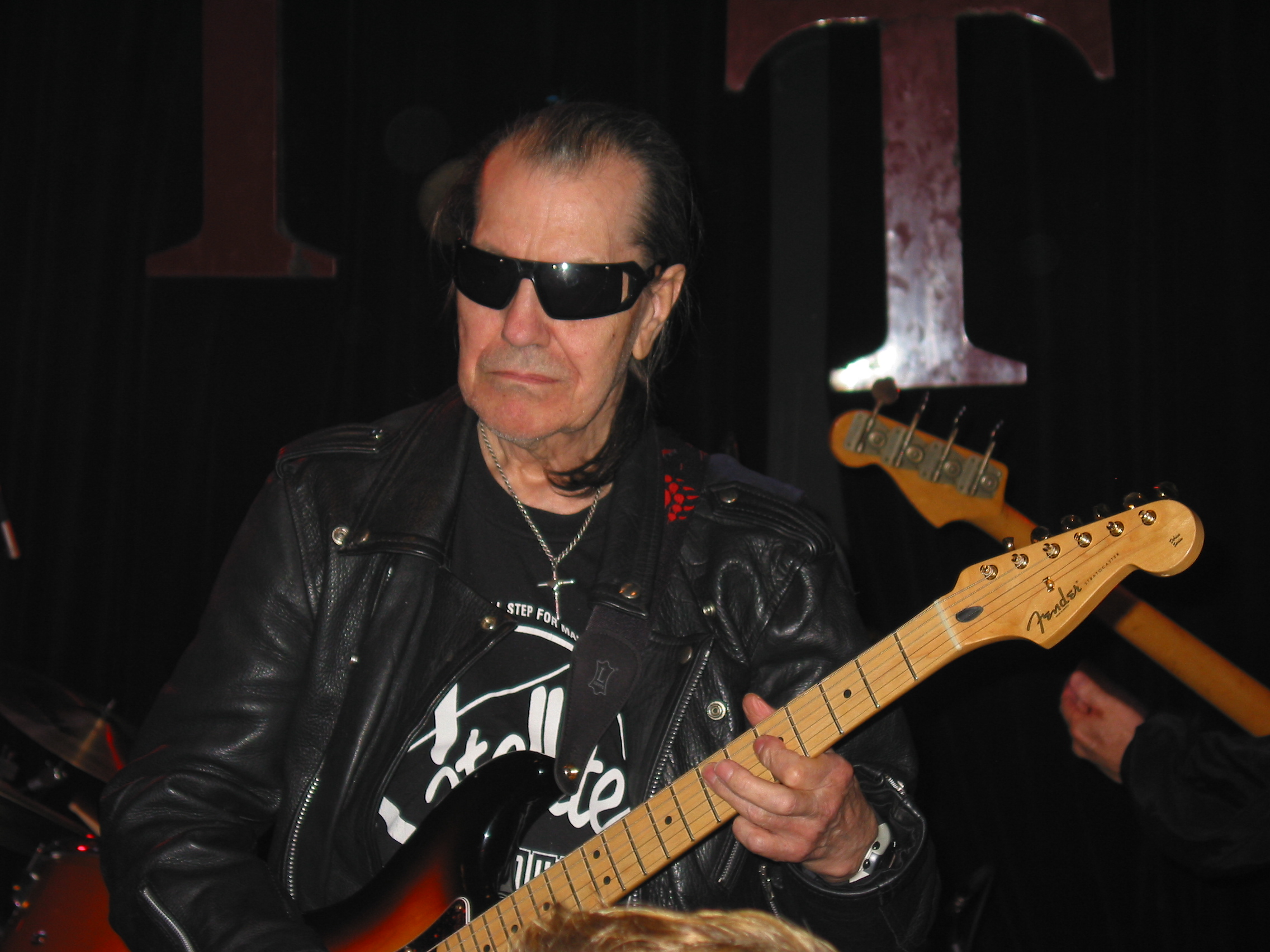
By Dwayne Yancey
In 1958, a 14-year-old English lad in a small city south of London heard a new song blasting out of a jukebox — and it changed his life.
Until then, he’d been playing some skiffle songs on guitar, a mix of folk, country and blues. After he heard the song coming out of the jukebox — “totally unique in its mystery, imagination and execution,” he later said — the teenager set out to imitate those exotic sounds.
The boy went by James Page then. The world knows him today as Jimmy Page, the founder of Led Zeppelin.
On the west side of London that year, a 13-year-old boy heard the same song and was likewise mesmerized by the strange sound.
His name was Peter Dennis Blandford Townshend and the world knows him today as Pete Townshend, the guitarist of The Who.
The song they were so entranced by, and which changed the trajectory of their lives but our musical culture, was one that first came to life, quite by accident, in Virginia.
This week the Virginia Department of Historic Resources approved a historical marker to the song. This is the story of “Rumble,” a song with no words that was deemed so dangerous it was banned from some airwaves — but made musical history anyway.
* * *
Fred Lincoln Wray Jr. — he went by the nickname “Link” — never really fit in. He grew up in North Carolina in the 1930s where his family identified as white on census forms even though they were of Native American heritage — Shawnee on one side of his family, Cherokee on the other. His mother refused to teach her sons the Shawnee language for fear they’d get caught speaking it; Wray later told stories of hiding from the Klan.
He also learned how to play the guitar from a Black neighbor he knew only as “Hambone.”
In the 1940s, the family moved to Portsmouth, Virginia, and Wray — by then a teenager — started playing in bands. He served in the Army during the Korean War but contracted tuberculosis. Doctors removed a lung and told him he’d never sing again. Wray tried anyway.
By 1957, he was pushing 30, still trying to eke out a living as a musician. One night in late 1957 (the details of the exact date are hazy), his band (Link Wray & His Ray Men, or possibly the Wraymen or possibly the Raymen, those details are hazy, too) had a gig at the Fredericksburg Armory. A sock hop, really. A dance for teenagers. The emcee was Milt Grant, a well-known Washington, D.C., disc jockey who had a television program. Think of him as the Dick Clark of D.C.
The hit song of the day was “The Stroll,” by The Diamonds, a Canadian vocal quartet. It inspired a dance craze. Grant asked Wray to play the song — or something close to it. Wray didn’t know the song, though. Here’s how the Library of Congress — yes, that Library of Congress — described what happened that night in Fredericksburg: “Not knowing the chords to the recent song of the same name by the Diamonds, Wray began to improvise on his guitar. Then, when someone grabbed one of the mikes and stuck it up to one of the amps, creating the tune’s signature distortion, a modern classic was born.”
“The kids went ape,” Wray later said. They kept shouting “play that weird song!” So he did. Four times.
Wray was encouraged to record the song. “When we went to record it, I didn’t get that live sound like I did in Fredericksburg,” he later said in the Library of Congress account. “I got a pen and started punchin’ holds in the tweeters. I didn’t mess with the big speaker. So I started playing and got that distorted sound, plus I had a tremolo. I used a combination of that at the end.”
He called the song “Oddball” because it was. It used a musical technique that wasn’t new but also wasn’t in vogue at the time: the power chord.
The DJ helped Wray send the song out to record companies. The big ones weren’t interested. A smaller one was, and in March 1958 the song was released — with a new title. The record company executive’s daughter thought the song reminded her of the street fights in the musical “West Side Story.” Some accounts say she renamed it “Rumble.” Others say Phil Everly of the Everly Brothers did; he was on the same label. What is certain is that Grant claimed half the songwriting royalties, as was common at the times.
Before long, the song was an improbable hit — No. 16 on the Billboard charts. Some stations thought the aggressive riff was incendiary and refused to play it. “The nation at that time, anxious over sudden spikes in juvenile delinquency, was eager to drum out anything that could be cited as an instigator,” the Library of Congress says. “Industry charts of the time show that ‘Rumble’ scored just as strongly, if not more so, with young black audiences, as it did with white teenagers, no doubt adding further to the furor.”
No matter. On the other side of the Atlantic, a rising generation of British teenagers heard it — and were moved. “I remember being made very uneasy the first time I heard ‘Rumble,’ and yet very excited by the guitar sound,” Townshend later said.
Page remembered it “roaring” from the jukebox. “It had a profound effect on me.”
They weren’t the only ones. So were others with names like Jeff Beck, Eric Clapton, Ray Davies, Jimi Hendrix, Paul McCartney and Neil Young. So did James Newell Osterberg Jr., who heard the song in a University of Michigan student union building. “I left school emotionally at the moment I heard ‘Rumble,’” Osterberg later said. We know him now as Iggy Pop.
Wray’s improvised two minutes and 25 seconds of sound changed the course of rock’n’roll. It used power chords. It used distortion — “two qualities roughly akin to being one of the first paintings to feature paint,” Slate magazine later wrote.
“He is the king,” Townshend once said. “If it hadn’t been for Link Wray and “’Rumble,’” I would have never picked up a guitar.” That’s a bit of hyperbole; Townshend was already playing guitar by the time he heard the song, but “Rumble” clearly made an impression.
There had been rock’n’roll before “Rumble” but by the late ’50s it was somewhat in decline. Then all those British teenagers who had heard the song formed bands and we know the rest of the story. Rock music exploded onto the scene with renewed force in the 1960s.
It also left Wray behind. He was never able to replicate his hit. Record labels dropped him when sales were poor, although there always seemed to be another one willing to offer him a contract. Wray spent the rest of his life as something of a cult figure for music aficionados (Townshend wrote the liner notes for one album), but he was never a star. Wray wound up moving to Denmark. That’s where he died in 2005.
Nearly two decades would pass before Wray’s song was inducted into the Rock and Roll Hall of Fame in a new category of singles. Page played at the induction ceremony. Today, “Rumble” is a staple for soundtracks. You can hear it in “Top Gun,” “Pulp Fiction,” “Independence Day,” “The Sopranos” and even “SpongeBob Squarepants.” Bob Dylan has called it “the best instrumental ever.” When Wray died, Dylan opened five straight shows with a cover of “Rumble.”
Now, at last, a historical marker is bound for Fredericksburg to mark the site of the song’s debut. The Armory whose walls first shook with it is long gone, but the echoes continue around the world to this day.
(This story originally appeared in Cardinal News and is being republished here with permission.)