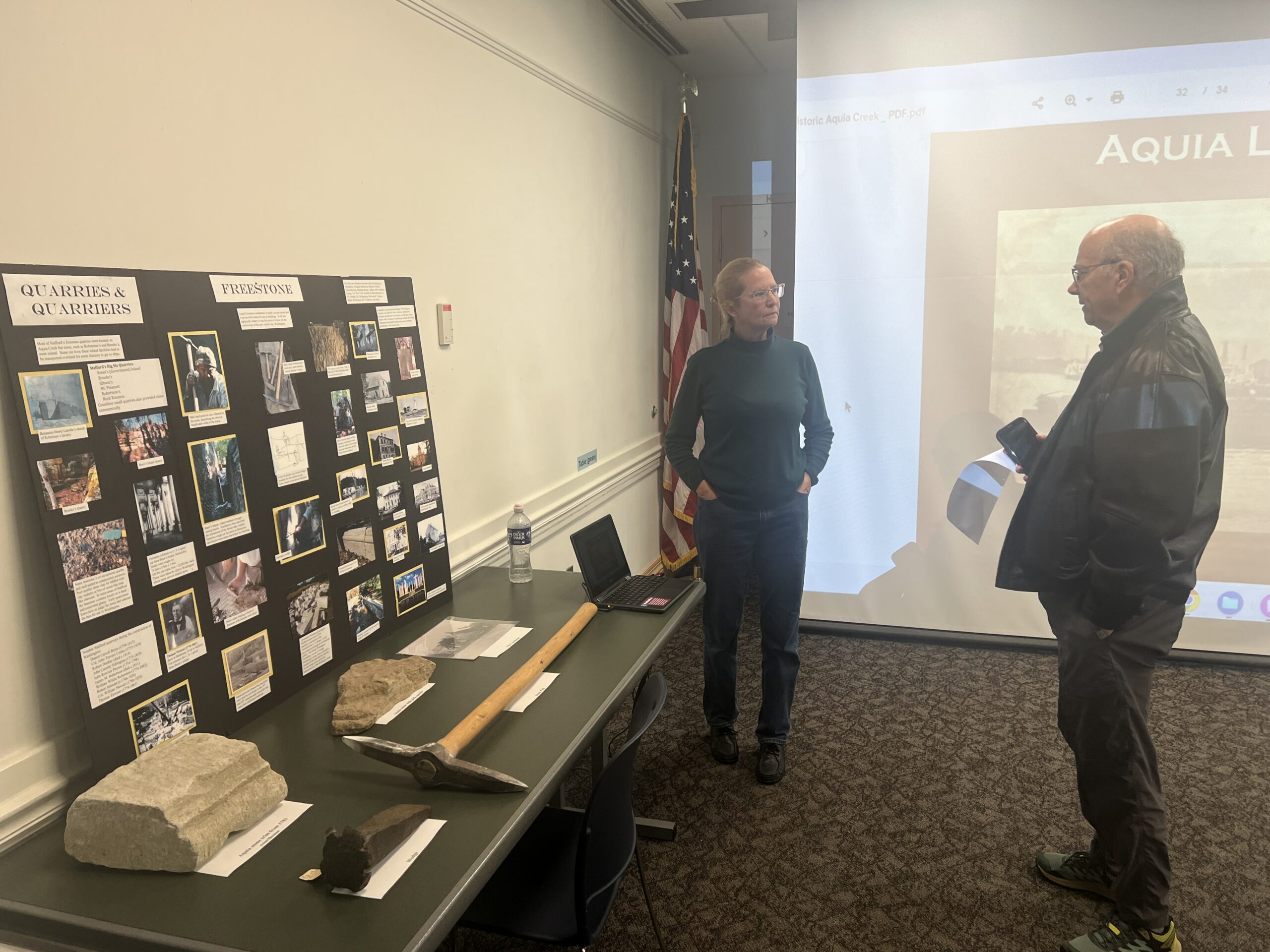
To some, Aquia Creek may be part of a scenic getaway, but it was a bustling place many years ago.
The tributary was the site of commerce and entertainment and even some Revolutionary War history, as Jerrilynn Eby MacGregor of the Stafford County Historical Society (Discover Stafford) noted in a recent presentation.
MacGregor’s talk at the Central Rappahannock Regional Library’s Porter Branch was part of the VA250 event series. Established by the General Assembly in 2020, VA250 commemorates the 250th anniversary of the Revolutionary War and the independence of the United States in Virginia.
Aquia Creek “really is the thoroughfare to the world,” said MacGregor, because it was navigable to international sailing vessels.
“So you could go from Aquia Creek, sail down to the Potomac River, sail on down to the Chesapeake Bay, out into the Atlantic Ocean, go anywhere in the world you wanted to go, and lots of folks did,” she said.
Because of this, said MacGregor, there were several commercial landings on the creek from the earliest days up until about 1930.
Tobacco was a major product going in and out of the area, and the crop’s prominence begat other businesses, including stores, taverns and ordinaries.
That meant jobs were created, MacGregor said. Business owners needed laborers in the tobacco warehouses and at the wharves for offloading and onloading ships, as well as skilled carpenters, coopers to make barrels that the tobacco went in, brick and stone mason, blacksmiths, saddle harness makers, tailors, and even teachers.
“There are records of all of these jobs being active up there around the town of Aquia,” she said.
Also, there was even a horse racing track in the area, though MacGregor said she’s only seen one newspaper story about it and isn’t sure exactly where it was.
A bit of Stafford County Revolutionary War history happened in the region, too.
In July 1776, William Brent departed from his “fine brick house” on the property called Richland to go to Prince William County to take care of business there and left the Stafford militia to guard it.
“Well,” MacGregor said, “the Stafford militia decided to get drunk. They were having a drinking party.”
Simultaneously, Lord Dunmore, Virginia’s colonial governor, who was in the area, decided he should go home, she said. So he had his ship stop by Richland. But the drunk militia started taunting Dunmore’s men and daring them to come ashore.
The British, instead, waited for the militiamen to pass out. Then they came ashore and set fire to Brent’s house, his crops and his barns.
They were headed to Brent’s mill up the road when they encountered the Prince William militia coming south. So the sailors left, MacGregor said.
After the revolution, the economy in the area was supported by the shipping of Aquia freestone. This is sandstone that was used in the construction of federal buildings in Washington, including the White House, U.S. Capitol, U.S. Patent Office and U.S. Post Office.
The freestone came from quarries, most famously at Government Island, which is now a park in Stafford.
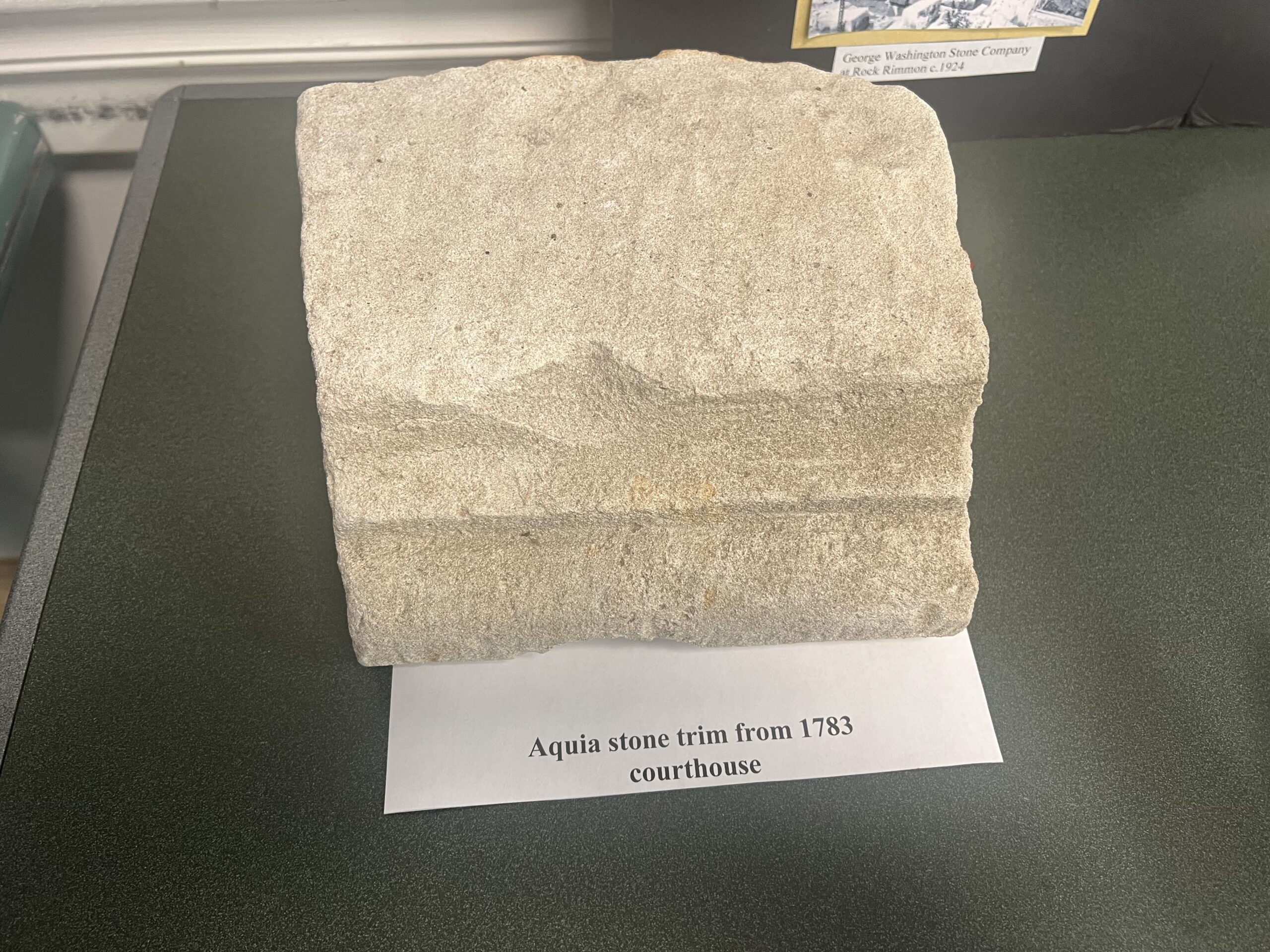
A piece of Aquia freestone.
Shipping in general was important to the area. Between the 1750s and 1930s, at least 255 sailing vessels and unpowered barges had business dealings on Aquia Creek, MacGregor said, as well as 85 craft powered by steam or other means.
A lot of the products being shipped were bound for Baltimore, Alexandria, Washington and Philadelphia, she said.
But traditional industry wasn’t the only thing that went on in the Aquia Creek area.
In June 1867, a bare-knuckle boxing championship was held at Brent’s Point.
“We don’t know precisely where it was, but they described it as being a natural amphitheater, so somewhere out there, there’s a depression,” MacGregor said. “They set up bleachers, and they had seating for 3,000 people; about 1,500 came in.”
The purse for the fight was $2,500, and a title of “Light Weight of America” was on the line, she said.
The combatants, Barney Aaron and Samuel Collyer, fought 69 rounds in two hours and 10 minutes, MacGregor said. Bare-knuckle fights like these were popular in the 19th century, but they were eventually made illegal, she said.
A newspaper account said that Collyer’s face was “lacerated to a jelly and his left eye completely closed,” she said.
Aaron was declared the winner when his opponent became unresponsive.
“And then Aaron, even though he’s the champion, he dies shortly thereafter,” MacGregor said.