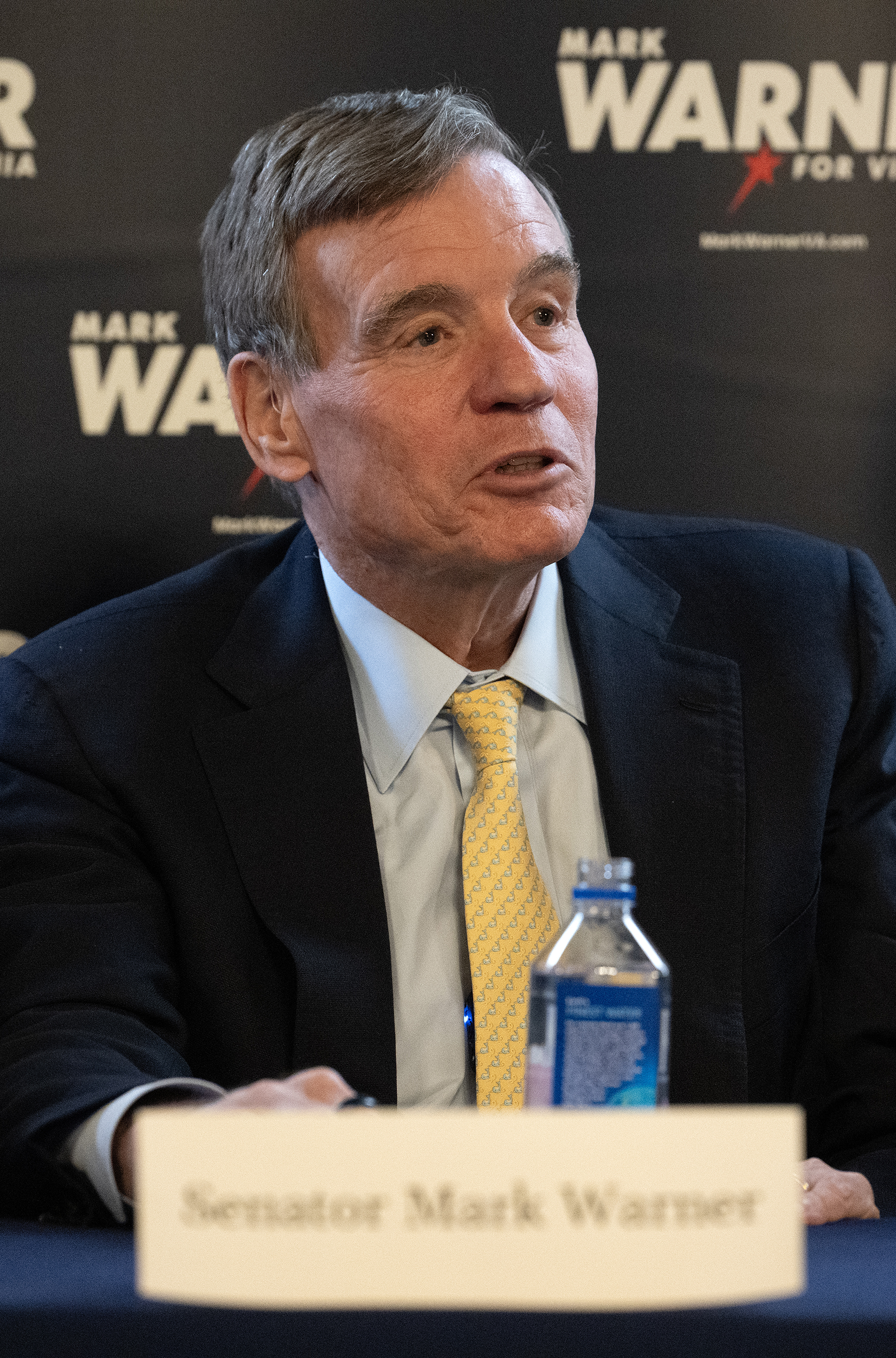
In central and Northern Virginia, the issue U.S. Sen. Mark Warner hears about most from voters is rising gas prices. But the second?
Data centers, which arguably make up the biggest issue across the Fredericksburg area as the technology businesses have been proposed in all five regional localities: Fredericksburg, and in the counties of Spotsylvania, Stafford, King George, and Caroline.
Warner told reporters in a conference call Thursday that he will announce comprehensive data center legislation soon. He’s already working to further regulate the industry by co-sponsoring a bill led by Sen. Chris Van Hollen, his fellow Democrat from Maryland.
The Power for the People Act would require new data centers to prove that they’re not taking power from the electric grid in a way that would drive up energy costs for consumers, Warner said.
“I think it’s a good first step,” he said.
The Power for the People Act holds data center operators accountable for their role in driving up energy prices through reforms that would prevent consumers from subsidizing data center development through their utility bills, according to an announcement of Warner’s cosponsoring of the bill.
It also ensures data centers connecting to the grid do not overwhelm it, preventing reliability issues that result in outages, and ensuring that all of this is done with strong labor standards in place, creating good-paying jobs.
Warner noted, too, developments in artificial intelligence, which is cited as driving the need for new data centers.
“The issue is this: We’re not going to stop artificial intelligence,” the senator said. “We have to put guardrails on it. But I also think we need guardrails on data centers.”
There are currently more than 600 data centers in Virginia and more than 4,300 across the U.S., the announcement said. And they can push costs for consumers higher in two ways:
- They increase overall electricity demand, sometimes outpacing available electricity supply, resulting in higher utility bills across the grid; and
- They require expansion of the electric grid, and the cost of these upgrades are often passed onto all customers — not just the new data centers.
To address affordability and reliability issues, Warner’s office said, the Power for the People Act ensures data centers are paying for the energy costs they cause by:
- Directing states to evaluate the need for new rate classes specifically for data centers to more effectively assign costs caused by that customer class, while providing technical assistance to states to support this process. This proposal would essentially follow a measure the Virginia State Corporation Commission announced last year.
- Directing the Federal Energy Regulatory Commission to issue a rule to make sure data centers are paying for the local transmission upgrades that would not be needed if the new data center did not exist.
It also would create a system to manage data center interconnection to the grid that would incentivize data centers to:
- Offset their impact on the grid by bringing their own new and additional power generation and battery storage systems to the grid, as well as by agreeing to certain flexibility requirements.
- Mitigate pollution by using clean energy resources.
Sens. Dick Durbin (D-Ill.), Richard Blumenthal (D-Conn.), Cory Booker (D-N.J.), Tammy Duckworth (D-Ill.), Tina Smith (D-Minn.), Peter Welch (D-Vt.), and Angela Alsobrooks (D-Md.) are also sponsoring this legislation.
Local reaction
Reached Friday, Charlie Payne, an attorney for several data center clients in the Fredericksburg region, said he hadn’t read the bill, but that data center companies aim to pay the cost of their energy needs.
“The data center industry wants to pay its fair share for power,” he said.
After examining the legislation, Erin Sanzero, president of Protect Stafford, a local nonprofit group advocating for responsible data center development, said it’s a “serious and welcome effort to name and address the challenges of data center demand.”
“There are some excellent provisions in the bill, particularly the explicit exclusion of diesel-backup generation, which is a concrete and meaningful environmental standard that addresses a real and too-long-overlooked public health concern,” Sanzero wrote in an email. “That kind of specificity is exactly the kind of legislation we desperately need.”
But, Sanzero wrote, that same precision doesn’t carry through to the most important question: who actually pays the energy costs.
“Without a proportional standard written into the statute itself, data center costs will continue traveling as wolves in sheep’s clothing, dressed up as reliability needs when they are, largely or entirely, the actual driver,” she wrote. “This is a strong first step, and it deserves a stronger second step.”
Kevin French, Protect Stafford’s vice president, also noted that energy regulations are notoriously complex.
“We need to ensure the bill is examined to minimize unintended consequences that could encourage data centers to employ risky, dirty or noisy alternatives, such as gas-turbine generators, to avoid grid costs altogether,” he wrote in an email.