The gravesites of American soldiers who died overseas in World War II are often looked after by European families.
So, when a Belgian caretaker was seeking a photograph of Fredericksburg-area native George Sanford Sullivan to add to his tombstone, they reached out to the Central Rappahannock Regional Library.
Library staff discovered that Sullivan, who died in the war in 1944, was born in Stafford County in 1912 and raised in the Corbin area of Caroline County by Ella E. Purks. They contacted Wayne Brooks of the Caroline Historical Society, who located a picture of Sullivan and delivered it to the library, which then shipped it overseas.
For Brooks, that series of events highlights the importance of preserving history.
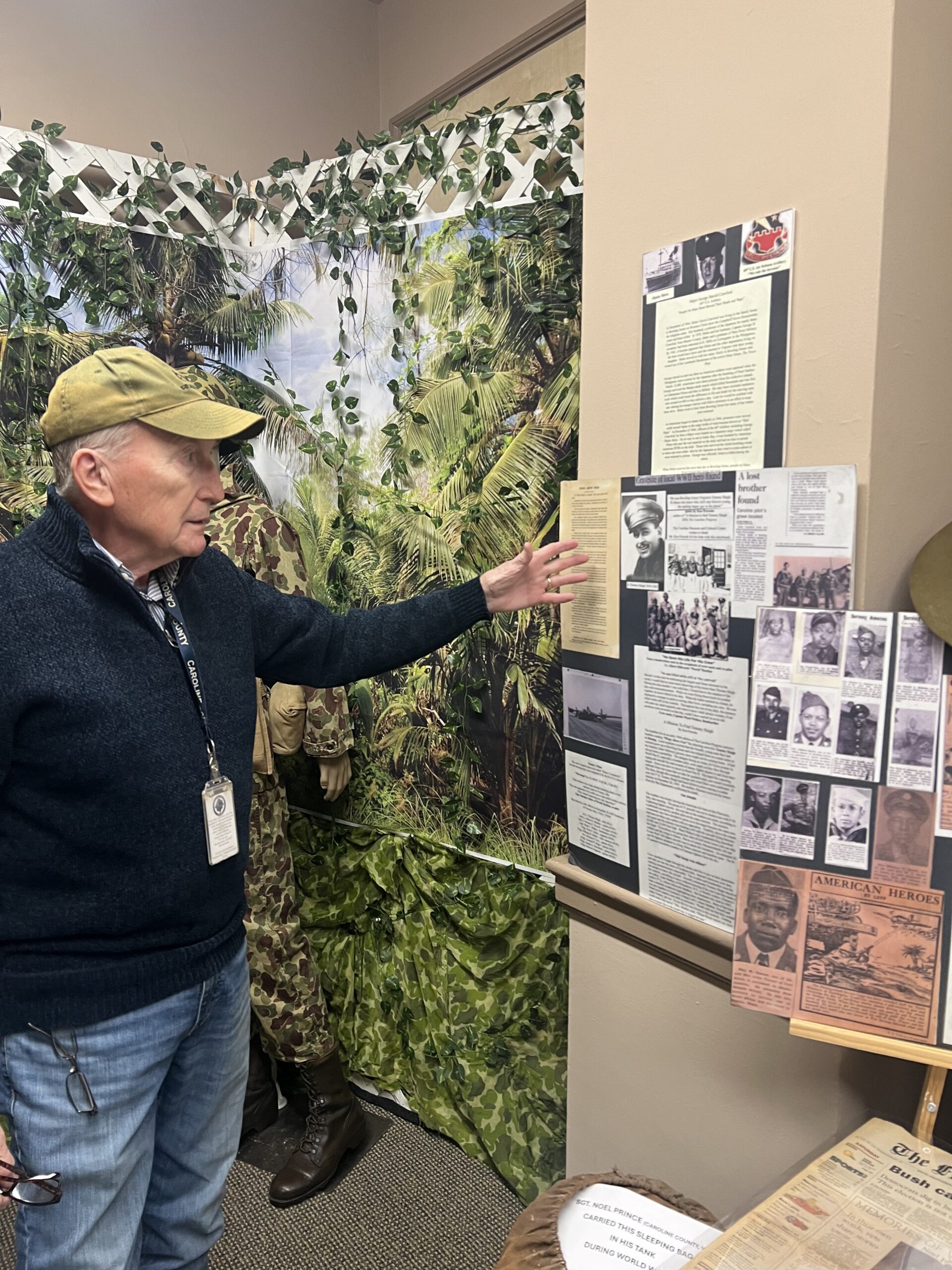
A World War II display assembled by Brooks has been up for the past month at the Caroline Historical Society, located in the Sidney E. King Arts Center on Main Street in Bowling Green.
It includes Sullivan’s narrative and many other stories of Caroline World War II veterans, making use of articles, artifacts and photographs. Brooks is encouraging county residents to visit the historical society, which is open every Thursday and Friday from 11 a.m.–3 p.m. The display doesn’t have a definitive date for removal, and special tours can be set up by calling (804) 366-1848.
“Well, it makes me feel good that people will come in here and actually learn more about the Caroline residents that were World War II veterans,” Brooks said. “We have the stories of those that lost their lives in World War II.”
Brooks said 30 county residents are documented to have died in the conflict that ended 80 years ago. The total includes Thomas Haigh, who was the pilot of a B-24 Liberator bomber that was attacked by German fighters.
“He went down with the plane, but he made everybody that was alive bail out, and he took the plane down,” said Brooks of Haigh.
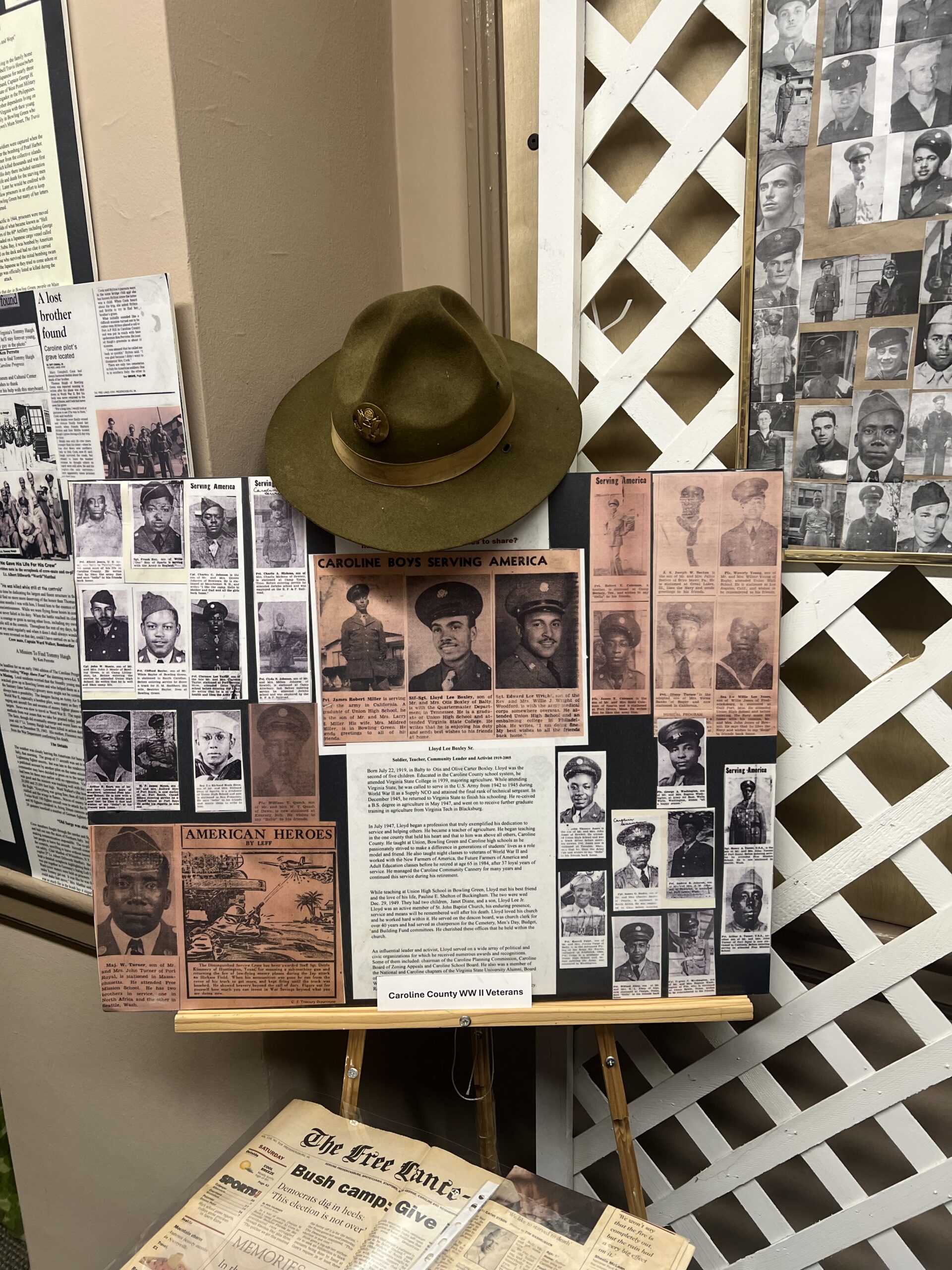
A display at the Caroline Historical Society honors World War II veterans. (Photo by Taft Coghill Jr.)
The display features photographs of 400 county residents who were involved in the war.
Brooks said that when the county’s former newspaper, the Caroline Progress, relocated more than a decade ago before eventually closing down, the editors provided wooden blocks with images of the soldiers to his wife Kay Brooks, who was the director of the county library. Kay Brooks then gave the images to the historical society.
With the blocks in tow, Wayne Brooks contacted Billingsley Printing in Fredericksburg when he was looking to commemorate the 75th anniversary of the end of the war, five years ago.
“So, we had those wooden blocks with the images, and that’s what they used to use when they were printing the newspaper,” Wayne Brooks said. “They would set the type, and they would set the block in there with that image on it, put the ink on it, they would run it off, and it would be in the newspaper. Well, we had all those blocks.”
Wayne Brooks and Gary Billingsley, who owns the print shop, printed the photos on an aging press over three days. Brooks invited the community to review the hundreds of photos and was thrilled when county residents were able to identify about two-thirds of the soldiers pictured. The photos are now a major part of the display.
Brooks is working on a book about all those men and women pictured. The book will include a biography of each veteran.
“I think Wayne has done a wonderful job,” CHS President Kathy McVay said. “It’s nice to have a display that honors Caroline County citizens and the sacrifices that they made. I really hope people can come see it.”
The exhibit includes military jackets, some worn by Caroline soldiers. It also tells the story of the United Service Organization (USO) buildings that were segregated in the county, with white service members and their families meeting at the Town Hall in Bowling Green and the Black soldiers and their families gathering at a building in front of the old Union High School. Brooks noted that, after the war, the county used the Black USO for recreation services before tearing it down in the late 1970s.
“When they would go to the USO, they would have dances, they’d sit there and write letters home, listen to music, read books, record messages and send them home,” Brooks said. “You can still play those [recorded messages] and the soldier would be talking on it to his family.”
In addition to the World War II exhibit, the historical society has a display on the history of churches in the county. The display discusses Salem Baptist Church and Jerusalem Baptist, County Line Baptist, Shiloh Baptist, Carmel Baptist, and Second Mt. Zion Baptist. The interpretations go into detail about the tradition of homecoming in churches as well as the vital role the institutions played in the history of the county.