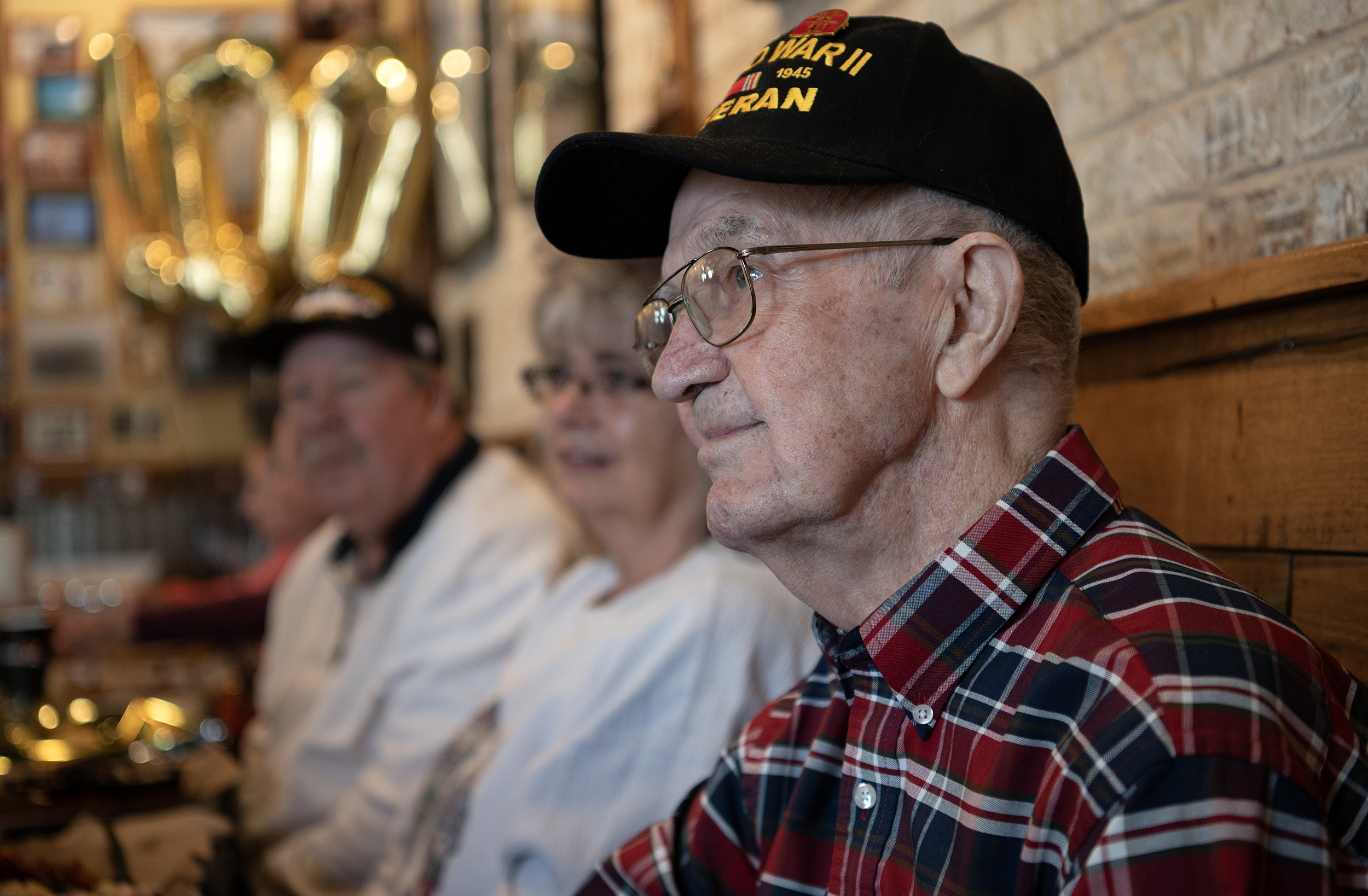
The guest of honor sits on a shiny wooden bench at the back of Mission BBQ in Fredericksburg at lunchtime. If it were any other day, you might not notice him at all: a slight, aging man in a baseball cap with a paper-lined tray full of meat and sides.
It is not any other day.
Justin Carter Jr. is turning 100, and the cap he wears identifies him as a World War II veteran — among the last of a generation that is quickly disappearing. His party occupies the back wall of the restaurant, plus several tables; there are balloons and a giant sheet cake announcing Carter’s entry into the elite ranks of centenarians.
So many people have come to see him that he barely touches his lunch — a slab of ribs — and instead shakes hands and smiles graciously and shares stories as if he has all the time in the world.
Among them: Gordon Combs, a friend who orchestrated the celebration, and his wife, Julie, who grew up next door to Carter. There is Stacey Jamieson, a Navy recruiter with whom Carter swaps sea stories, and Hannah Lorenzo, a high school senior who is about to enter the Navy.
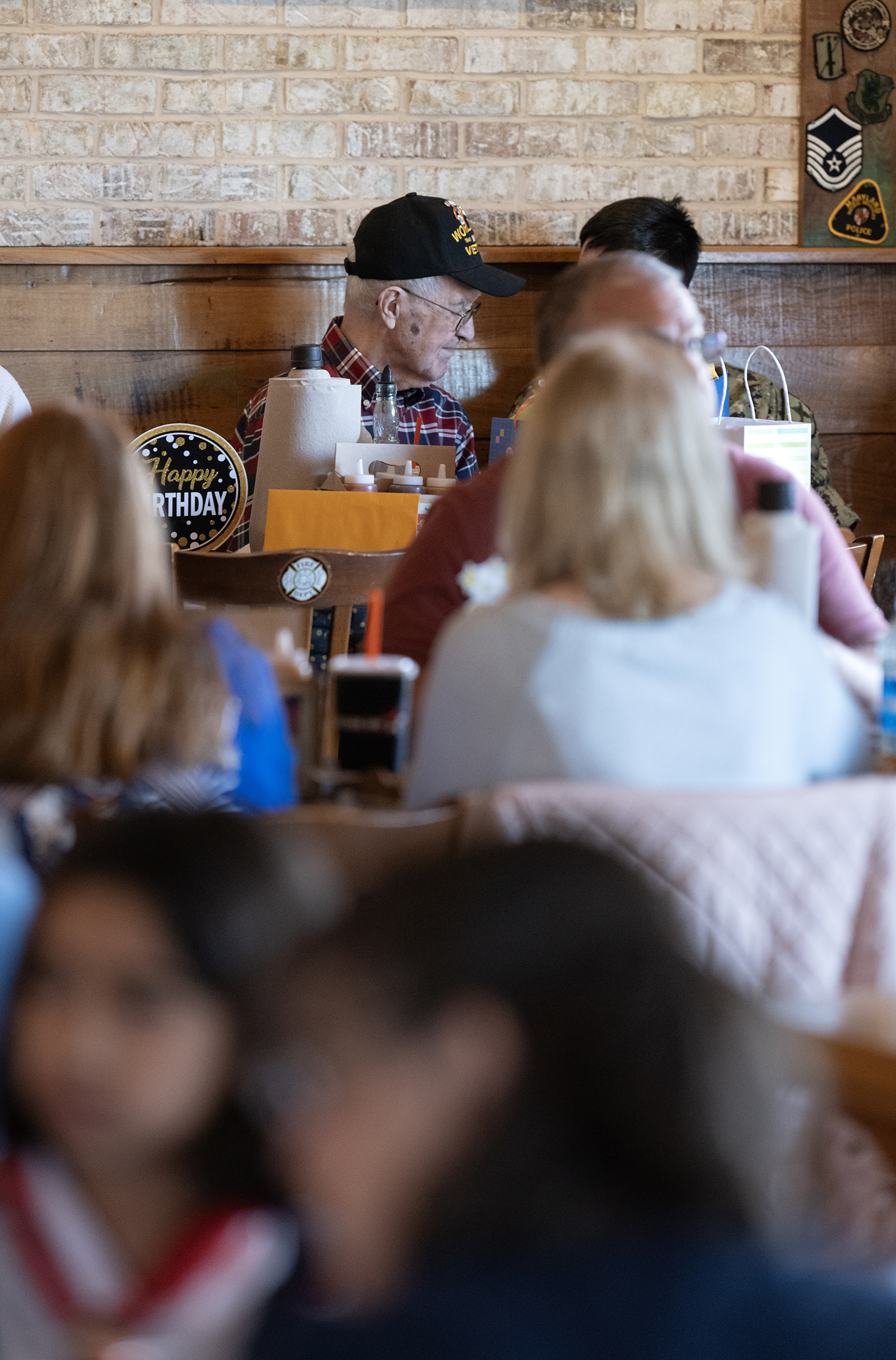
World War II veteran Justin Carter, Jr. celebrates his 100th Birthday with friends and family at Mission BBQ on April 20 in Fredericksburg. (Photo by Jeff Kearney)
By the time the cake is cut and the lunchtime diners have sung happy birthday, a small line has formed in front of Carter: family and friends and well-wishers who’ve never met him before.
Carter is living history, and they know it.
Of the 16.4 million Americans who served in World War II, fewer than 45,000 survive. Five years from now, that number will sit around 3,000; a decade from now, less than 200.
By 2037, there will be no one left to recall memories of the world’s greatest conflict.
‘Ready to go’
Carter was a 15-year-old high school sophomore when the U.S. entered the war. Two years later, in 1943, more than 3.3 million men were inducted into the U.S. military through the Selective Service System.
Carter knew he was going to war, one way or another. He enlisted in the Navy and reported for duty on June 6, 1944 — D-Day. He heard the news on the car radio on the drive to Richmond.
“I was ready to go,” Carter said.
For the last three years, he’d watched Americans sacrifice for the war effort, rationing oil and gasoline and staples like sugar and meat and coffee to ensure troops stayed supplied and America’s military had the weapons they needed to win.
For Carter and those he knew, going without and going to war had never been a question.
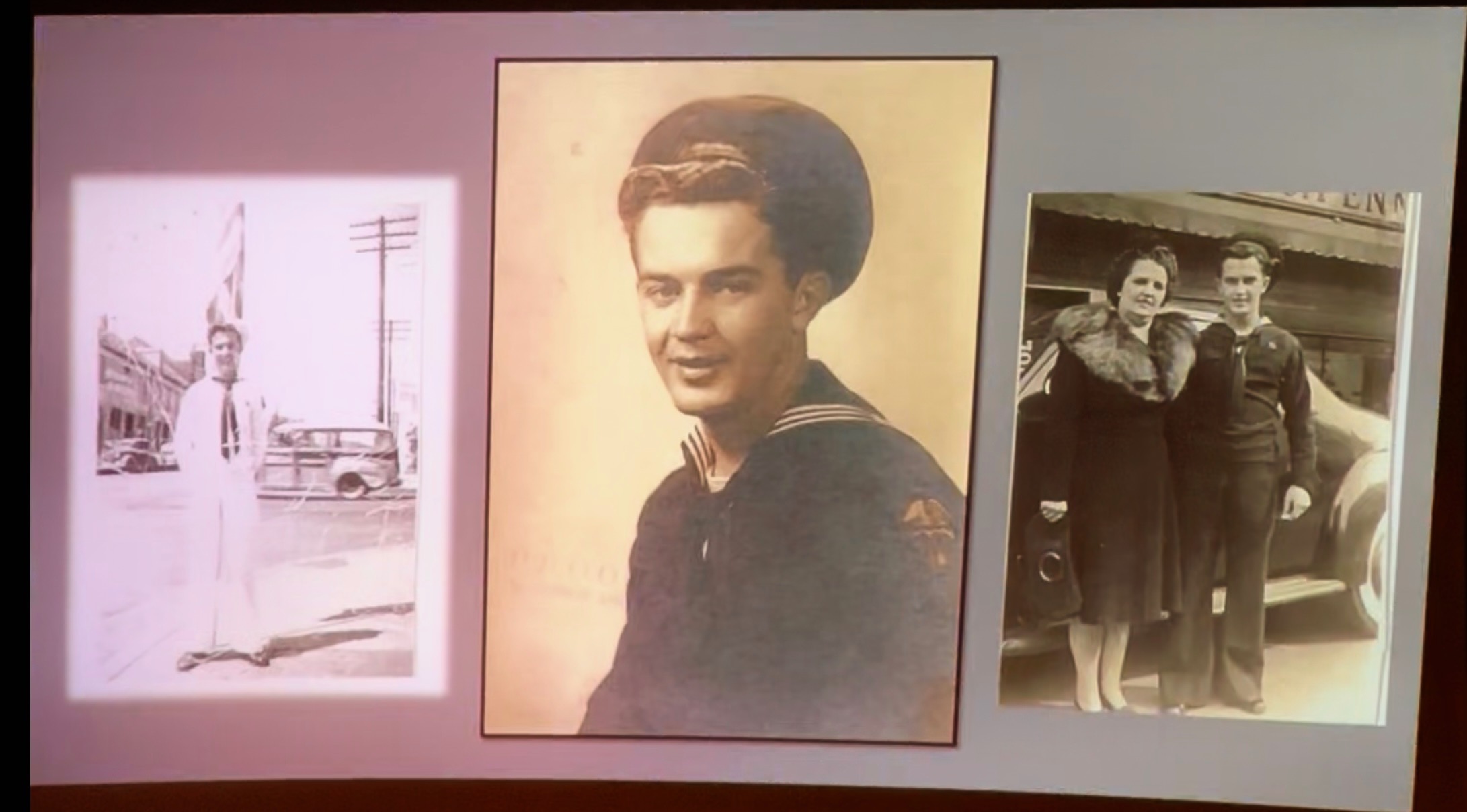
Photos of Carter Jr. as a young sailor. (submitted)
“I don’t think you’ll ever see this country come together ever again the way they did in World War II,” he said, growing emotional.
After 10 weeks of boot camp at Camp Perry, Ohio, he returned home for 10 days before joining a busload of sailors bound for Camp Bradford, near Norfolk, a training hub for Landing Ship, Tank (LST) crews that prepared thousands for amphibious assaults. A month later, he and his crew of 110 men boarded a train headed west.
“They didn’t tell us where we were going,” he said.
At daybreak, they arrived in a city and marched to a hotel for breakfast before re-boarding the train. They eventually arrived at the Navy Pier in Chicago, a holding station for LST crews.
“We were there about a week or so and then put on a train,” he said. “The rumor was that we were going to Evansville, Indiana. It was dark the next morning when we got on the ship and headed down the Ohio River.
“Years later, I looked up the history. It wasn’t the Ohio River. It was the Illinois River. The Navy was afraid it would be leaked. Everything was secretive.”
The crew next spent two days in New Orleans, where Carter got a proper haircut, before heading to the Gulf of Mexico for more training. After sailing around Florida, they returned to Norfolk, where the USS Satyr was being converted from an LST-852 to a landing craft repair ship.
Except for a month in New York learning about guns and anti-aircraft guns, the crew spent the next four months in a holding pattern. In April 1945, the Satyr was finally ready. The crew sailed to California and then Hawaii before heading for the island of Guam.
“I never had any fear,” he recalled. “I just wanted to do what they wanted me to do.”
The Satyr had been in Guam for three or four days, Carter said, when one afternoon all the horns in the harbor started blowing.
The war was over.
The Satyr next sailed for Tokyo Bay near Yokosuka, Japan, where Carter caught a glimpse of the USS Missouri. There, on its decks in September 1945, the Japanese had formally surrendered.
‘People don’t start wars’
The months of waiting for the Satyr while the war raged on had seemed like a waste at the time.
“Those four months,” Carter realizes now, “kept me off Okinawa.”
The Battle of Okinawa, which lasted from April to June 1945, was one of the deadliest battles in the Pacific Theater. More than 100,000 Japanese soldiers were killed; there were some 50,000 Allied casualties.
“The kamikaze was terrible,” with at least 149 Allied ships hit or sunk. “The smaller ships caught the brunt of it.”
The Satyr was just 328 feet long and 50 feet wide. Though many ships headed for home as soon as the war was over, the Satyr remained.
In Otaru, Japan, Carter said, “we were the first boatload that went ashore. It was the first time we’d seen Japanese, and it was the first time they saw Americans. That’s when I realized people don’t start wars. It’s the upper brass that starts wars.”
On liberty In Yokosuka, Japan, Carter took a small train to Tokyo. There was nothing along the way, except for a few steel beams sticking up from the horizon.
“I got off the train in Tokyo. I walked half a block. I realized there ain’t no Tokyo,” Carter said.
In March 1945, U.S. B-29 bombers had dropped more than 1,600 tons of bombs containing napalm on the city. The resulting firestorm destroyed 16 square miles and killed more than 100,000 civilians.
Carter turned around and went back to the train station.
Except for a woman behind the ticket counter, he hadn’t seen a single soul.
After war, a peaceful life
Carter was discharged from the Navy on June 11, 1946. He’d served his country for two years — a tiny window in a century of life.
In Fredericksburg, where he’d been born and raised, he worked at the FMC cellophane plant from 1946 until it shuttered in 1978.
Carter hadn’t been home long when he met the woman who would become his wife at Ann’s Beauty Shop, where a sign on the door said, “We curl up and dye for you.”
He still remembers the first time he saw her, the most beautiful girl he’d ever seen. Her name was Doris.
“She was doing my mother’s hair, and I asked her for a date,” Carter recalled. They married 15 months later, on Nov. 12, 1947, and in June 1950, bought their first home, a two-bedroom bungalow for $6,400 in a new subdivision called Ferry Farm. Seven years later, they upgraded to the 3-bedroom rambler. They raised two children, Terry and Tony Carter, and took vacations to New England, to the mountains and the Virginia coast.
He was a hands-on father, said his son, Tony Carter. “He did everything for us.”
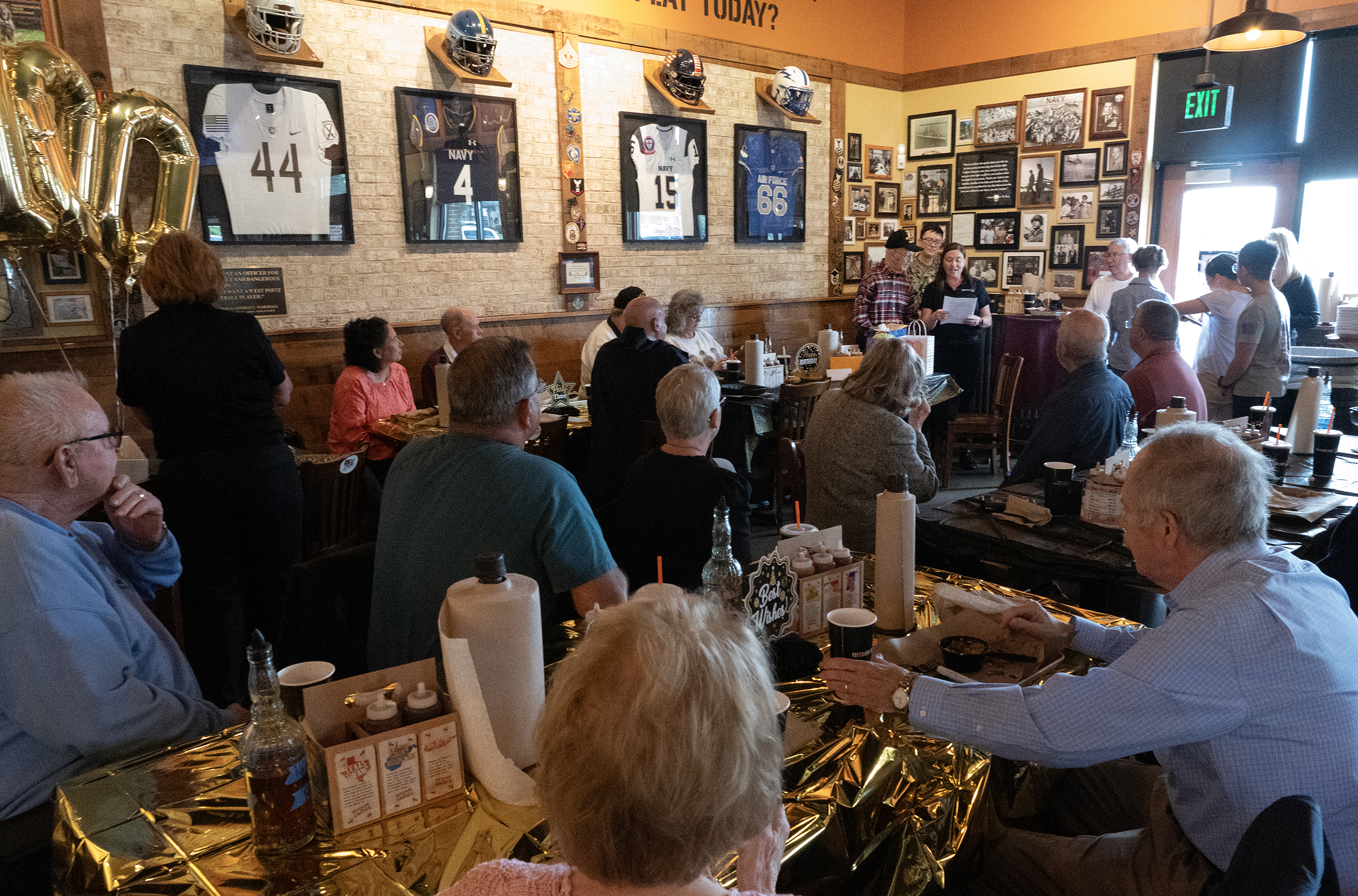
World War II veteran Justin Carter, Jr. celebrates his 100th Birthday with friends and family at Mission BBQ on April 20. Carter was 15 and a high school sophomore when the United States entered the war. Photo by Jeff Kearney.
He coached their Little League baseball team and modeled endless patience. Nothing ever seemed to rile him. He listened, offered advice when asked, and lent money when his children needed it.
“He’s my hero.”
After the cellophane plant shut down in 1978, Carter spent 10 years as an insurance agent. He retired in 1988 at age 62, then went back to work at 75, delivering automobile parts three days a week.
Doris passed away nine years ago after several years of illness. His older son, Terry, died two years ago. He has a granddaughter and two great-grandchildren.
“My family is small,” he said. “I’ve outlived many of them. That’s what happens when you live a long life.”
Today, life is relatively quiet. Carter moved from the three-bedroom rambler into an apartment at Paramount Senior Living in Fredericksburg last May. At 99, the move made sense, he said, and would make things easier for Tony Carter and his wife, Val, who live nearby and are constants in his life.
Carter takes his three daily meals in the large dining room at Paramount; he is otherwise independent. He checks his own vitals and is quick enough to catch up with the nurse at the end of the hall to give her the results when she is making her rounds. He stopped driving a year ago at his doctor’s advice.
A presence nearly passed
If there is a secret to living a long life, Carter doesn’t know what it is. But he can tell you that his life changed more than half a century ago when “the Lord found me, or I found the Lord.”
Faith has a way of softening you, he said. He stopped smoking and drinking.
He never really slowed down, not much. He is slender and moves quickly; during his birthday celebration at Mission BBQ, he slipped out of the booth to catch up with someone less than half his age who had left their cellphone on his table.
He has always slept well, he said, and he had deep ties to his church, Ferry Farm Baptist.
He is endlessly social, his daughter-in-law, Val Carter, said. They’ll be waiting for a table at a restaurant, and he’ll strike up a conversation with a stranger, if he has ever truly known one.
At Mission BBQ, that same ease carries through the room. People lean in a little closer when he speaks, as if proximity might help them hold onto what he is saying a little longer. Carter answers questions the way he always has — directly, without embellishment, as though the facts themselves are enough.
The room behind him returns to itself — tables, noise, half-finished conversations. But for those who came to see him, something of the day stays with them: the sense of having briefly stood near a time that is almost gone.