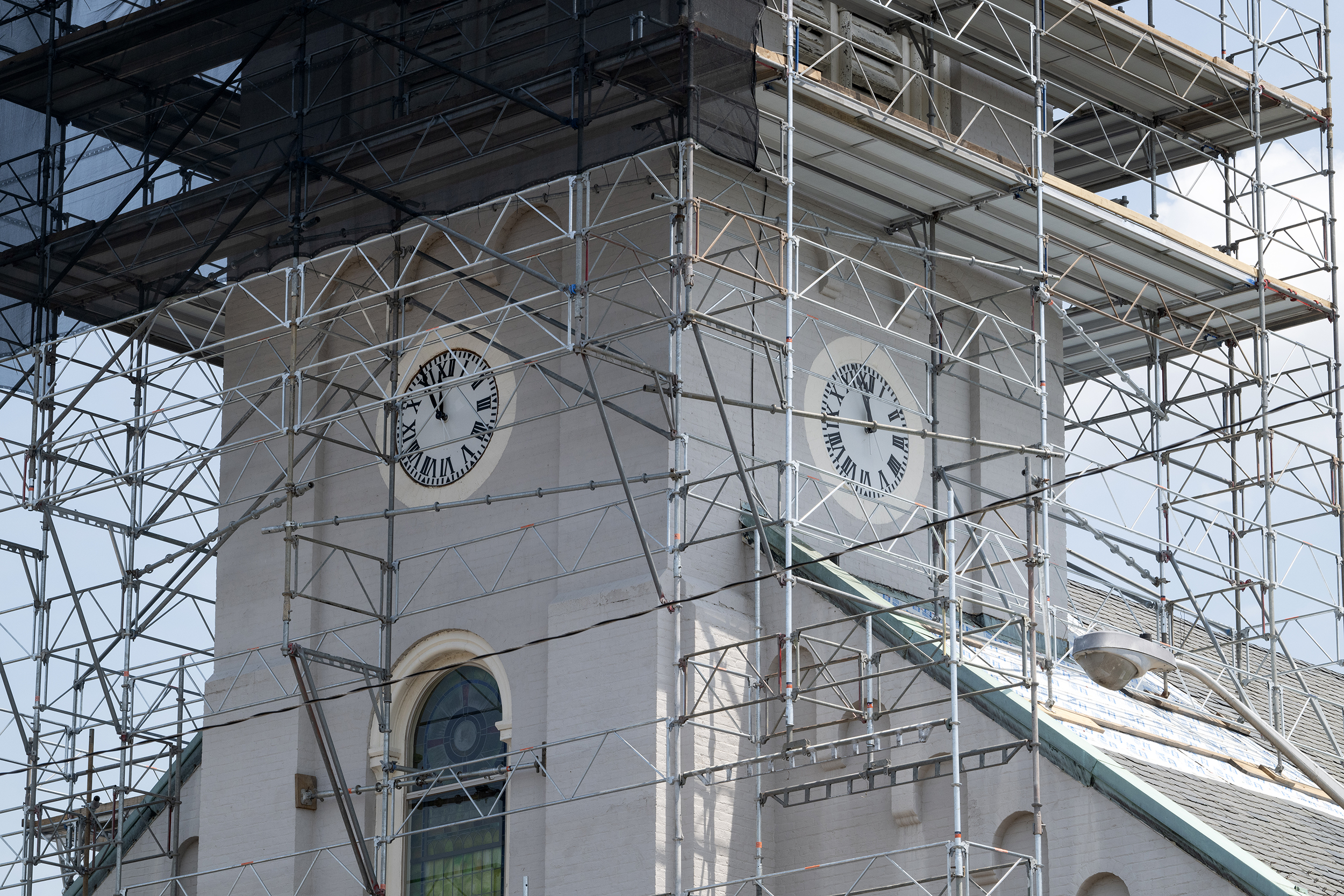
St. George’s iconic green and grey steeple, the object of fascination for generations of locals and visitors alike, has been encased these past few weeks in scaffolding that, like intertwined silver vines to the eye, spans the stories of the structure — and its history.
The work is part of an ambitious restoration project called, “Open to All in Love.” This month, the downtown Fredericksburg Episcopal church began work on the project’s second phase, with the goal of making the building “as open as we are,” said St. George’s chief of staff Laurel Loch.
“Our welcome statement states you are welcome at St. George’s, inclusive of race, nationality, sexual orientation, gender expression, and tradition,” she said. “It is a hallmark of who we are, and we’ve come to realize that we can’t fully live into that if we’re not more accessible.
“We’re a historic building, and that’s beautiful and wonderful, and it has its challenges. For people to enter the building with dignity, and also to move about the space independently, we wanted to step up and change and do better and be better for others.”
The construction includes an exterior accessibility ramp and new entrance into the building; a columbarium structure with 156 niches; construction of a retaining wall with handrail in the graveyard to help prevent future water damage; installation of railings along the graveyard path to the church entrance; a code-compliant railing at the office window well; restoration of the louvers in the bell tower; and work to the Sydnor courtyard.
“We want everyone to enter our space with dignity and a big portion of that is the ramp that we’re installing,” Loch said.
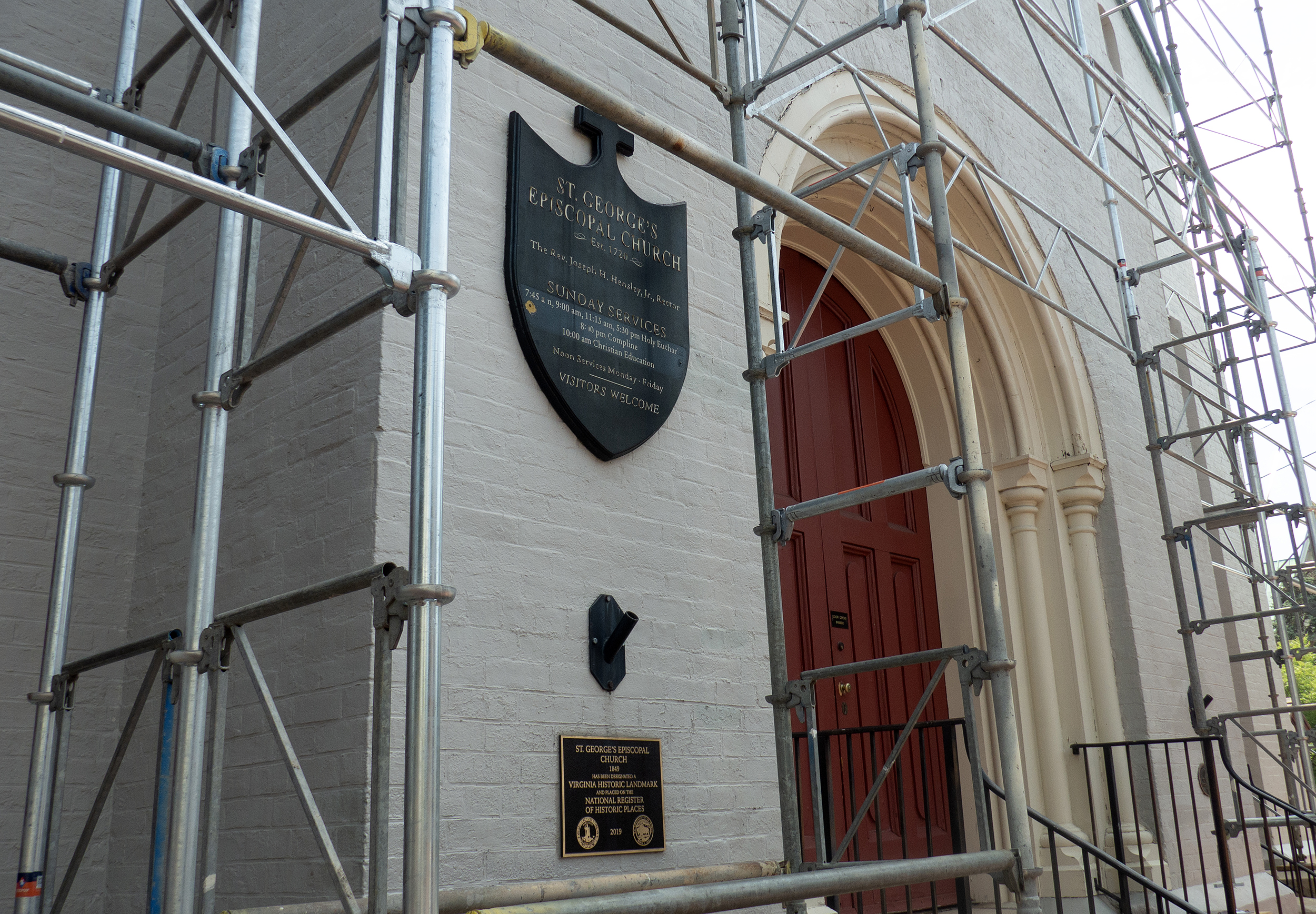
Work continues at St. George’s Episcopal Church in downtown Fredericksburg.
Contractor Daniel & Co. has begun removing the paint on the church wall along the graveyard, repointing brick as needed, and then applying a protective coating. The current paint was not appropriate for use on brick, said Loch, and is trapping moisture, leading to deterioration of the structure and some of the water issues the church has faced indoors.
Addressing long-standing water damage in the historic structure, ensuring foundational integrity, making the building accessible and providing a columbarium — a wall with niches for urn interment — are just a few of the goals for the renovation.
Next, Daniel & Co. will restore the stained-glass window casements on the graveyard wall. They will also create a new entrance for the ramp where one of those windows now stands before constructing the ramp itself.
That stained glass window, which depicts a crucifix and is the closest to the street on the graveyard wall, will be preserved inside the church.
Additionally, Daniel & Co. will restore the louvers (the framed, slatted features that allow air flow) in the bell tower. They estimate this portion of the work will take around three months.
After that, they will begin pouring the foundation for the columbarium.
Years in the works
To prepare for the work along the church’s historic graveyard, St. George’s partnered with Level Spirit Preservation, a group of stonemasons who specialize in preserving and restoring historic sites.
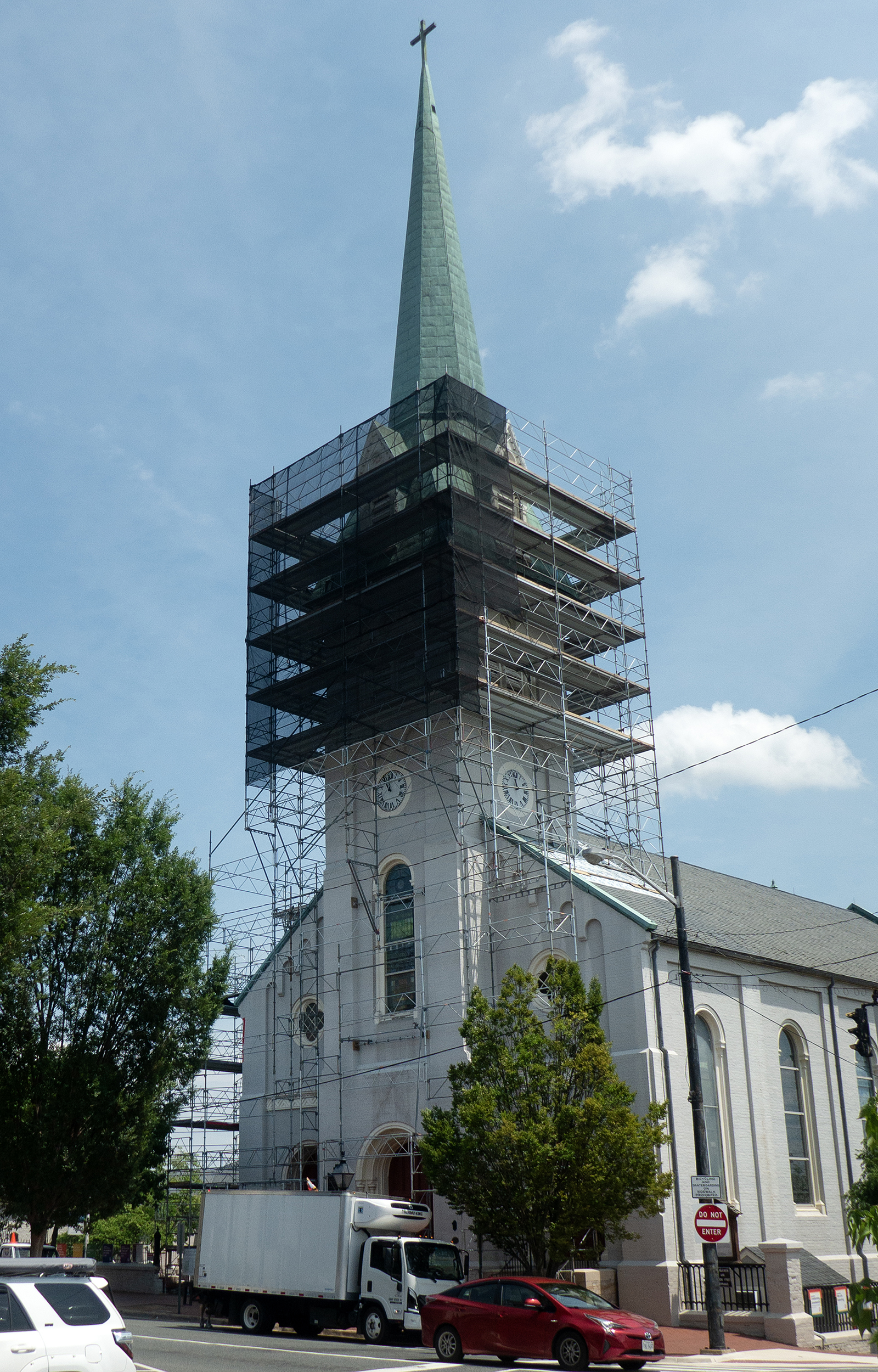
Scaffolding spans the steeple at St. George’s Episcopal Church, part of a $3 million restoration project.
Level Spirit has moved stones that were in the line of construction. These stones will be moved back to their original locations — where possible — after the project has completed. Others will be relocated within the graveyard to an appropriate location. Two especially-fragile stones have a wooden enclosure added for safety reasons.
The estimated cost for this phase comes to $2.375 million.
Late last year, construction concluded on structural work inside the church for interior accessibility, and remodeling bathrooms in the office for accessibility.
This work also covered the Faulkner Hall meeting space, fixing its foundation, repointing and repainting with a brick-friendly paint on the wall facing Market Square. The total cost for the first phase of construction was just under $870,000, meaning a total of $3.245 million is budgeted overall
This project follows years of fundraising and studying the needs of the building and the congregation, as well as what will be useful to future St. Georgians.
“[We’ve been] thinking about this building that we have received from our ancestors… and understanding that, hey, we’re ancestors too,” said Loch. “What can we give instead of leave for the community and for St. George’s in the future?”
St. George’s worked with a firm to complete an archeological study of the ground that was disturbed. That study is ongoing, but Loch said they revealed some interesting items relevant to the church’s historical structures.
Work was initially approved by Fredericksburg’s Architectural Review Board in 2023, with changes and subsequent needs approved in 2025.
Historic landmark for city
St. George’s Episcopal Church was constructed in 1849, the third church building erected on its lot. The parish was created in 1720, and the first church and graveyard were established in 1728.
“With its tall steeple clock that has operated consistently since 1851, St. George’s Episcopal Church, located next to city government buildings and the historic market square, is a landmark building at the center of town,” states the Virginia Department of Historic Resources in its building history of the structure.
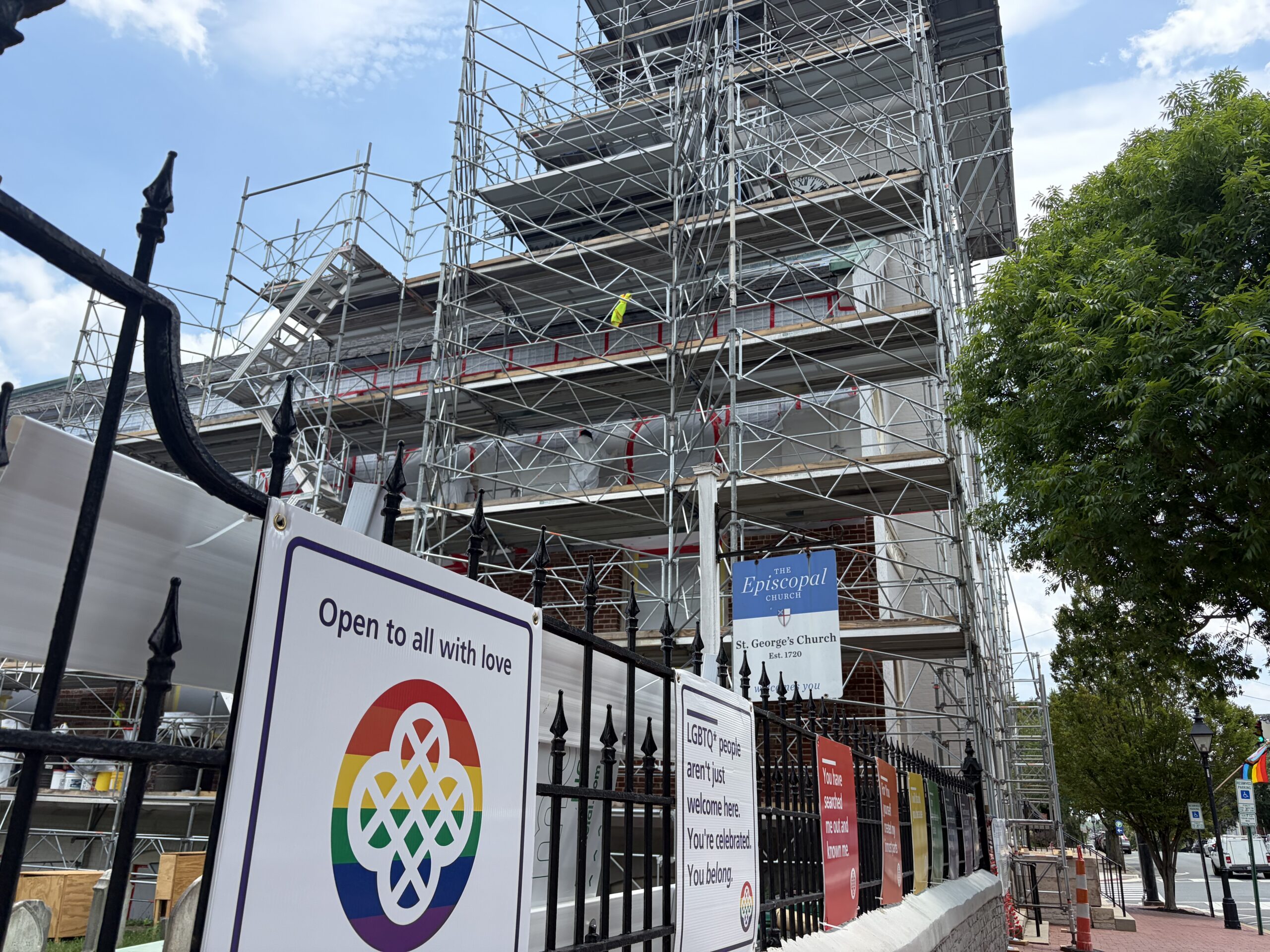
St George’s Episcopal Church. (Photo by Lindley Estes)
According to DHR, the church is the only Romanesque building in Virginia designed by renowned Baltimore architect Robert Cary Long, Jr. The building has played a role in some of the major events in the region. During the Civil War, after the First Battle of Fredericksburg in 1862 and the Battle of the Wilderness in 1864, St. George’s Episcopal Church functioned as a hospital.
The building was last extensively restored and renovated in 2009.
At that time, the interior was renovated to improve its liturgical function by incorporating modern technology, and installing a modern fire sprinkler system. A third story was added above McGuire Hall, linking it to the nave, and the nave was repainted with a design that recalled its Romanesque style.
In a blog for the Historic Fredericksburg Foundation in 2016, this restoration was described by Sam Biggers as a success story, noting that efforts to preserve the church were ongoing since the late 1990s.
“There are numerous preservation success stories, and one need not look far to see the benefits of preservation in our community,” Biggers wrote. “One of the most prominent buildings in Fredericksburg, St. George’s Episcopal Church, is a superb example of the positive effects of preservation. In 2009, St. George’s completed a seven-year restoration project, restoring the interior to its former glory.”
The current phase of renovation is expected to be completed this fall.
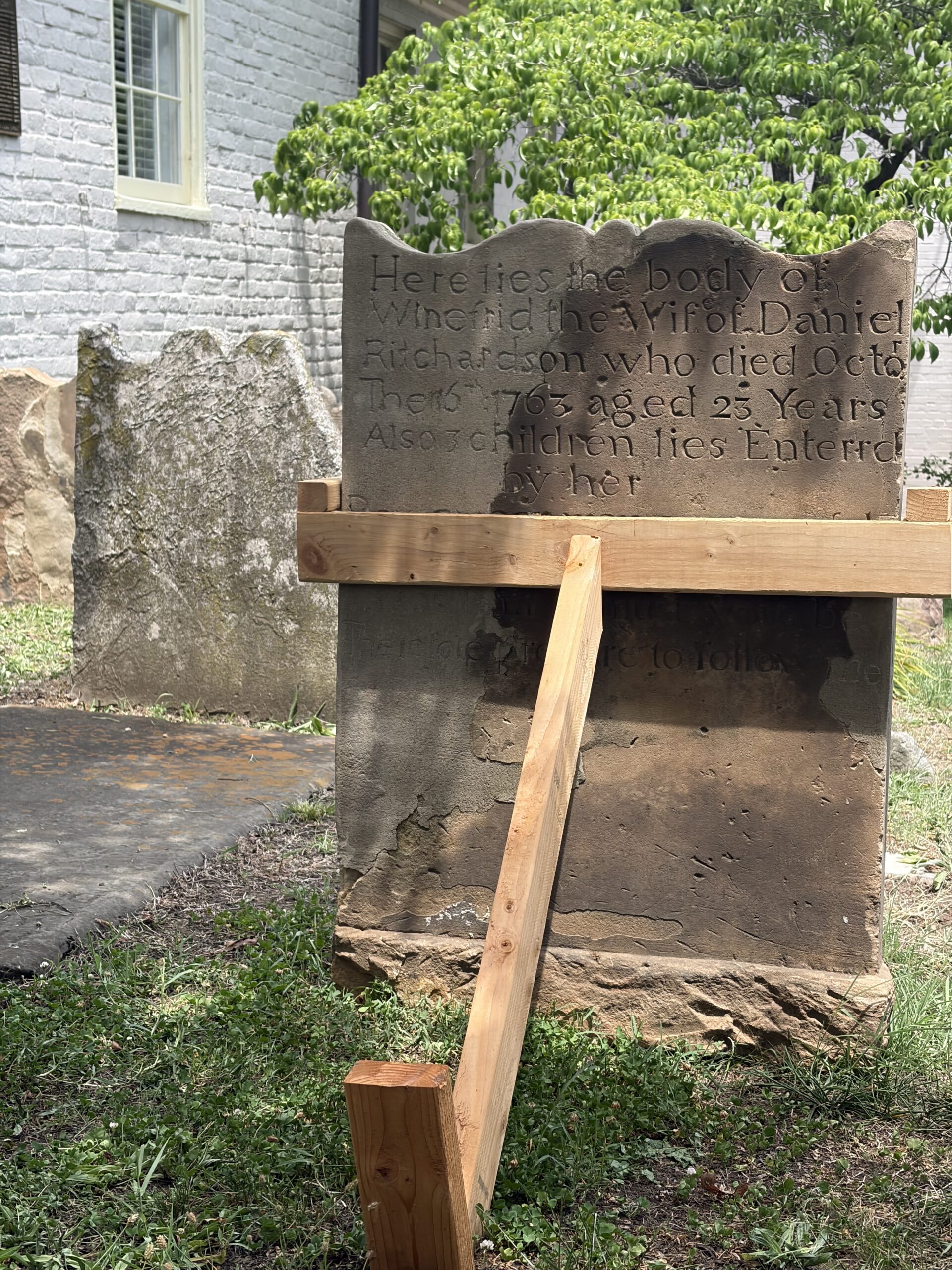
Some of the more fragile grave markers in the church cemetery are enclosed with wooden supports. (Photo by Lindley Estes)