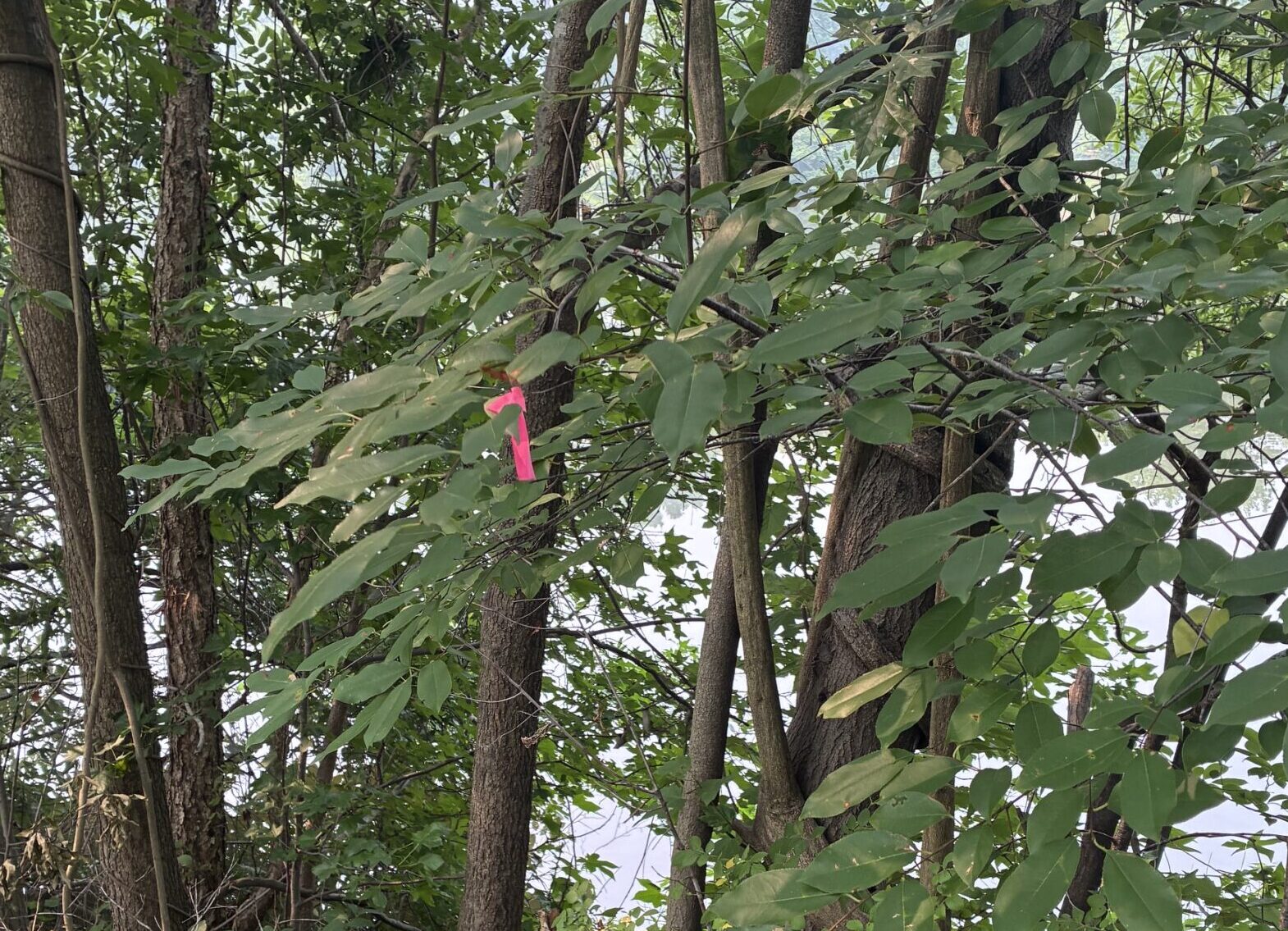
People running, walking, or biking along the Canal Path in Fredericksburg this summer may have noticed pink ribbons tied to some of the young trees growing heroically along the bank, among invasive trumpet vine, poison ivy, Tree of Heaven, and wisteria.
These are native adolescent and sapling trees that have established themselves naturally, said Bicknell Robbins, arborist for the city of Fredericksburg.
“The intent is to foster these trees as the next generation of trees to replace the existing mature canopy, which is in various stages of natural decline,” Robbins told the Free Press this week. He and his team also plan to plant larger trees between the Gayle’s Pond wetlands and the Canal, remove the invasive undergrowth, and plant “step-able perennial ground covers” to discourage the invasive vegetation from returning.
Robbins discussed these plans to improve visibility and beauty along the Canal Path, as well as other plans for the city’s urban forest, at City Council’s work session this week.
Citywide, public works has planted 238 trees, pruned 796, and inspected 4,629 this past fiscal year, Robbins said. That work also includes removing 248 trees.
Robbins told Council that on average, he has to remove 150 trees each year. The additional 100 removed this year were casualties of the drought and hot weather earlier this spring, he said.
“Since I’ve been here, I’ve noticed that it seems to be hotter,” he said. “That has taken its toll,” especially on native species, such as Canada red chokecherries, serviceberries, and hornbeams.
“People ask why I don’t just plant native trees in the urban forest,” Robbins said. “The answer is, I’m not planting trees in a native Virginia setting. An urban forest is not a native Virginia setting, and our understory trees especially don’t do well in a heat island.”
So maintaining the urban forest means selecting species that will survive under existing conditions, he said.
This fall, Robbins said, public works will replant 187 trees and remove another 13.
He is also working with contractors to plant trees in an estimated 430 locations outside the downtown corridor, including along Fall Hill Avenue between the Interstate 95 overpass and Mary Washington Boulevard, along Sam Perry Boulevard, and along the 1500 block of Olde William Street.
“The actual number of trees planted in these locations could increase or decrease based on the type of trees selected and as of yet unknown utility conflicts,” Robbins told the Free Press. “I am also looking at other areas such as Blue and Gray Parkway between Lafayette Boulevard and Bellman Road, as well as the Dixon Street cloverleaf area as potential planting sites.”
Robbins told Council that he’s also working to educate citizens that trees growing between sidewalks and streets usually belong to the city, not the homeowner.
“I’m finding that many citizens just do not recognize that trees in the utility strip are in the city’s right-of-way, and those are our trees and under our purview,” he said.
He said that if residents are concerned about how a tree is growing, they should request that public works inspect it through the city’s interactive tree map.