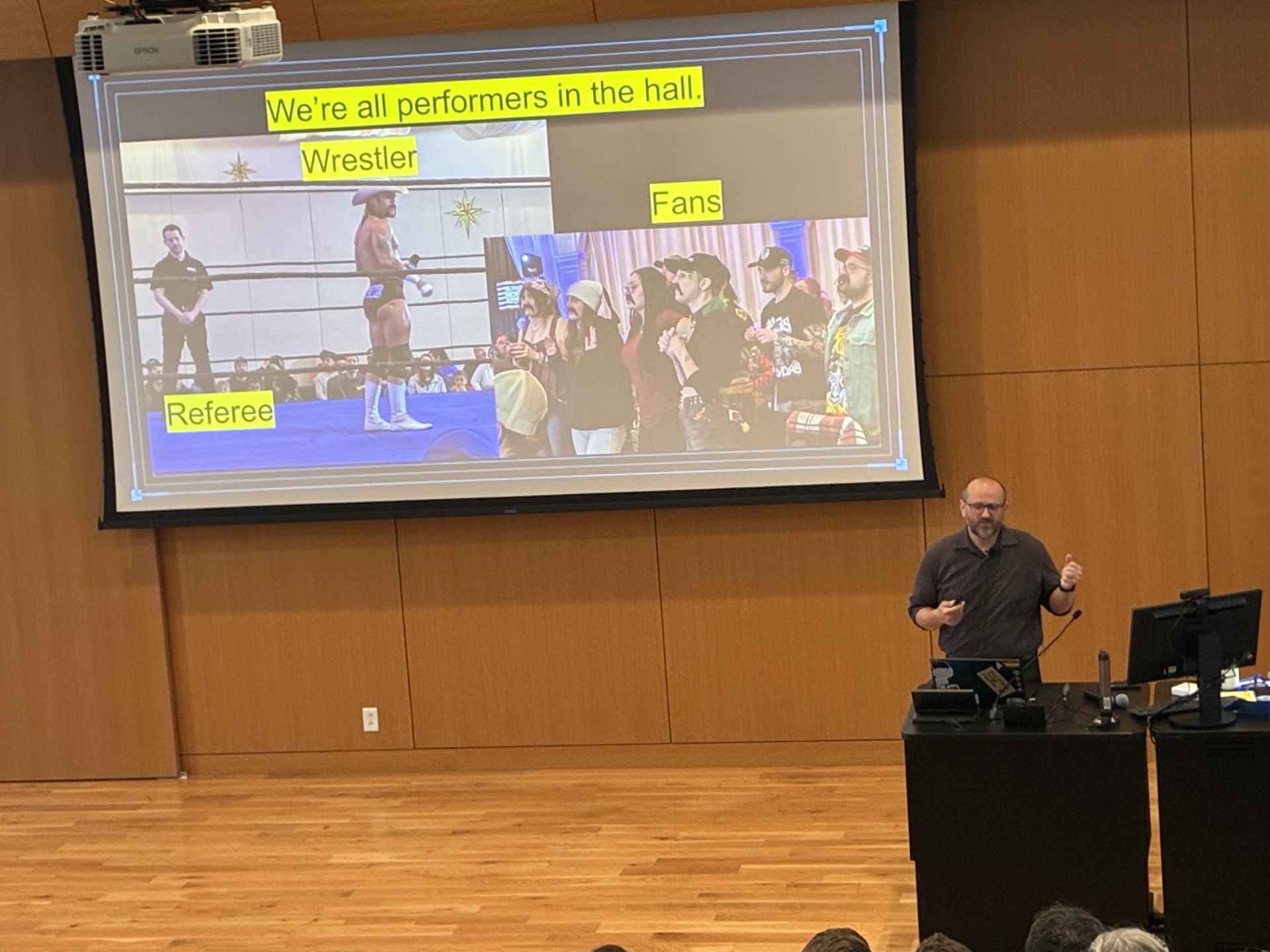
Picture a wrestling ring set up in a fancy event hall.
There are two fighters in the ring, and they’re fighting hard, and even though everyone knows it’s a performance, it feels real.
There’s a hero and a villain, and both are playing well-rehearsed roles and following a script. The audience is also following a script — loudly chanting “boo” at the villain.
“All of us have been standing in a hall like this for four years. We all took our seats and started to boo. We were handed a script and we are following it,” said Lance Eaton, senior associate director of AI in Teaching and Learning at Northeastern University.
In this analogy, the hall is higher education, the villain is AI, and the audience members are liberal arts educators, who have been following a script and chanting “boo” for four years, rather than approaching the new technology with a sense of curiosity and exploration.
“Liberal arts especially should be a place where we notice a script” and push back on it, Easton said.
Eaton delivered the keynote address at the University of Mary Washington’s inaugural conference on “Reimagining the Liberal Arts in the Age of AI,” held July 21-23 on UMW’s campus and organized by the UMW Center for Teaching.
Registration was capped at 100 attendants and was completely full.
“We will have some messy conversations,” said Victoria Russell, director of the Center for Teaching and co-organizer of the conference along with Krystyn Moon, professor of history and American studies.
Over two days, attendees, who came from across Virginia and the country, will attend sessions such as “Traditional Knowledge, Indigenous Archives, and Data Sovereignty: What AI is Missing” with Brad Hatch, cultural resources officer with the Patawomeck Indian Tribe of Virginia; “Reading the Word, the World, and the Code: Applying Critical Literacy to AI,” with two professors from Washington & Lee University; “AI Ethics, Intellectual Theft, and Knowledge Production in Liberal Arts Higher Education” with professors from Molloy University in New York; and “Strategies for Engaging Faculty Across Disciplines in AI: A Case Study” with professors from Eastern Connecticut State University.
Eaton told the audience that his keynote would be “a provocation,” designed to “push us to continue our thinking.”
He said there are many aspects of AI that are well worthy of critique — including its impact on the environment, its mass surveillance abilities, the industry’s labor practices, intellectual property and copyright concerns, and the profit-driven companies benefiting from it.
But often, Eaton said, criticisms of AI have been “the performance of critical thinking versus real critical thinking.”
He asked attendees to consider operating from three key assumptions — that all exploration is meaningful; that everyone is a critical thinker, especially students seeking higher education; and that any discourse that begins from the position that people now are less than they were in the past should be rejected.
Eaton described how AI has swept in to fill a void created by years of higher education not only becoming increasingly expensive, but operating under standardized models of assessing student knowledge. He said these models may be convenient to the institution and comfortable for the educator, but may not be meeting students where they are.
“We have made students demonstrate their richness of thinking through standardized assessments,” he said. “It’s an artificial system, so students are matching it with artificiality.”
“We built systems out of convenience,” he continued. “We can build new ones out of care.”
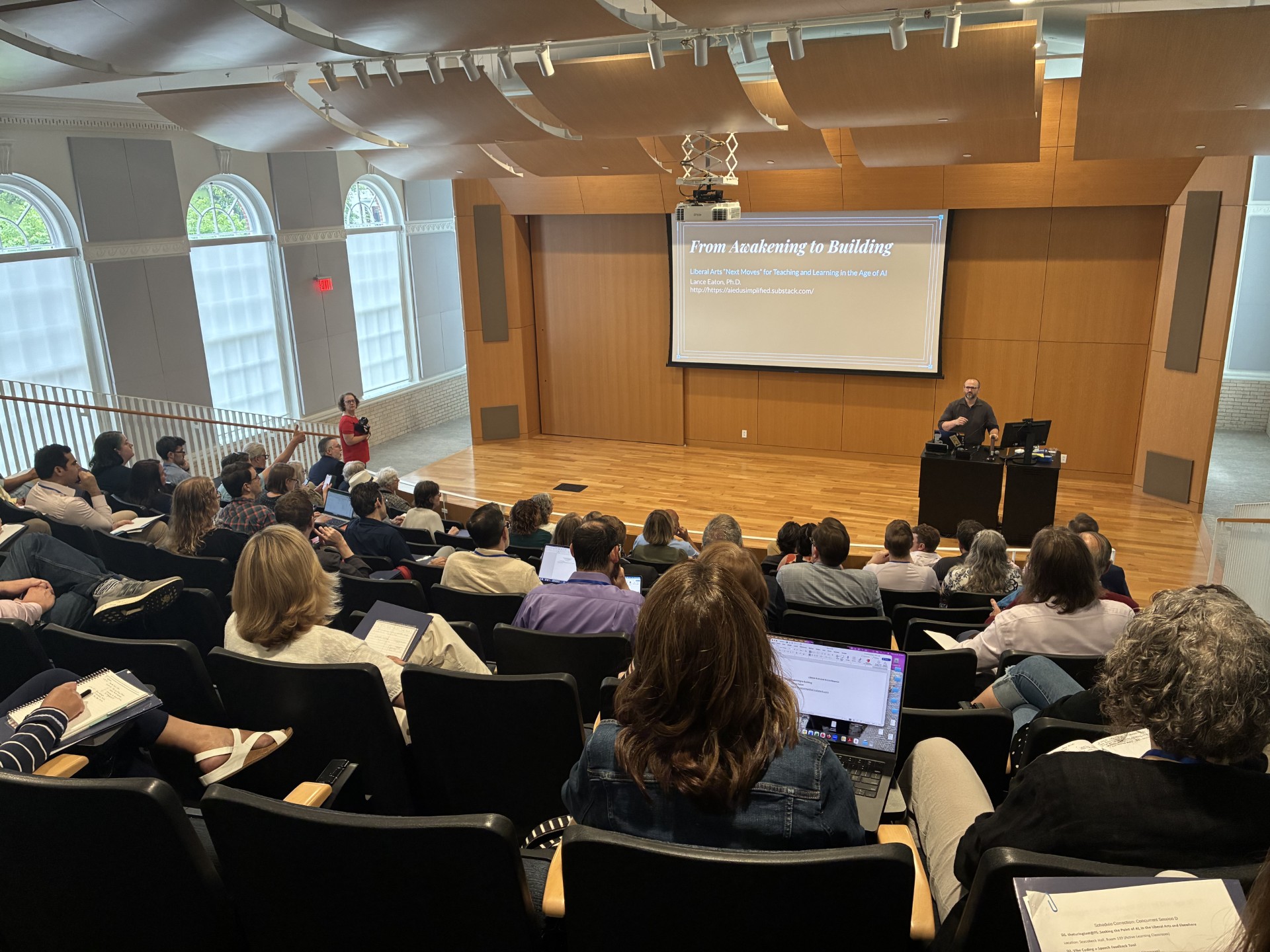
Attendees at Eaton’s keynote speech on July 22, 2026.
This requires educators to “rethink the design and logic of the learning space” and “create spaces where students are standing behind their work, instead of doing the work to have it graded and dismissed,” Eaton said.
He suggested that educators start their courses not by delivering information, but with a few days of deliberating.
“Ask students questions like, ‘How do you expect to use AI? How do you want to be assessed? What are your stress points? What does accountability look like for you? What’s a fair claim of proof?’” Eaton said. “And have them sign off on it … but not as a trap.”
He said students need help and a space to wrestle with these questions, and liberal arts educators should be there to facilitate that work, instead of loudly chanting “boo.”
“That chant cost us four or five years that we could have spent exploring” and building up liberal arts education for the students of today, Eaton said.