Local, state and federal officials noticed several generations of the Loving family present when they glanced around the historic Caroline County Courthouse in Bowling Green on Valentine’s Day.
Youth, teenagers, adults, and senior citizens were on hand to witness the Caroline County Courthouse campus become enshrined into the United States Civil Rights Trail because of its affiliation with the Loving v. Virginia Supreme Court case, which ended the ban on interracial marriage 59 years ago.
In 1959, Caroline residents Richard and Mildred Loving were convicted of violating the Racial Integrity Act of 1924, in the very courtroom where their family and public officials gathered to honor them on Saturday.
“This place holds deep significance, not only in Virginia history, but in American history,” said Rita McClenny, president and CEO of Virginia Tourism. “It was here that Richard and Mildred Loving were tried and convicted simply for choosing to love each other. Their courage, resilience, and quiet determination ultimately helped change the nation.”
McClenny said the family’s presence “reminds us that these stories are not distant history; they are personal legacies that live within your hearts.”
The Lovings’ daughter, Peggy Loving Fortune, was in attendance, along with her children, grandchildren and many other relatives, family members and friends. After the ceremony at the courthouse, the group was bused to a reception at the Bowling Green Town Hall.
During the ceremony at the courthouse, U.S. Rep. Eugene Vindman (D-7th District) said “the freedom to marry or not marry a person of another race resides with the individual and cannot be infringed by the state,” because of the Loving couple’s resilience.
“1967 seems like a long time ago, but it wasn’t really that long ago,” Vindman said. “There are many folks in this room that were around during that period … I know for the young folks, it’s hard to imagine the state or anybody else telling you who you can date or who you can marry. But that all started here in Caroline County when two people met and fell in love and decided to make a life for themselves together.”
After the couple married in Washington, D.C. on June 2, 1958, they wanted to return to the Central Point area of Caroline, where they were raised, to be close to family. But they were arrested on July 14 in their home by Sheriff Garnett Brooks and two deputies. On Jan. 6, 1959, they were prosecuted and convicted of violating the state’s anti-miscegenation law.
Judge Leon M. Bazile sentenced each to one year of incarceration, but promised to suspend their sentence if they left the state and didn’t return for 25 years. They moved to Washington but yearned to return to their home.
“While this [courthouse] building is an intricate and important part of this narrative, their story did not begin here,” said Jeff Sili, vice chair of the Caroline Board of Supervisors. “It began when two young people from a unique community called Central Point simply fell in love …
I was told many times that Mildred did not seek attention or accolades for her actions, but simply wanted to live in Caroline to raise her children with her family and in her community. Mildred wanted to come home.”
The U.S. Civil Rights Trail added six new sites in four states this year, including two sites in Virginia (Caroline and Gloucester). The other new sites are the Texas and Pacific Railway Depot in Natchitoches, Louisiana, the Jefferson Street Sound Museum and the Museum of Christian and Gospel Music in Nashville, Tennessee, and the Jacksonville Civil Rights Trail in Jacksonville, Florida.
The Trail, a collection of more than 130 churches, courthouses, schools, museums and other landmarks primarily in southern states, was launched in 2018. It’s meant to highlight areas where activists challenged segregation in the 1950s and 60s to advance social justice.
The Trail added 21 stops in the City of Fredericksburg in 2024. Fredericksburg Economic Development and Tourism Sales Manager Victoria Matthews assisted Caroline Tourism Manager Kathy Beard with the Loving project.
Chris Williams, the assistant director of the University of Mary Washington’s James Farmer Multicultural Center, also aided the county in the application process. Williams gained insight from his experience working with Fredericksburg for four years collecting information for its application.
Williams had ties with the Loving family as an instructor for the couple’s great-granddaughter, who graduated from UMW in 2024.
Williams noted that UMW Associate Professor and Director of the Center for Historic Preservation Christine Henry located the original documents related to the arrests of the couple, and additional materials.
“I thank [the family] for trusting me and Kathy throughout the process, and being incredibly open and supportive,” Williams said.
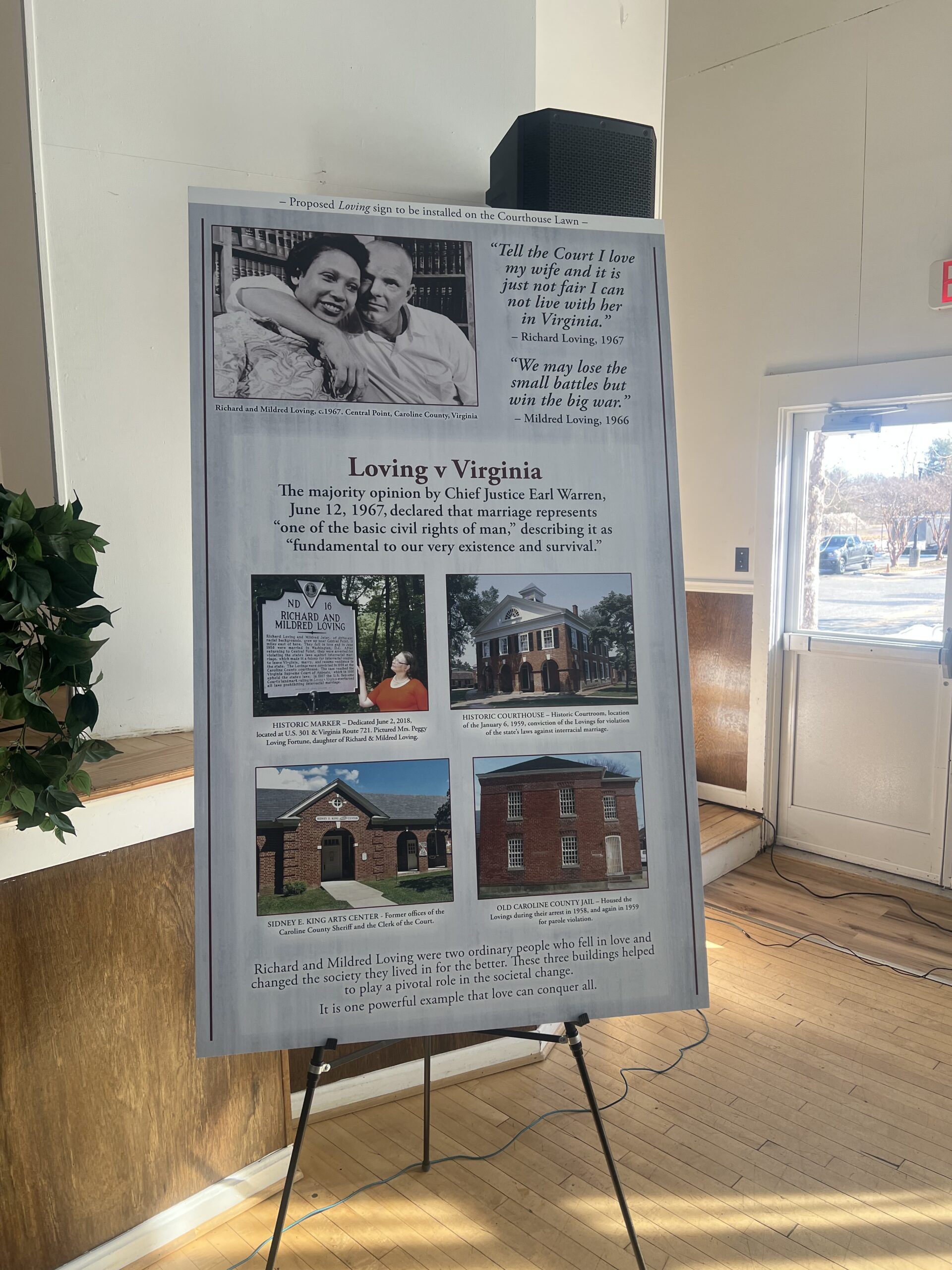
The Caroline stops on the trail include the courthouse, the Sidney E. King Arts Center, which was the sheriff’s office at the time, the old jail, and a state historical marker located at the corner of U.S. Route 301 and Sparta Road, which leads to Central Point.
A sign will be place on the courthouse lawn with pictures of the four sites included on the trail as well as quotes from Richard and Mildred Loving, and the majority opinion of then-Chief Justice Earl Warren, who on June 12, 1967, declared that marriage is “is one of the basic civil rights of man” and “fundamental to our very existence and survival.” A QR code will offer for additional information.
Del. Nicole Cole (D-Spotsylvania) said it’s fitting that the recognition of the Lovings occurred not only on Valentine’s Day, but also during Black History Month. Cole said the Lovings didn’t march in Selma, Alabama or protest segregated lunch counters, but became “giants” by simply lying in bed and not accepting a law that was meant to keep them apart because of their race.
“We gather this month every year because history does not keep itself,” Cole said. ” It must be tended; it must be told; and perhaps more importantly, it must be felt. Not as a distant chronicle of names and dates, but as a living inheritance of people, who endured, who resisted, who loved, and who refused to give up.”