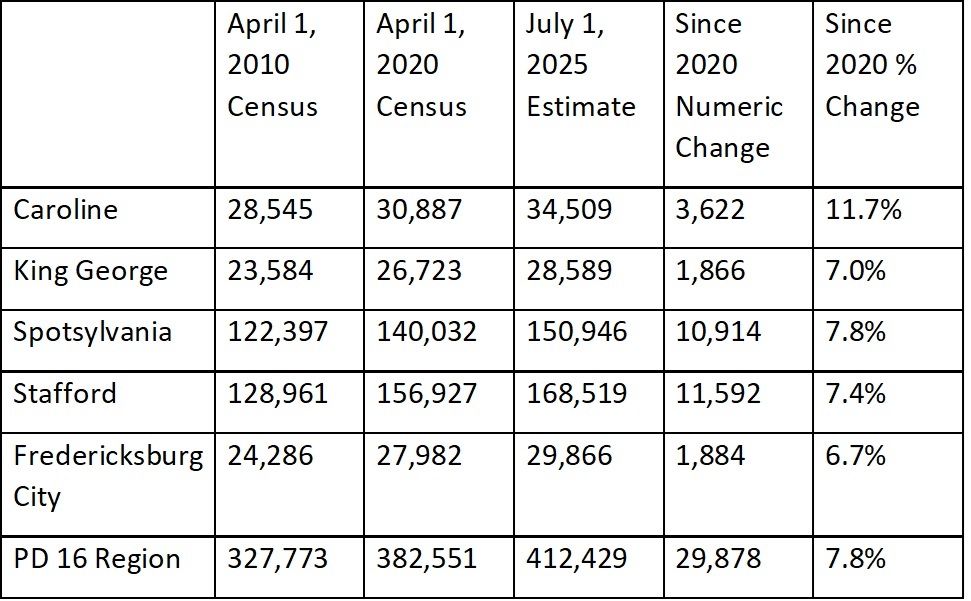
The Fredericksburg area’s population continues to grow, especially in Caroline, which is the fourth-fastest-growing county in Virginia, according to figures released Friday by the George Washington Regional Commission.
From 2020 to 2025, Caroline County added 3,622 people, a 11.7% population increase, behind only New Kent, Goochland and Louisa counties. The population in the locality in 2025 was 34,509, said the University of Virginia’s Weldon Cooper Center, which prepares official population estimates for the state.
GWRC’s region, also known as Planning District 16, had a 2025 population estimate of 412,429, up 29,878 people, or 7.8%, from the 2020 census. Planning District 16 is composed of Fredericksburg and the counties of Caroline, King George, Spotsylvania and Stafford.
In terms of regions, Planning District 16 ranked fourth in actual population growth since the 2020 census. Only the Richmond area, Northern Virginia and the Crater region (Petersburg/Chesterfield) exceeded it with population changes of 83,830, 61,242 and 38,967, respectively.
“The GWRC region once again has the fastest growth rate of any of the 21 planning districts in Virginia,” GWRC Executive Director Chip Boyles said in an announcement of the numbers. “Our region continues to monitor and plan for fast-changing commuting, housing and economic patterns occurring from the migration of families from D.C., from Northern Virginia and from the Richmond areas.”
Fredericksburg also was the sixth-fastest-growing city, behind Falls Church, Poquoson, Suffolk, Winchester, and Waynesboro, and tied with Fairfax City. Fredericksburg’s population estimate went up from 28,029 in July 2024 to 29,866 in July 2025, an increase of 1,837 people.
The Weldon Cooper Center’s estimates provide an approximation of a locality’s population count on July 1, 2025. Population estimates are typically based on a variety of observed administrative-record data, such as births, deaths, school enrollment and residential housing construction to detect population changes since the most recent decennial census.
State and local government agencies use the data for funding, planning and budgeting purposes.