The real-estate tax rate in Stafford for the next fiscal year remains unclear.
The county’s board of supervisors met with the school board on Thursday night, also discussing tax rates and economic development but didn’t come to any consensus.
County Administrator Bill Ashton has proposed a $1.12 billion local government budget for the fiscal year that begins July 1 that would increase the real-estate tax rate by 6 cents.
The spending plan calls for raising the rate from the current $0.9236 per $100 of assessed value to $0.985. The county fire levy also would go up, from $0.0131 per $100 of valuation to $0.014.
The supervisors agreed in March to advertise Ashton’s proposed tax rates, which essentially means they can later set lower levies but not higher ones. It creates a sort of tax-rate ceiling.
On Thursday, they talked about potentially picking a rate that would be between the current one and Ashton’s proposed $0.985. The board is scheduled to approve a rate and the county budget April 28.
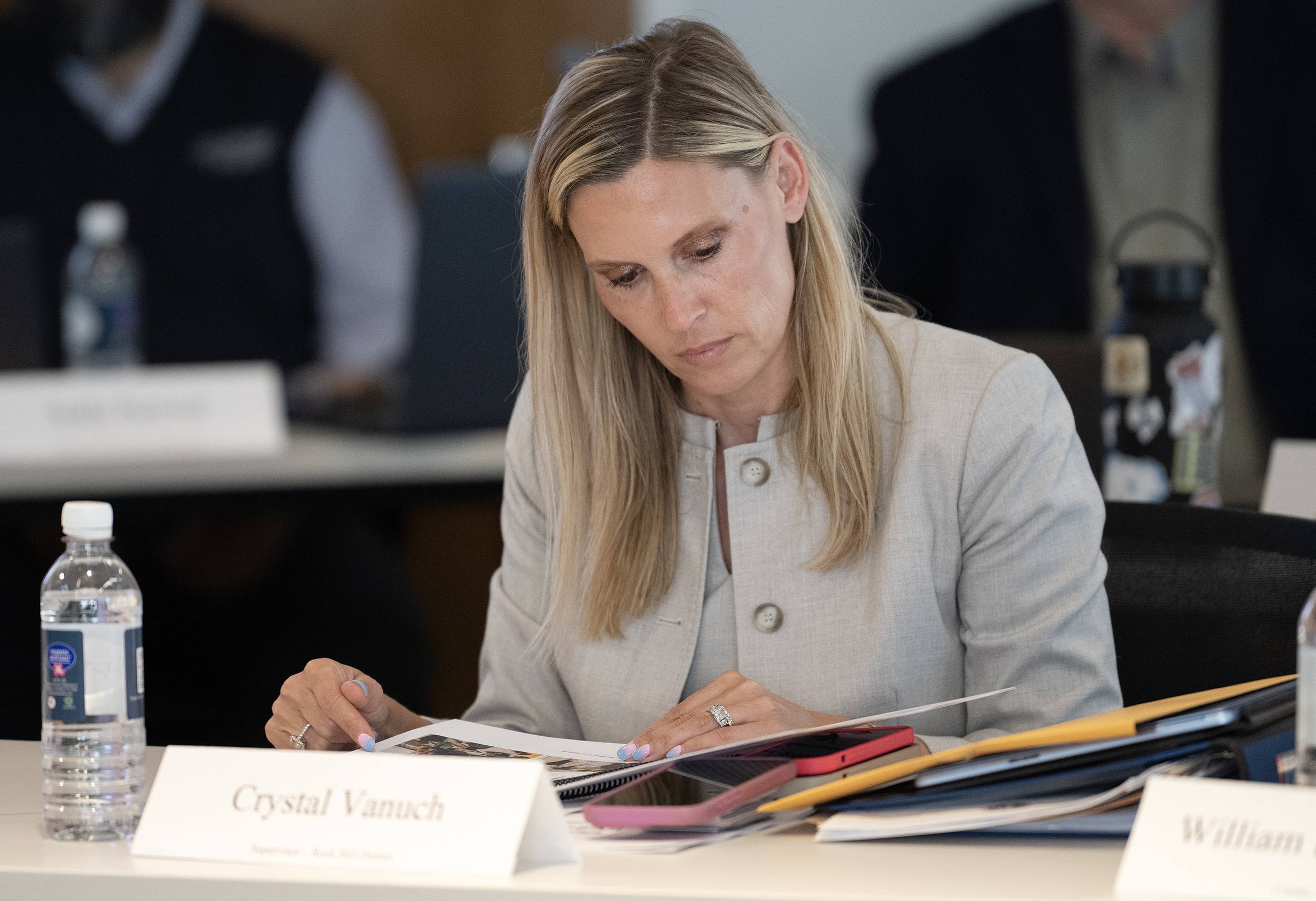
Rock Hill District Supervisor Crystal Vanuch, perhaps the biggest tax-rate watchdog on the board, suggested to her colleagues that they find some common ground on what to do with taxes. If that happened, they could then look at what may have to be cut from the county administrator’s budget.
“I’m going to say I’m not at 98 [cents],” board Chairman Deuntay Diggs said.
“And I’m not at 98,” Vanuch replied.
“And I’m not at 92 [cents]. So, I’m not going to be …” Diggs said, his voice trailing off before Vanuch, chuckling, said, “I’m at 85, so …”
Board Vice Chairwoman Maya Guy said she might be the only supervisor who would vote for Ashton’s proposed rate because she’s afraid going lower would mean cutting government services for residents or pay for county employees.
“I’m fearful of what that will do to people’s — not only their livelihood — but our ability to respond to 911 calls,” she said.
But Guy cautioned that she doesn’t really want to vote for a 6-cent tax rate increase because she has a one-income family and would feel the financial effects herself.
“I’m going to hurt myself,” she said.
County government staff on Thursday gave the supervisors information on what potential budget cuts would look like.
Going down to a $0.965 tax rate, for example, would require a $5.3 million reduction in the proposed general fund budget, while lowering even more, to $0.925, would mean cutting the general fund by $15.9 million.
Every penny on the tax rate equals $2.65 million in revenue, county staff said.
The supervisors also are examining potential across-the-board cuts to county departments beyond what Ashton would trim in his proposal.
An additional 2% cut would mean, for instance, “primarily administrative and operational reductions.” But a 6% hack could mean effects such as “significant staffing reductions and unfilled positions,” “elimination of major services and programs,” and “reduced public safety support and infrastructure maintenance.”
Falmouth District Supervisor Kecia Evans also asked when the county might begin seeing a lot of increased revenue from taxes on data centers.
That money won’t start coming in for a few years, Ashton said, which means budget times could be tough for Stafford for a while.
“This is the reality you live in until we start seeing some revenue on that side,” the administrator said.
Before examining possible budget cuts Thursday, the supervisors met with the Stafford School Board.
That board is requesting a $10.6 million increase in local funding this year to support operating costs associated with three new schools, along with $8 million for staff compensation and benefits. Combined, the total funding increase request is $18.6 million.
Ashton, however, proposed less than that: a bit more than a $15 million increase for education.
School officials also said Thursday that they now need an additional $2.3 million that wasn’t in the budget the School Board approved in February to forward on to the Board of Supervisors, which has the final say.
That would cover the local share of a proposed school-employee bonus coming from the state as well as increased fuel costs.
“We are all feeling it at the gas pump,” Stafford schools Superintendent Daniel Smith said. “So is our school division.”