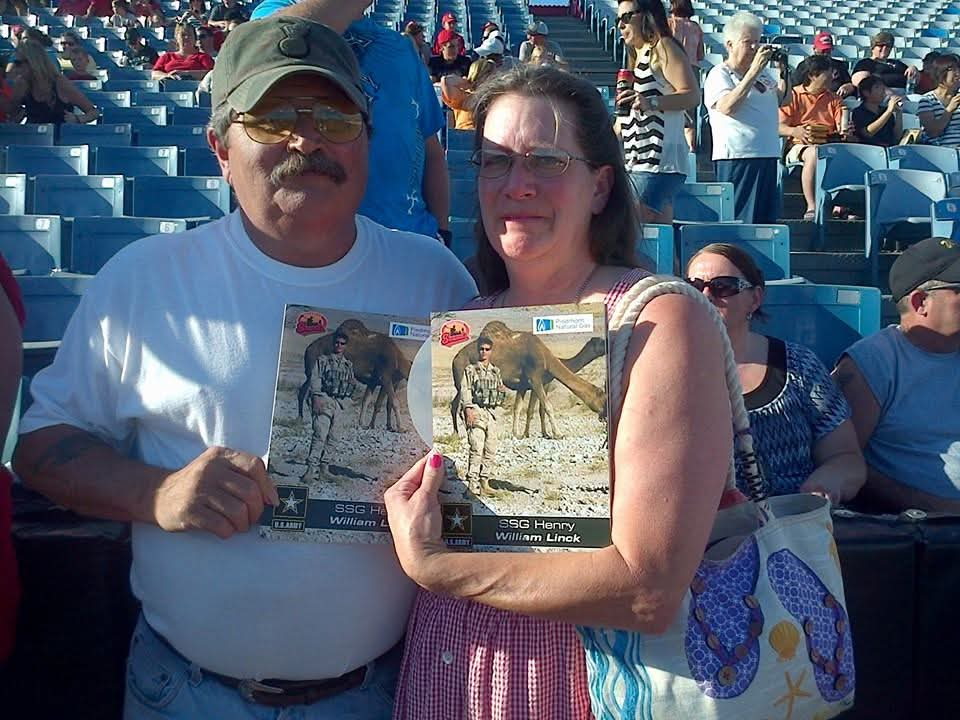
Rick and Debi Linck did not expect their son to die.
Henry Linck had joined the Army at age 18 in peacetime, but war soon came: first in Afghanistan, then in Iraq.
When they watched the planes strike the World Trade Center, Henry’s parents understood — as much as one could in those early hours and days — that the course of their lives had changed.
Debi was so worried that she wrote a letter to Henry’s commanding officer at Schofield Barracks, Hawaii. She couldn’t stop thinking about Pearl Harbor. Rick, who’d run a gunboat during two tours in Vietnam, was more pragmatic.
Henry would do what the Army told him, and then some.
He deployed to Afghanistan twice over the next four years. He graduated from the Army’s elite Ranger School — one of the military’s toughest training programs — and earned Jumpmaster qualification, a distinction reserved for highly experienced airborne soldiers.
In the fall of 2005, Henry arrived at Fort Richardson, Alaska, where the 3rd Battalion, 509th Parachute Infantry Regiment would soon be reactivated for the first time since World War II. He was assigned as a squad leader in Able Company, one of the battalion’s combat units, and geared up for this third deployment — this time in Iraq.
Debi believed he’d make it home a third time. Service members were deploying — and surviving — multiple deployments. Why, she thought, should it be any different for Henry?
But Iraq was a different beast. By 2006, the country had descended into brutal sectarian civil war, with Iraqi militias surging, civilians dying by the thousands and American troops fighting grueling urban battles across the country.
Linck was on patrol in Baghdad on Dec. 7, 2006, when he was killed by an improvised explosive device. He was 23.
Nearly 20 years later, his parents are still learning how to carry what came after.
Remembering Henry
The walls of the Lincks’ home in Caroline County still hold Henry everywhere: His photographs and medals and insignia. His uniform hangs in a garment bag in Rick’s closet; his dog tags hang around Debi’s neck. They still drive the Durango Henry left in a storage unit in Alaska.
Grief doesn’t freeze time, but love does. Every once in a while, Debi and Rick are overcome with it, and they blink through tears they didn’t see coming.
Another wall holds Henry, too.
At Mission BBQ in Fredericksburg, Henry’s photographs hang among the faces of American service members on the restaurant’s wall.
Rick and Debi often eat lunch beneath them. They have come again on a recent Friday afternoon in May, and they take their usual seats.
The couple has spent the better part of two decades trying to ensure Henry is remembered. Now, time is asking something new of them.
In three days from this meal, Rick will undergo surgery for throat cancer. Doctors will remove his larynx, taking with it a voice that has carried Henry’s stories for nearly 20 years.
Before Iraq, before Arlington — before grief became part of the architecture of their lives — there was Henry.
An appetite for knowledge, adventure
They called him Scooter. He spent much of his early life in Kansas, near the Nebraska border, before moving to Spotsylvania County at 16.
Before he learned to walk, the baby named Henry would not crawl. But there were places to go and things to see. So he used his arms to get there, scooting his bottom across the floor.
The nickname stuck. It followed him into adolescence and young adulthood. It followed him to war.
It follows him still. “Scooter” is stitched on a garden flag that hangs outside Debi and Rick’s home.
If Henry was ever afraid of anything, no one knew it.
“He was a daredevil,” Rick said, recalling the time, at the beginning of 12-year-old Henry’s summer break, when he jumped off a railroad bridge.
The drop was about 20 feet, and Henry and his friend aimed for the river below. The friend hit the water. Henry did not.
“He spent all summer in a cast. He sat all summer with a cast on. As soon as it was off, he and his buddy went back down and jumped again. This time, he hit the water. He wanted to prove he could do it,” Rick said.
“You always knew he was up to something,” added Debi, “because he’d grin like a Cheshire cat.”
In the Army, his teammates learned to recognize it.
“He hated school,” Debi said, “hated it with a purple passion.”
But he loved to read. If he didn’t know something, he’d find the answer in a book.
During an ill-fated attempt at homeschooling when Henry was a teenager, the only way Debi could get him to focus was by asking what interested him and finding a book on the topic. Then she’d make him write a report on it.
Later, she said, Henry read the Koran. He read the Bible from cover to cover. “When we got his stuff from Iraq, there were two military trunks full of books.”
In Iraq, he irritated his teammates by staying up all hours of the night reading beneath a book light, something he’d done in Hawaii and Alaska, Debi said. During jump school, while everyone else sat around nervous for their jumps, Henry sat, cool and collected, with a flashlight and a book.
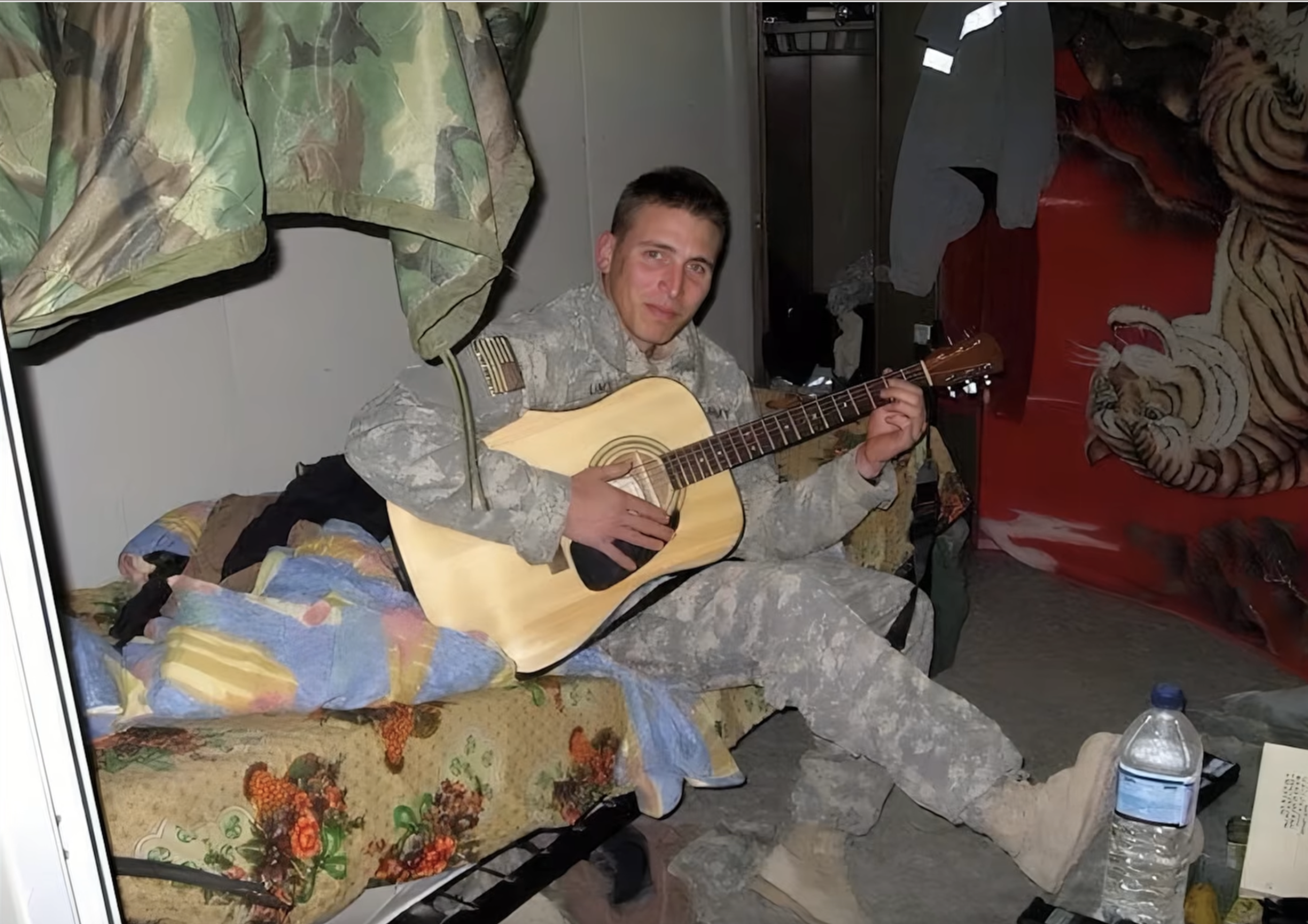
Among other talents, Henry Linck played the guitar. He’s pictured here strumming in a tent during one of this three deployments to the Middle East. (Photo courtesy of the Linck family).
In 1998, when Henry was 16, he joined Rick — a long-distance truck driver — on the road. By then, Henry had decided traditional school was simply too restrictive. Together, they traveled from Kansas to Florida, where, at a truck stop outside Miami, Henry wanted to order an alligator burger.
“I told him, ‘You order it, you have to eat it.’ He ordered it. Later that night, I had to go into the truck stop and buy Pepto-Bismol.”
Henry was unfazed. At a truck stop in Louisiana, he ordered gumbo off the locals’ menu. The same rule applied: You order it, you eat it.
“When that gumbo came out, the waitress brought six glasses of milk. It was so hot after one bite you could see the sweat on his face.”
At the Big Texan Steak Ranch & Brewery in Amarillo, Texas, Henry insisted on taking the restaurant’s famous challenge: eating a 72-ounce steak, a salad, a baked potato, shrimp cocktail and a roll in under 60 minutes.
“He ate the whole thing and asked for another,” Rick said.
They spent a month and a half on the road, crossing the country, picking up and dropping off loads, visiting friends, eating at out-of-the-way places, sleeping in the truck’s sleeper cab, where they sometimes made crockpot dinners.
A year later, Henry, who had left school, realized his options were limited without a high school diploma. He joined Job Corps, a vocational training program for young adults, and got his GED.
When he announced he was joining the Army with a buddy, Debi, at least, was surprised. Henry never liked people telling him what to do.
But it was his decision to make, and they supported it.
“I wasn’t going to bug him and I wasn’t going to argue with him about it,” Rick said. “I told him, ‘I don’t care what you do, as long as you do it with pride.’”
Before he left, Rick offered some of the wisdom he’d gleaned during his own time in the military: Lead by example. And never ask someone to do something you wouldn’t do yourself.
Eleven months later, on a picture-perfect Tuesday morning, four passenger airliners veered off course.
Rick was on the other side of the country delivering a load when he heard the news. He called Debi.
“Sweetheart, have you watched the news? Turn the news on.”
Back in Caroline County, she flipped on the television and watched: planes cutting through that cornflower-blue sky over Manhattan, a smoking Pentagon and, later, a charred Pennsylvania field.
A week later, Rick was delivering body bags to Queens. And Henry was gearing up for war.
‘We regret to inform you’
Five years later, on another long-distance haul — this time to Florida — Rick’s phone rang.
A man’s voice came over the line: “Is this Frederick Linck?”
Rick has long since forgotten the man’s name, if it ever even registered.
“We have to inform you that your son was killed in combat. When will you be home?”
“Two days,” Rick told him.
“We’ll officially notify you in two days.”
Debi, a school bus driver, was preparing for her afternoon route when Rick called.
“They didn’t want me to drive my school bus that afternoon,” she said.
But she couldn’t imagine doing anything else. Another driver rode with her. Then, she went home and waited.
They both still remember the knock at the door. And the words that followed: regret to inform you.
Henry was buried at Arlington National Cemetery.
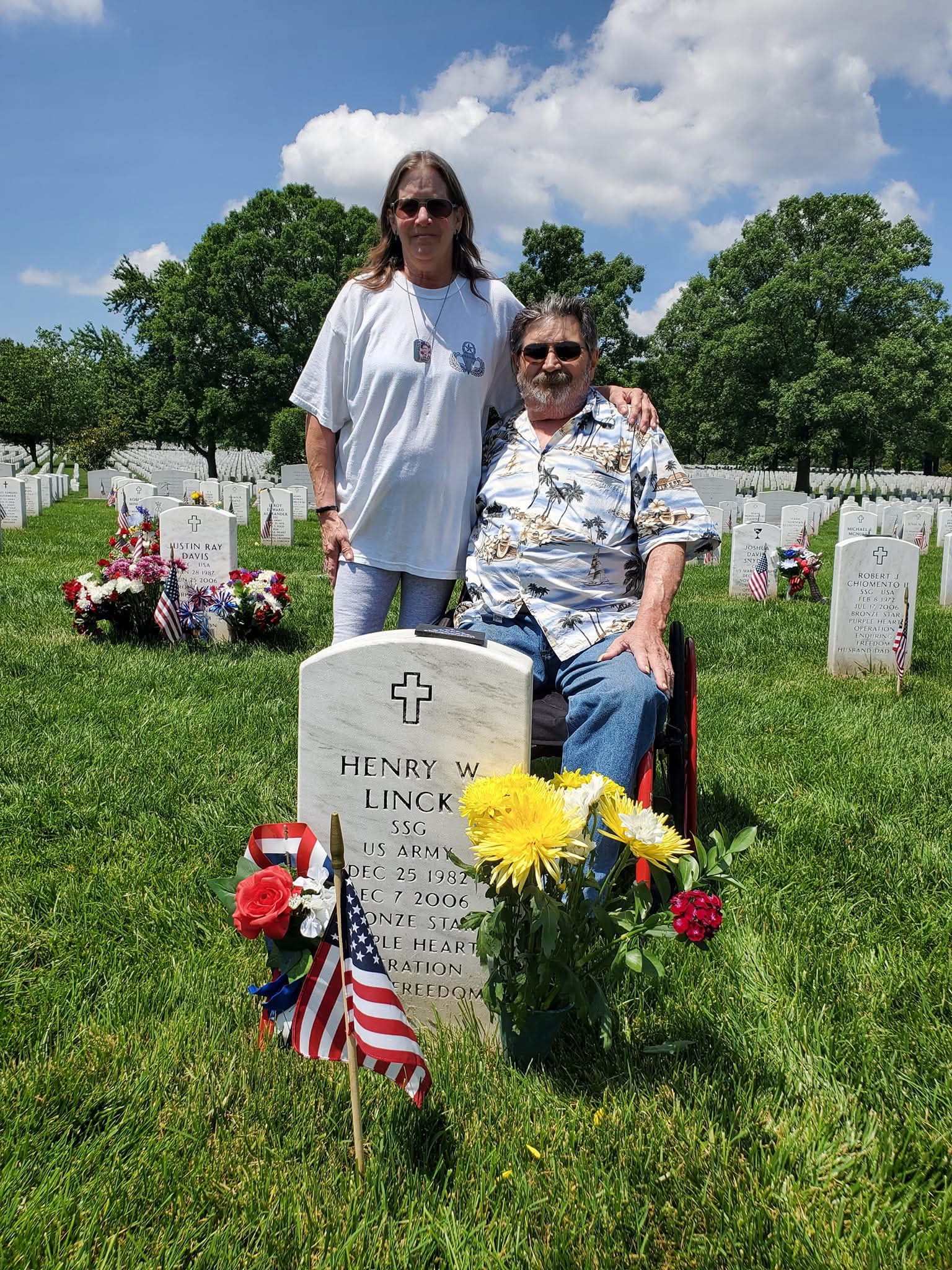
Debi and Rick Linck lay flowers at the grave of their son, Henry Linck, in Arlington National Cemetery. (Photo courtesy of Linck family)
Afterward, Debi returned to her bus route. Rick went back on the road, but not for long. His boss worried he was unraveling.
And there was more loss still to come.
Within months, Debi’s mother died. Then Rick’s mother. Then Rick’s father.
It was all too much for him. Eventually, it became too much for Debi, too — too much grief, too much pressure, too much holding everything together. She filed for divorce.
By then, Rick had no job and no home. For a time, he slept in a tent in a friend’s yard.
A year passed before he woke one morning and realized he had two choices: he could live or he could die.
Henry, he knew, would want him to live.
A lasting, living legacy
A year later, Rick and Debi remarried.
Grief had been like a spiral. Now began the slow, steady climb out of the depths. Counseling helped. So did wrapping themselves in the memory of their son, in the stories Henry’s teammates shared, in the memorials that bore his name, in the swelling pride that came from learning what an exceptional soldier their son had been.
The proof was partly in his record: just 23, Henry had earned an extraordinary record of military achievement, including the Bronze Star Medal, Purple Heart, Combat Infantry Badge, Expert Infantry Badge, Ranger Tab, Parachutist Badge, Air Assault Badge, and Foreign Jump Wings — distinctions that marked him as a highly skilled, combat-tested airborne infantry soldier and respected leader within the Army.
There were role calls and public remembrances, moments when Henry’s name was spoken into microphones before crowded rooms.
But it was more than that. At least two of his fellow soldiers would go on to name their children after Henry. To this day, Debi said, his commanding officer still tells his soldiers about her son.
This was what it meant to rebuild life around an absence that never leaves. This is what it was to perform the strange mathematics of surviving a child.
Mostly, there was the work of remembering.
Then, in 2015, came another rupture. After years of chronic back pain linked to injuries from his time in Vietnam, Rick underwent a routine spinal decompression and fusion surgery — a procedure designed to relieve pressure on the spinal cord and stabilize damaged vertebrae. He drove himself to the hospital that morning and went inside.
It would be the last time he ever walked.
Overnight, their lives had changed again. Debi became his full-time caretaker. Then, three years ago, came another diagnosis: Rick had throat cancer. After radiation treatments, doctors believed the cancer was gone. But it was still there. Smaller — but still there. And it had not yet spread.
He had two choices. Undergo surgery to remove his larnyx or enter hospice.
Live or die.
He chose to live.
Now the disease has brought them to the edge of another goodbye. Their greatest fear, they say, is not death. It is forgetting.
The wars in Iraq and Afghanistan stretched across two decades, touching a tiny fraction of American families. Rick and Debi know how easily names fade. A photograph on a wall. A folded flag. A headstone visitors pass without stopping.
As long as they are alive, they say, Henry will be remembered.
In the garden flag fluttering outside the house. In the stories they still tell over lunch beneath his photograph at Mission BBQ. In the silence that sometimes overtakes them without warning.
And, they believed, he was with Rick on the morning of his surgery.
When Rick woke after a successful procedure on May 18, he no longer possessed the voice that has carried his son’s name for nearly 20 years.
But Henry, by then, was already spoken for.