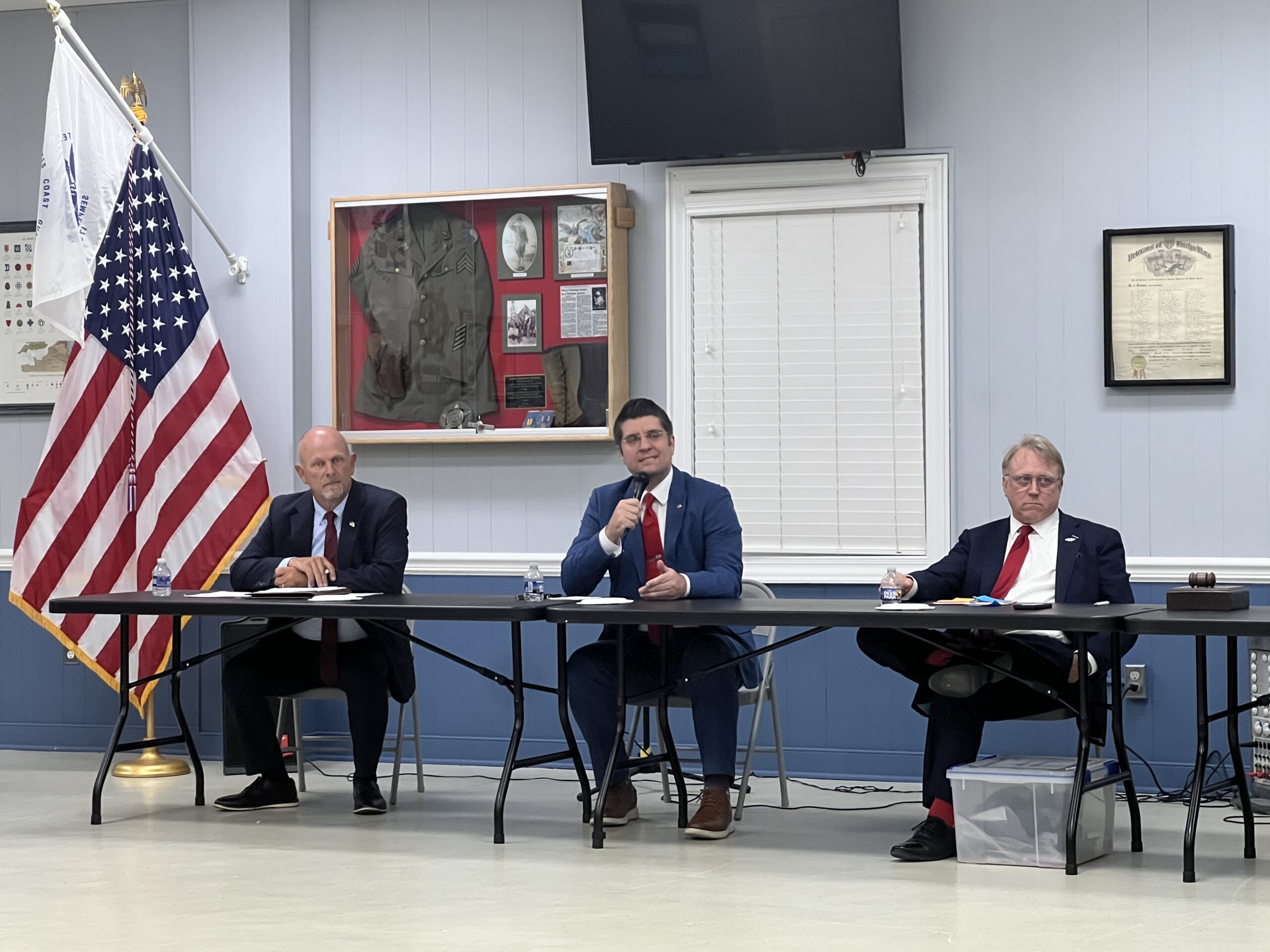
Early voting in the Aug. 4 GOP primary for Virginia’s 7th Congressional District began Thursday, and the night before, the men who want to capture their party’s nomination had their say in Fredericksburg.
Republicans Philip Harding, Doug Ollivant and Rick Smithers appeared at a candidate forum Wednesday night put on by the Fredericksburg, Spotsylvania County and Stafford County GOP committees.
As might be expected, the hopefuls staked out similar stances as they presented themselves to a crowd gathered at VFW Post 2701. After all, each wants to defeat Democratic incumbent Rep. Eugene Vindman in the district that includes the Fredericksburg area.
One matter that brought some distinction, however, was data centers.
Smithers — a veteran, business owner and pastor — argued for a moratorium on the technology businesses.
“You should be concerned,” he said. “You’re not going to have any clean drinking water. You’re not going to have any nice views, and look out your back door and sit on the back porch and drink sweet tea and look at the sunset. You won’t have that.”
Data centers can provide “economic benefits,” Smithers said, but their growth should be “balanced with the needs of families, farmers and small businesses.
“My concern is this: that ordinary Virginians could end up paying higher utility bills or support massive energy demands from large corporations,” he said. “It’s like that every time they do these big projects, y’all. It’s like that every time.”
Smithers lives in Wirtz, which is outside the 7th District. But he can run because House of Representatives candidates don’t have to reside in the area they seek to serve. However, he told the Free Press after the debate that, if he wins the primary, he plans to move to the district.
“I’ve already been looking at places,” he said.
Ollivant, who lives in Culpeper County, said data centers are necessary and a national security asset.
“We want our data to be processed here. Modern military operations require a ton of it; therefore, there are going to be data centers,” he said.
But Ollivant, a retired Army lieutenant colonel who leads a global consulting firm, said the location of data centers should be decided by local governments.
“And that answer may be very different for different counties,” he said. “Stafford County may have a very different tolerance for data centers, positive or negative, than does Spotsylvania County. And that’s fine.”
To power those data centers, Ollivant said, the strategy should be small, modular nuclear reactors.
Harding — a businessman, global speaker and educator — said the federal government should encourage innovation in energy.
He also agreed that local leaders should have the final say on data centers.
But Harding, who lives in Woodbridge, seemed concerned about hearing that the Belvedere Plantation farm business in Spotsylvania could be replaced by data centers.
“Man, we got a lot of memories there,” he said. “I don’t know if they’re going to have pumpkins at the data centers or not, but maybe we can figure that out.”
Ollivant also separated himself from his opponents a bit by saying he’s running on a policy of “good food for good health.”
“We are broke because we are sick,” he said at the beginning of the forum. “We have epidemics of diabetes, obesity, hypertension, autoimmune diseases, and in large part, although perhaps not in totality, this can be traced back to our food supply. We need to have better food so we have better health.”
Later, near the end of the event, Smithers also said it was important for Americans to eat healthier. But, in answer to a question about his No. 1 legislative priority, if elected, he described food more in economic terms.
“I’m going to help you with your groceries,” Smithers said. “I’m going to help you with the electric bills. And I’m going to put more money in your pocket because you work hard for it.”
Ollivant said his first priority would be to help pass the Major Richard Star Act. That would end the offset for combat-injured medical military retirees, ensuring they can receive both retirement pay and Veterans Affairs disability compensation, according to the Wounded Warrior Project.
Under current law, veterans forced to retire early due to combat-related injuries are denied the full benefits they’ve earned and are required to forfeit part of their retirement pay, the nonprofit says on its website.
“Getting this low-hanging fruit that takes care of our veterans is attainable, and something I can do in my first term,” Ollivant said.
When it was his turn to answer, Harding said there’s nothing to say that anyone needs to wait for a government solution to societal problems.
“But beyond that,” he said, “once I’m in Congress, I’m going to continue to fight to lower regulation, empower small businesses and [fight for] families to be strengthened.”