Lines stretched long when volunteers distributed food in downtown Fredericksburg in 2021. Kids waiting with their parents could get antsy.
The pandemic had exposed — and exacerbated — the need for consistent, accessible support for local families. Giving kids something to do while their parents waited would help everyone, volunteer Javonne Kirby decided.
It was a stressful time. For parents, of course. But also for children. Kirby, who had spent years working at downtown restaurants, was out of a job. She was also newly sober, channeling her energy into volunteer work.
Art had long been a comfort to Kirby, as far back as she could remember. Maybe, she thought, it could help now. She started doing art projects with the kids while their parents waited. Soon, she noticed the parents looked interested, too, so Kirby asked if they wanted to join.
More often than not, they said yes.
Kirby didn’t know it yet, but something bigger had taken root.
Creative Connection
Five years have passed since that spring and summer when Kirby helped hand out thousands of pounds of vegetables to families in need. You can see people’s faces now — the smiles and frowns that were long hidden. People gather. They lean in close and hug and shake hands.
While the last traces of COVID-19 disappeared, the art projects that began as a means of distraction took on a life of their own. Today, Community Canvas is an art advocacy program that meets from noon to 4 p.m. on Mondays and Thursdays in a classroom at Fredericksburg Baptist Church.
On a recent Monday, there is coffee and several large tables and an adjacent room filled with almost every art supply imaginable: paints and canvases and beads and clay and markers and coloring books and frames and fiber and crochet needles.
Kirby, seated at one of the tables, had noticed something happening when people came together to make art. The atmosphere changed.
“They started to interact. They were friendly, playful. They built a little community,” she said. “A lot of the kids who were neighbors didn’t even know each other’s names until they sat down to do an art project. It was a way of connecting.
“I noticed we are all struggling to connect.”
For a time, Community Canvas existed at the food distribution center or out of the back of Kirby’s car. It found its permanent home about a year and a half ago. Everyone is welcome, and there’s no cost.
“After a while, we realized this would be perfect for adults,” Kirby said. “There aren’t any safe, welcoming spaces to go. The library is open, but besides that, there isn’t really anywhere to go that’s free. Things cost money. If you don’t have money, you can’t partake in the fun stuff. And we don’t think that’s right.”
She is working on a small collage. Kierra Underdo is across the table painting a self-portrait, the latest in a series that documents her life. She’s done 40 so far this year. Some are dark and graphic, about letting go of negativity and trauma.
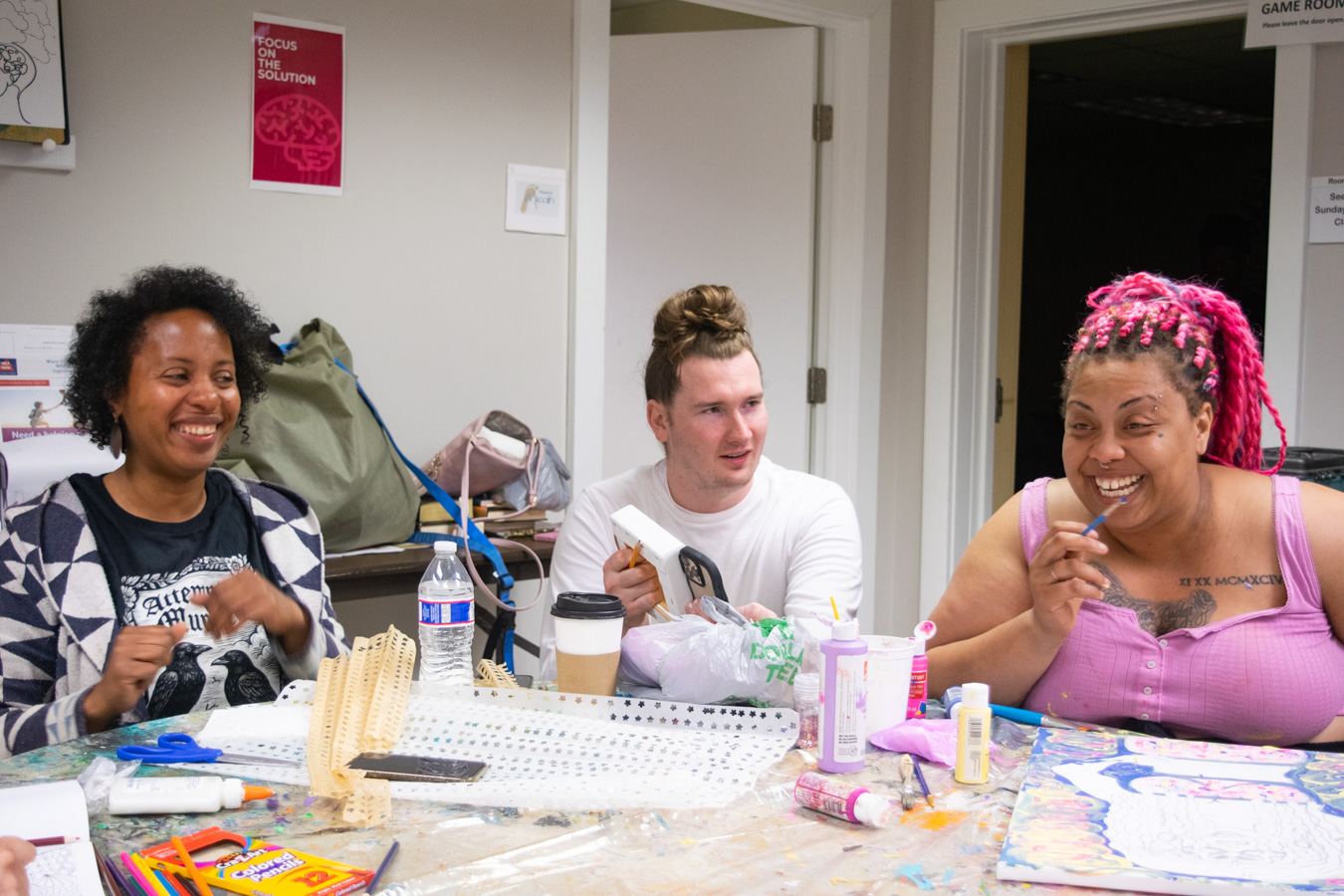
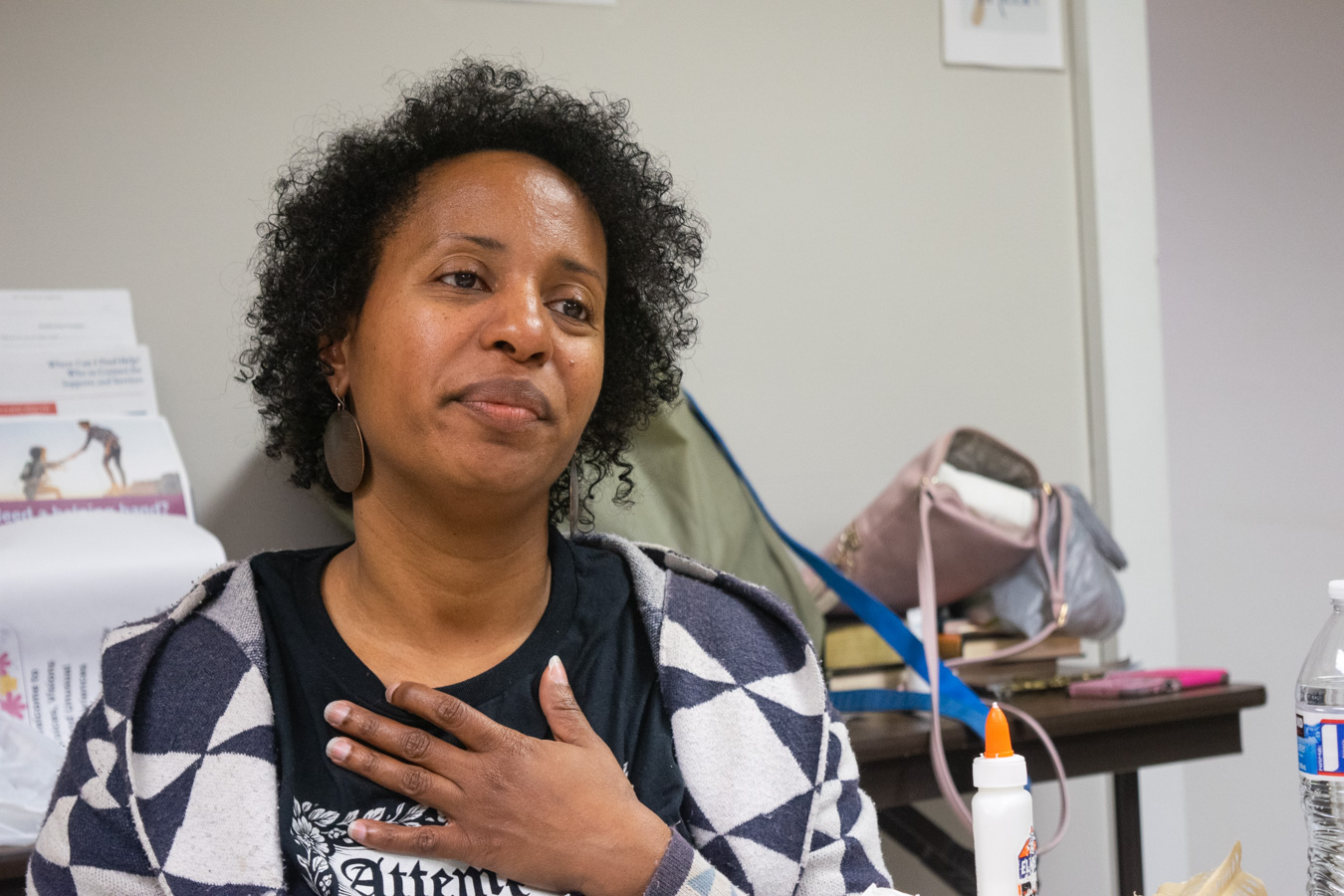
Javonne Kirby (left) founded Community Canvas as “a way of connecting” for neighbors who may not have other welcoming spaces.
The one she works on now is full of bright colors. Someone else has just completed their first sculpture — Kirby admires it. Clay projects and painted canvases dry on shelves nearby. Another painter calls her aside; he wants her feedback.
“They make beautiful, powerful things here,” Kirby says.
The room is noisy. Alive. Underdo is a regular.
“I’m a people person,” she says, “but sometimes I am alone in my head. This helps me a lot mentally. Instead of staying in bed all day, I come here. I can vent, I can hang out with my friends. And it’s free. It’s a time to be productive and express yourself.”
Underdo looks up at Kirby.
“This lady has saved my life,” she says.
The Artist’s Way
Kirby has been making art since she was 2. That’s the story her mother tells. At daycare, she drew a duck — a perfectly recognizable duck. The daycare workers, along with Kirby’s mother, were sure they had a prodigy on their hands.
Kirby kept drawing. Her parents kept her supplied with pencils and crayons and markers and anything she needed. The schools she attended gave her the time and space to create.
At 18, Kirby relocated from New Jersey to Winston-Salem, N.C., and soon after she became pregnant with her daughter. After she was born, Kirby moved with her mother and baby to Fredericksburg. They were familiar with the area; Kirby’s grandfather had served as principal of Ralph Bunche High School, which served Black students in King George County during segregation.
It would be a good place to raise a family, they decided — a good place for Kirby, who had struggled with addiction since she was 10 years old, to make a fresh start.
It was not the success they’d hoped for, at least not for many years. After getting clean from a heroin addiction, Kirby turned to alcohol.
“I thought it wasn’t nearly as bad, but it ended up almost as bad as I ever was when I used harder drugs,” she said.
Art took a backseat. Then it disappeared.
“I spent a lot of years living that lifestyle until 2020 when I got into trouble. I was facing some jail time. I’d had enough — or maybe I hadn’t, but I was facing jail time. Finally one day I reached out to my mom and asked her for help. She made some calls. She said, ‘I’m going to help you.’ It was the first time I’d asked for help. I’d suffered through it by myself, and I never knew there was help.”
Her mother found a place for her. Kirby spent two weeks in a local rehab facility. She came out on March 11, 2020.
Days later, they shut the world down.
Full Circle
Forced social distancing might have gone either way for someone so new to recovery. Restaurants were closed. Kirby was without a job.
She started volunteering at the free farmer’s market and the Free Fridge and Pantry downtown.
“That occupied my brain and my time, which kept me sober,” Kirby said.
There was something else, too.
For years, Kirby had not known help was available for addiction. Now she wanted everyone to know. She also wanted to help others find recovery. She completed a 72-hour peer recovery specialist course, then logged 500 required hours as an intern at the Rappahannock Community Services Board. Soon after, a job opened up.
For the last five years, she has served as a peer recovery specialist. She also works with an Assertive Community Treatment team, which provides comprehensive, individualized services to adults with severe and persistent mental illness when traditional methods haven’t worked.
Along the way, Kirby began creating art again.
“It’s like being reunited with an old friend. It’s part of what makes me whole, and I can share it with people and see how it makes them whole,” she said. “It’s another reason Community Canvas became a priority. A lot of people I work with live independently and don’t have things they can do. Any of the places they go, they can feel unwelcome or isolated. I’m trying to create a space they feel comfortable in.”
“Javonne’s compassion and innovation have been a game changer for how some of our most vulnerable neighbors identify their gifts and learn how to share them with others,” said Meghann Cotter, executive servant-leader of Micah Ecumenical Ministries, which has awarded Kirby a 2026 Drum Major for Justice Award.
“Everybody’s got gifts. Mine is art, and that’s the one thing I can share with others. It’s really cool to see people come in who say they aren’t creative and then they create something like that,” Kirby said, pointing to a small owl molded from clay.
Every third Thursday, Kirby incorporates resources into Community Canvas: a sleep expert, a yoga instructor, someone to explain advanced directives or teach Narcan training, which can rapidly reverse opioid overdoses. Two community members have received scholarships for the same peer recovery course Kirby took and are now working toward certification. One has started a basketball group. Another has begun a conflict resolution group.
“When you’re at your lowest, it’s hard to see it ever being anything different than that,” Kirby said. “But I was able to experience something else. I found help. I slowly worked my way to where I am today. Everybody should know they can do that too.”
These are the things that happen, Kirby said, when people come together and busy their hands with brushes and clay and knitting needles.
Sometimes the conversations are light. Sometimes they run deep.
Sometimes, someone shares their struggles with substance abuse and tells Kirby she couldn’t possibly understand.
She tells them she does.
Meghann Cotter is a member of the Free Press journalism advisory committee.