
Smoke from wildfires in Canada are visible in the region today, resulting in the Virginia Department of Environmental Quality issuing a Code PURPLE Air Quality Alert. The alert means that air pollution concentrations within the region contain fine particulate concentrations that are unhealthy for the general population. AirNow.gov shows the Fredericksburg region in the purple “very unhealthy” zone for all residents.
Meteorologist Sean Sublette says the conditions won’t last into the weekend. “The smoke and haze will begin to thin out later tonight, then a generous breeze from the southwest will scour out what is left of it tomorrow morning,” he said.
Air currents are responsible for why the smoke has reached this far south, Sublette said. “During the summer, wind currents are much lighter than in the winter, so smoke can drift a long way from its source — in this case, western Ontario, Canada — without dissipating. Several days ago, the smoke was in New England, but the winds have temporarily shifted, bringing it into Virginia.”
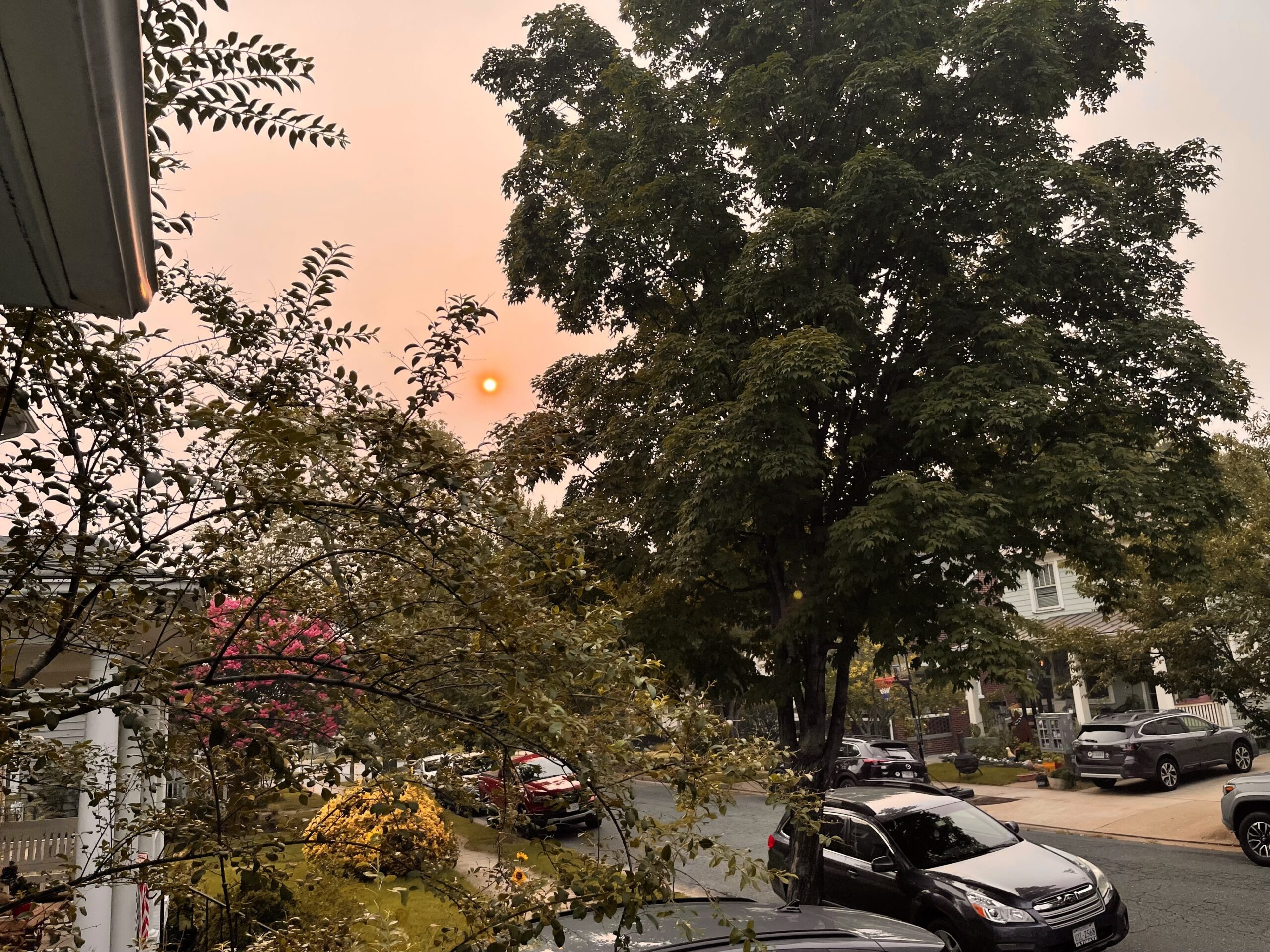
A hazy morning sky greeted Fredericksburg residents Friday. (Submitted photo)
This isn’t the first time that wildfire conditions in other parts of the continent have had an affect on the region. In July 2023, another Canadian wildfire sent smoke into the area. Sublette said that wildfires are on the rise as the climate warms.
The spring snowpack melts earlier and the temperatures are higher — raising the risk of wildfires. Because most of these regions are so remote, they are often allowed to burn themselves out, which can take several weeks, or longer.”
He stressed that overall, air pollution is better than it has been.
“This also serves as a reminder that air pollution, overall, is not as bad as a generation ago, when federal air pollution standards were passed,” Sublette said. “It makes days like these stand out even further.”
Other precautions people can take include wearing an N95 mask, limiting exertion while outside, and postponing outdoor activities for times where the air quality is more favorable.
“When wearing an N95 in hot weather, it is very important to stay adequately hydrated and to take frequent breaks in air conditioned indoor areas,” Perkins said.