Tuesday night’s Stafford County Board of Supervisors meeting had a green tinge to it.
That’s because the supervisors were discussing potential moves to increase revenue in the locality.
They didn’t take any votes, as the matters were talked about in a work session, and Supervisors Tinesha Allen and Crystal Vanuch were absent from the gathering.
But they engaged in conversations about money, including implementing a business, professional and occupational license tax in the county.
Stafford is the largest county in Virginia that doesn’t charge this tax, Commissioner of the Revenue Scott Mayausky told the supervisors Tuesday.
Instead, the locality charges a merchants’ capital tax, which is levied on a business’ inventory. That generates about a million dollars a year for Stafford, Mayausky said.
Stafford has been talking about changing from merchants’ capital to a BPOL — state law says you can have one or the other; not both — which Mayausky estimated would bring in more money: $3.5 million to $4 million annually, if it was set up like Spotsylvania County’s business-license tax.
That’s one reason the notion of instituting a BPOL has come up in Stafford over the past several years. One of its champions currently is Garrisonville District Supervisor Pamela Yeung.
Four thousand to 5,000 businesses operate in the county, Mayausky said, but the “license” part of the BPOL is kind of a misnomer. The program wouldn’t allow the county any more regulatory authority of a company.
“So it doesn’t give us authority to close a business down if they’re operating in a dishonest manner,” he said, “or if they’re scamming people. That is not the purpose of the business license. It is a tax only.”
It has three components: a license fee, a license tax and a gross receipts exemption. For the license fee, Stafford could charge a business up to $50 annually. For instance, the commissioner said, Fredericksburg charges $25 per year, while Spotsylvania doesn’t charge a license fee.
The license tax is determined by a firm’s prior year’s total gross receipts. For example, the license tax for 2027 would be based on the gross receipts generated in 2026.
Finally, localities are required to have a minimum exemption from taxation. That means Stafford would have to have an exemption of at least $100,000.
As an example, a store that generated $1 million in gross receipts could generate $1,800 in taxes in a year, Mayausky said.
The cost of administering a BPOL would be $300,000-$350,000, he said, as it would require hiring two employees in his office and buying additional equipment and software.
The taxing program could be implemented in time to be effective for the next fiscal year, which begins July 1.
The supervisors will talk about the tax again July 7, when they are scheduled to vote on advertising a public hearing on the matter.
Instituting the tax is sure to be unpopular with the business community, and Stafford has been attractive to some companies in the past because it didn’t have a BPOL.
Stafford also adopted a business-license tax about 15 years ago only to later repeal it, Mayausky said.
Tax-paying companies don’t like it, he said, because it’s based on gross receipts without deductions. It would be like an income tax that was based on a person’s gross income without allowing deductions for, say, home insurance or home mortgage, Mayausky said.
“So even if your business is operating in the red, you are filing on the gross receipts,” he said.
Four of the five supervisors at Tuesday’s meeting seemed supportive of enacting a BPOL.
Board Chairman Deuntay Diggs said he is “all in” for the new tax, but he hopes that businesses understand this would be an effort to spread around the cost of the county’s government instead of relying mainly on revenue that comes from homeowners’ real estate taxes.
“So we’re being fair across the board,” Diggs said. “That’s what I hope the message is.”
Hartwood District Supervisor Darrell English, however, said he’s not yet sold on the BPOL.
“I understand that we need to get the tax rate off of the citizen,” he said, “but I just don’t want to put the burden back on the business, either, especially the mom-and-pop business who is trying to survive, and all they’re doing is just staying above water, and then we pop another tax on them.”
Data center revenue
The supervisors also talked about how they might spend tax revenue that is expected from data centers coming to the county.
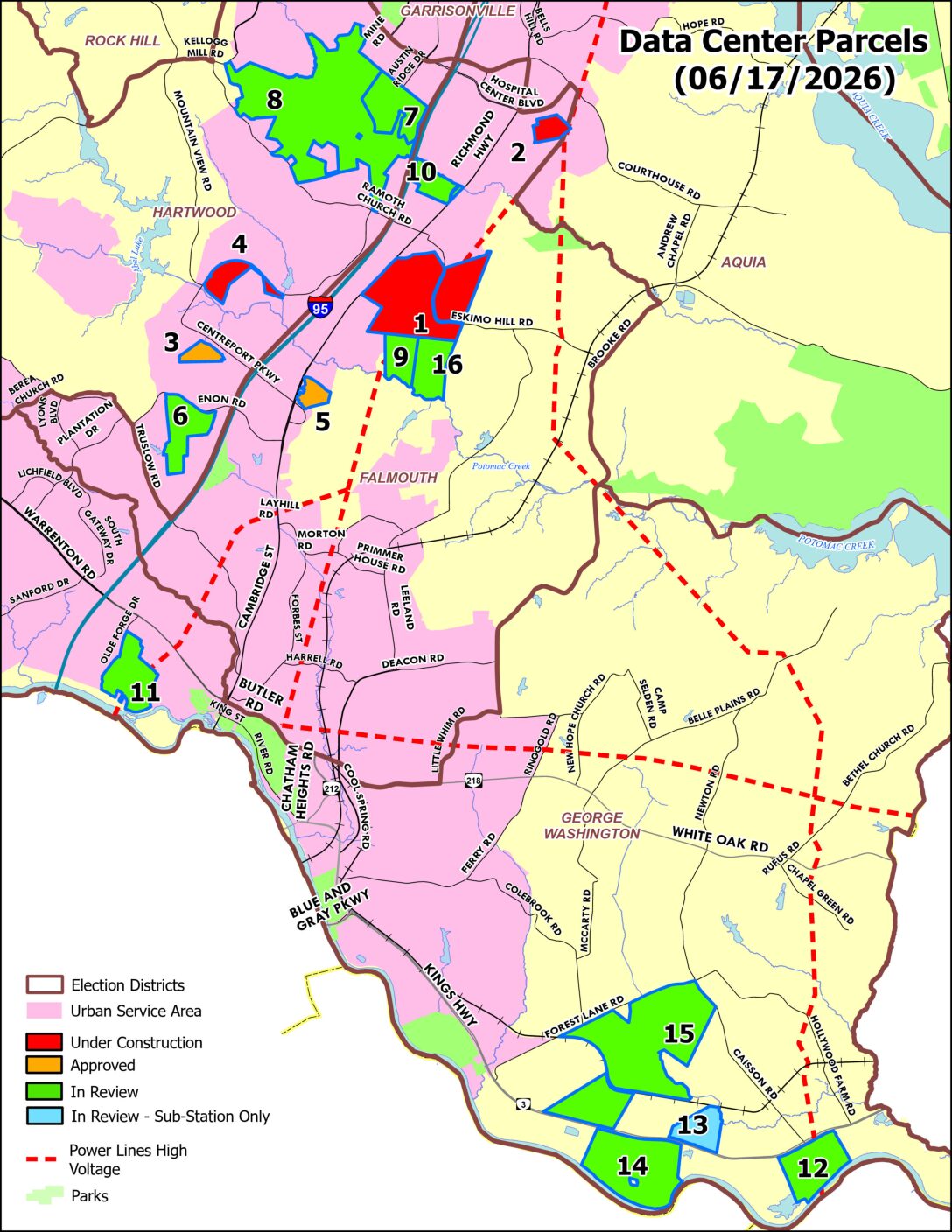
Five data centers are already approved, with three under construction, and developers have applied to build 11 more in Stafford, said Michael Zuraf, the county’s planning and zoning director.
The supervisors and staff didn’t talk much about exactly how much tax revenue data centers would generate. They spoke more about how the county would use that money.
Regardless of a total revenue figure, Stafford government staff recommends setting aside 10-14% of all net data center revenue proceeds in a rainy day fund.
Then, money in excess of 14% could be considered by the supervisors for use in one-time projects. And, if funds fall below 10%, a board-approved plan could be created to return to 10% within three years.
The idea, said county CFO Andrea Light, is to limit the use of data center revenue for ongoing, operational uses in case something happened to the industry and businesses failed.
Light presented three strategies for the revenue’s use: one that emphasized paying for transportation costs, another centered on operating needs and a third that would spread money around in a balanced approach.
Board Vice Chairwoman Maya Guy said she could see using data center money to give property owners a tax rebate.
And she’d like to see this revenue stream pay for environmental impacts in the county. She emphasized that she wasn’t pointing a finger at data centers, which are criticized over environmental impacts, but rather talking about improving the environment generally.
Diggs agreed with the notion of paying for environmental matters, but he said he was most interested in devoting money to other priorities.
“So, for me, my number one on this is going to be the tax rate,” he said of the real estate rate. “It has to come down for constituents. Reduce it. Yeah, reducing the tax rate. The second is going to be transportation.”
English and Yeung said they’re interested in data center money potentially being used to pay down county debts.
The supervisors will continue the discussion at a future meeting, Light said.