BALTIMORE — Sometimes, you have to go out of town to appreciate what you have back home.
I’ve been on a history kick for a while now, as you know if you’ve read this column over the past few weeks. And so my son and I came here, to my favorite big city, Sunday to see the Sail250 Maryland & Airshow Baltimore.
We aimed mainly to see the fleet of international and U.S. tall ships, historic vessels and modern military boats, and we did, even touring the Indian Navy’s INS Sudarshini.
This is a sail training ship, and “Sudarshini” means “beautiful lady Sundari” after the younger half-sister of Buddha. I also learned that the boat is called a “three-masted barque” and can remain at sea for at least 20 days at a time.
I can’t really swim, so I couldn’t remain at sea for much more than a day or so, and I’d be rather upset if there wasn’t a Starbucks in every port. (Bonus points if you knew that Starbuck is a character in “Moby-Dick.”)
So, though it was cool to see how the Indian Navy lives at sea, I won’t be signing up to go along.
On the other hand, I will be signing up to see the Rappahannock Whalers again.
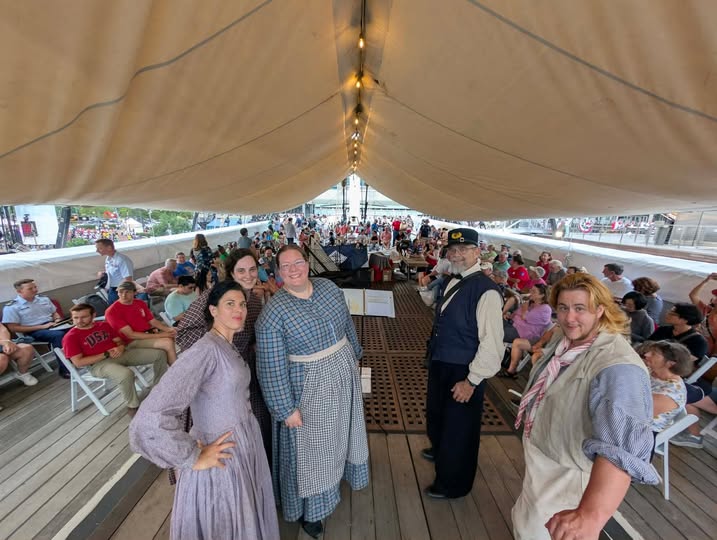
A little ways away from the Sudarshini in the Inner Harbor at Sail250, the Whalers were aboard the USS Constellation, a preserved sloop-of-war that now functions as a museum ship in Baltimore year-round.
The Rappahannock Whalers are a special group of Fredericksburg-based historical interpreters who appear at events dressed in period costumes and sing sea shanties.
As my editor Kathy Knotts wrote in a feature story about the crew last fall, sea shanties (also spelled “chanteys”) weren’t meant as entertainment back in the late 1700s to mid-1800s. They were “rhythmic work songs that helped sailors coordinate everything from hoisting sails to hauling anchor.”
But they’re certainly entertaining now, and the Whalers sang for visitors who toured the Constellation over the weekend. A special concert Saturday night drew 150 music fans, and more would have been there if not for the fire-marshal-type cutoff.
“We expected maybe 10 or 20, and they kept pouring in, kept pouring in,” said group member Steve Blancard, who lives in Fredericksburg.
The Whalers even carried their commitment to historic portrayal to after hours. They slept on board the Constellation, the last sail-only warship designed and built by the U.S. Navy, over the weekend.
Founded in 2018, the Whalers performed in Baltimore last year and Fredericksburg-area fans can see them in Port Royal on July Fourth, and at Rising Sun Tavern in downtown Fredericksburg in September.
My son, Jackson, and I got a special taste of the music Sunday when the group sang the shanty standard, “Roll the Old Chariot Along.”
But you don’t have to know the songs to enjoy a Whalers gig. That’s because you can quickly learn the tunes as they’re sung.
“There’s also that benefit to the format of a lot of these songs, where so much of it’s based in call-and-response,” said Whaler Jack Kelly, who lives in Tappahannock.
In addition to performing, the Whalers also provide historical perspective. They explained that whaling was big business in the days of yesteryear because whale oil was used for lighting and for lubrication for machines.
At the end of interviews, I always ask what I’ve forgotten to inquire about, and Whaler Paul Stier had an excellent answer for me Sunday.
“Oh, you’re forgetting to ask, ‘How do we historically justify ladies in our group?’” the Fredericksburg resident said.
One might think it’s just a 21st-century addition that Emily Sorenson from Richmond, Rebecca Welker-Lamond of Columbia, Md., and a third chanteuse, who goes by “Phoenix,” are in the Whalers.
But that’s not right. Historically, on shipping operations, sometimes the captain’s wife would tag along on voyages, Stier said.
Sean Holliday, who lives in Stafford County, may have made my day, however, with his shanty knowledge.
I knew little about shanties before Sunday. But one thing I did know was that Robert Hunter, the main lyricist for the Grateful Dead, once wrote shanties for the band’s roadies. He thought it would be beneficial for the crew to sing them while they set up the stage.
I didn’t figure any of the Whalers would know this obscure fact I learned from satellite radio, but I asked.
And, sure enough, Holliday knew this detail.
But why wouldn’t he? Like any other historian, if there’s one thing he and his mates are into, it’s the details.