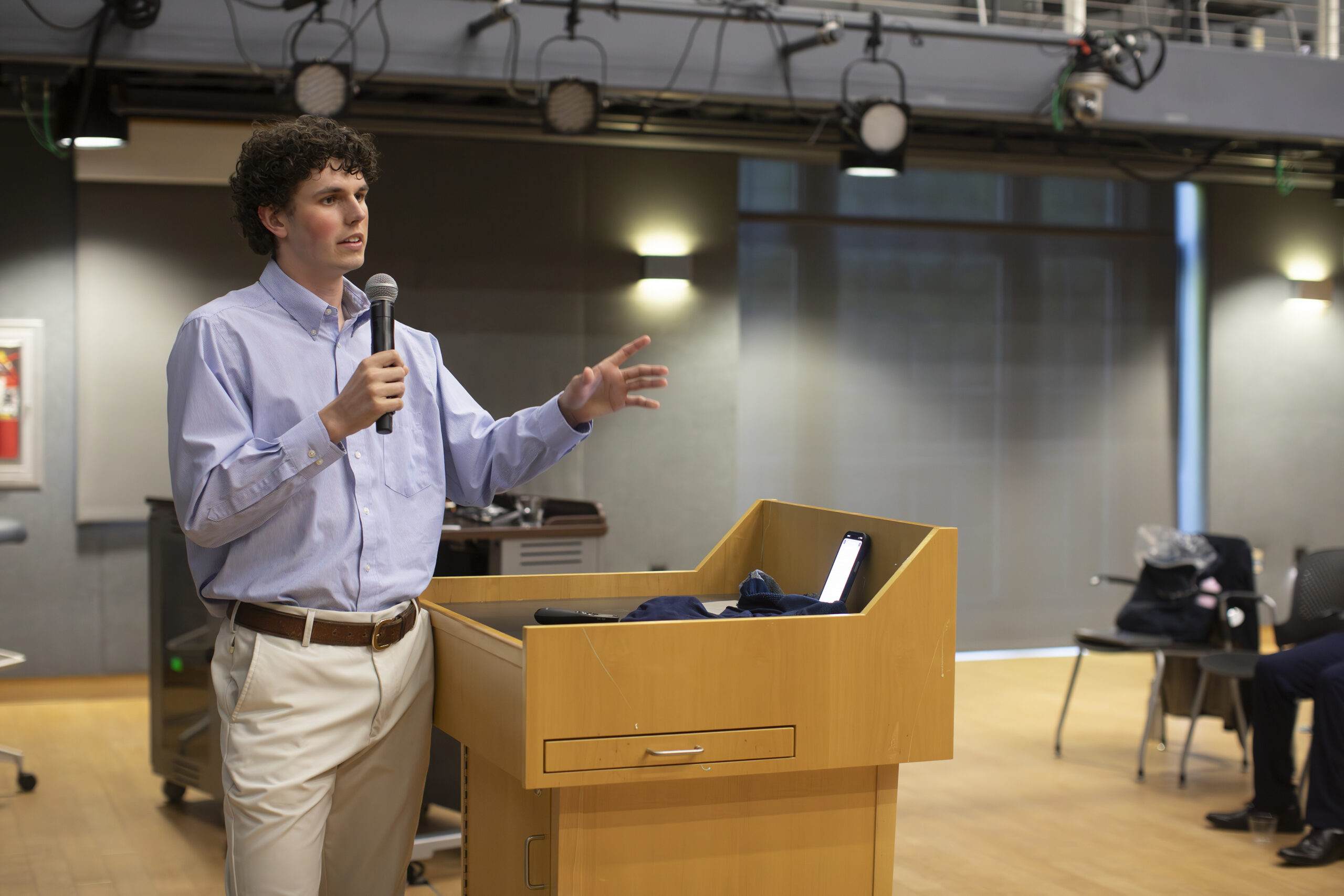
Five judges. Nine nerve-racking, high-stakes pitches. Live feedback.
And $10,000 on the line for the next big idea.
Think Shark Tank — just with way nicer judges, a campus crowd and student entrepreneurs chasing real startup funding.
The University of Mary Washington’s annual Eagle Egg Pitch Competition has helped fund several start-ups over the years, from an oyster farm to a mobile café for commuters and an organic beeswax candle company.
Hosted by the College of Business, this year’s event included pitches for a line of American rugby grip socks, a laundry service for college students and a shoe charm company aiming to tap into a $15 billion global market.
The 2026 top prize went to John “J.D.” Nett, a junior from Leesburg, Va., for his LAX Gear Dryer, an invention that oxidizes odor-causing bacteria on lacrosse gear, leaving it clean and dry in hours.
Nett built his first prototype in his family’s garage as a seventh grader. Every car ride home from practice, he said, his mom had the same complaint: the smell. The first iteration was big, bulky and built from scrap. It worked.
Ozone, Nett explained, attacks odor-causing bacteria where soap can’t reach, neutralizing the source rather than masking the smell. Server fans circulate ozone through pads, pockets and helmet liners inside a sealed bag that lifts off once the cycle is complete.
Nett has already sold the LAX Gear Dryer at summer lacrosse tournaments where, he said, the product sells itself, to players, coaches and — of course — moms. With his $10,000 in venture funding, Nett plans his first 50-unit, 3D printed production run.
The first pitch competition was held in 2019. This year, UMW alumnus Bryan Eckle, who graduated in 1996 with a degree in business administration, provided a founding gift that increased the contest’s prize money. Eckle called it the Eagle Egg Innovation Fund because, he said, bringing ideas to life is like hatching an egg. Students were also eligible for $500 Concept Awards to ensure that those with limited financial resources weren’t excluded.
“For many UMW students, even a few hundred dollars for prototyping can be transformational,” Filiz Tabak, dean of the College of Business, said in a news release.
Eckle, who is co-founder of Summit2Sea Consulting and chief solutions officer at cBEYONData, was among five judges at the pitch competition, all of whom are UMW alumni. Following each presentation, the judges asked students questions about their innovations.
The competition “shifts student learning from theoretical to experiential,” Tabak said. “Even without launching a venture, students with entrepreneurial experience interview better. They have real-life stories to share, demonstrate initiative, understand financial impact and think cross-functionally.”
A real-life experience inspired Aloysious Kabonge, a data science major, to create Proof Mode, an app that allows students to prove that they — and not AI — authored their papers.
Two years ago, Kabonge said, he turned in an English paper that his professor thought was AI-generated.
“Honest students can’t prove they didn’t cheat,” he said.
A 2025 story in The New York Times reported that students are increasingly resorting to extreme measures to prove they didn’t cheat, including providing time-stamped screenshots from their writing process to uploading videos to YouTube documenting their writing. Students also report increasing anxiety around AI-detection software that can falsely flag human-written content.
Kabonge’s app “does not scan for AI,” he said. “It captures when and how you wrote. It’s validating proof of process.”
His business model calls for making the application free for students and charging colleges and universities a subscription fee.
“Every honest student deserves proof,” Kabonge said.
The judges awarded him second place — and $2,000.
Third place, which came with a $1,000 prize, went to Maximilian McCusker for ZIP Rugby, a brainchild he hatched as a sophomore after undergoing double shoulder surgery and being sidelined from his sport for a year.
Right now, it can take months to get a rugby “kit” — a specialized uniform that includes jerseys, shorts, boots and grip socks — when ordering from overseas. ZIP Rugby, which McCusker bills as “America’s first performance Rugby brand,” delivers kits on time while creating a unified brand identity for teams.
He’s already sold more than 500 pairs of socks without a website and has secured deals with six university teams.
“We want to become the definition of American rugby,” McCusker said.