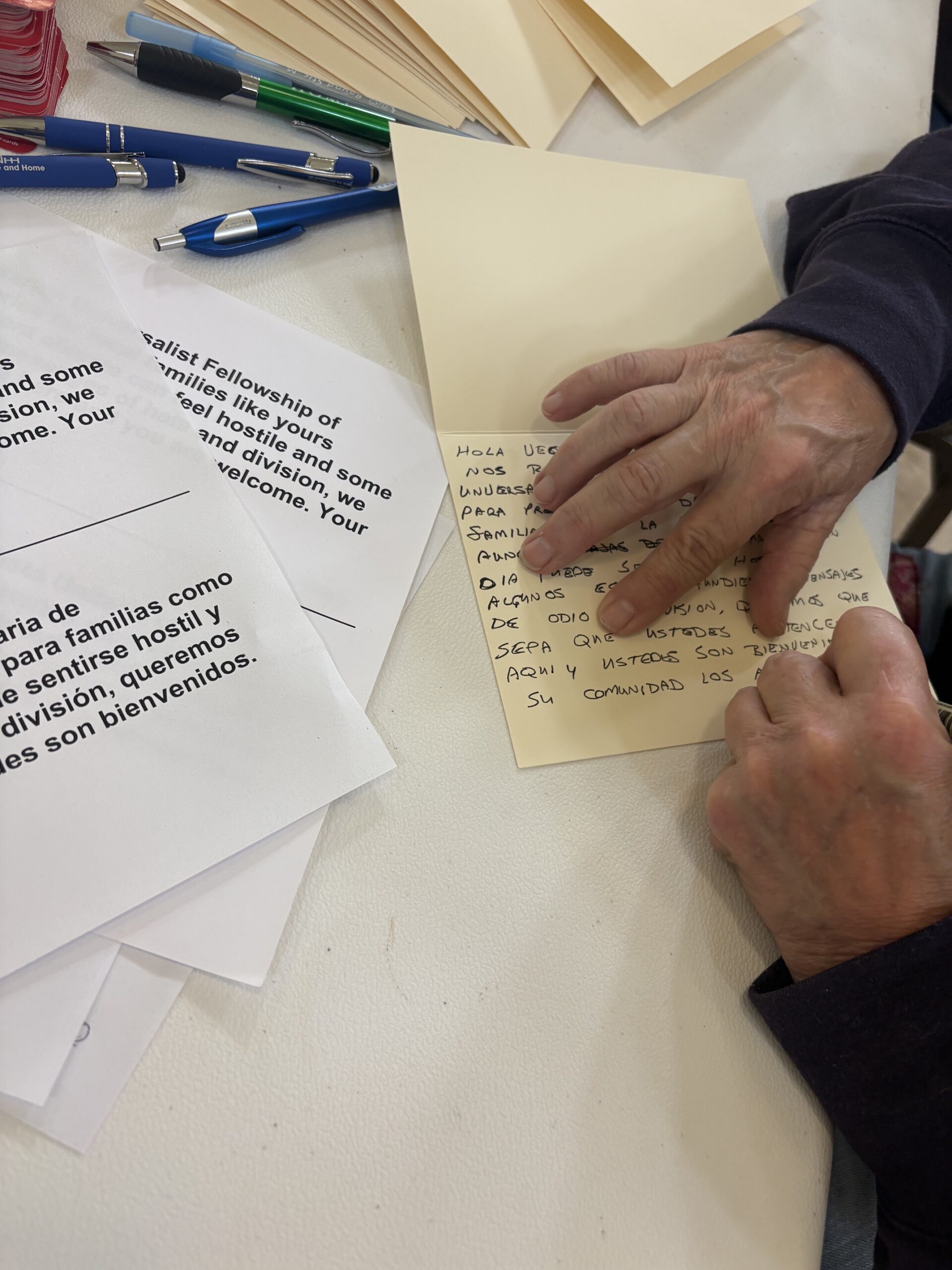
The typewritten templates scattered across a table inside the Unitarian Universalist Fellowship of Fredericksburg on Saturday afternoon were printed in both Spanish and English, the latter version included ostensibly so that volunteers could understand what they were copying.
But for Kit Carver, both the message and the work ungirding it translated perfectly.
Carver and other volunteers came together to prepare grocery boxes and handwritten cards for delivery to 50 families in the local Latino community who have been affected by immigration policies under the Trump administration.
“One of our missions is to feed the community,” Carver said. “And, so, this is all part of that mission: to feed the community. And this community doesn’t feel safe to come out. So, we’re going to them.”
The project was made possible by a $1,000 grant from the American Humanist Association as part of the American Empathy Project. The UU partnered with Maria Fuentes, who operates her own mutual aid organization, as well as the Fredericksburg Regional Food Bank, to collect food for distribution.
Press the Issue
The UU (25 Chalice Circle, Fredericksburg, Virginia 22405) is accepting donations that will be distributed to needy families. Fuentes said that fresh fruits and vegetables — as well as products like formula and diapers — are especially in demand in her community.
Building trust with a vulnerable community proved a hurdle initially, and the fellowship leveraged its relationship with the nonprofit Virginia Organizing to help reach families in need.
“The first person we talked to as part of this outreach project let us know if it was a cold call — if we just showed up their house to like try to canvas — they would not have answered the door,” said Rosemary, a UU volunteer who helped organize the efforts. “So, it’s all about like utilizing the connections we have.”
Fuentes is one of those connections. The mother of nine — three biological and six adopted — began her work in mutual aid during the pandemic, when her neighbors in Washington, D.C., were suddenly unable to leave their homes to secure basic necessities.
She remembers waking up at 3 a.m. to load a truck with food that eventually reached 100 people.
“Since then, I’ve had communications with people who give out food,” Fuentes said in her native Spanish. “And, when I moved [to Virginia], I didn’t lose those connections.”
Years later, it’s not a quarantine but rather the fear of deportation and family separation that’s deterred many in the Latino community from leaving their homes. Many families are eligible for WIC and food stamps, noted Fuentes, but have refrained from seeking them due to concerns about their immigration status.
“They’re scared to apply for government aid, because they’re afraid that ICE will use that information to investigate them,” Fuentes said.
That fear often extends to in-person outreach. Rosemary recalled a community member who described their recent experience at a “food distribution event.”
“But then, when they got here, they started asking for social security numbers,” Rosemary said. “It just created like a culture of fear because they didn’t know whether it was going to identify them as somebody to be targeted.”
Saturday’s efforts aren’t a one-off. Using the remaining grant funds, the UU has an event scheduled later this month where community members can receive “red cards,” which will empower them to assert their constitutional rights during encounters with law enforcement — even if they lack English language skills.
As volunteers packed fresh fruit and vegetables inside — two potatoes per box — a boy no more than six or seven stood beside a pickup truck receiving cases of canned beans; it was clear that Saturday’s event was as much about combatting fear as hunger.
“Even though the current climate can feel hostile and some people out there are sowing division,” read the card that families will receive along with their groceries, “we want you to know that you belong here and are welcome.”
And those stacked translations? They might not be necessary much longer.
The UU has started offering Spanish classes.