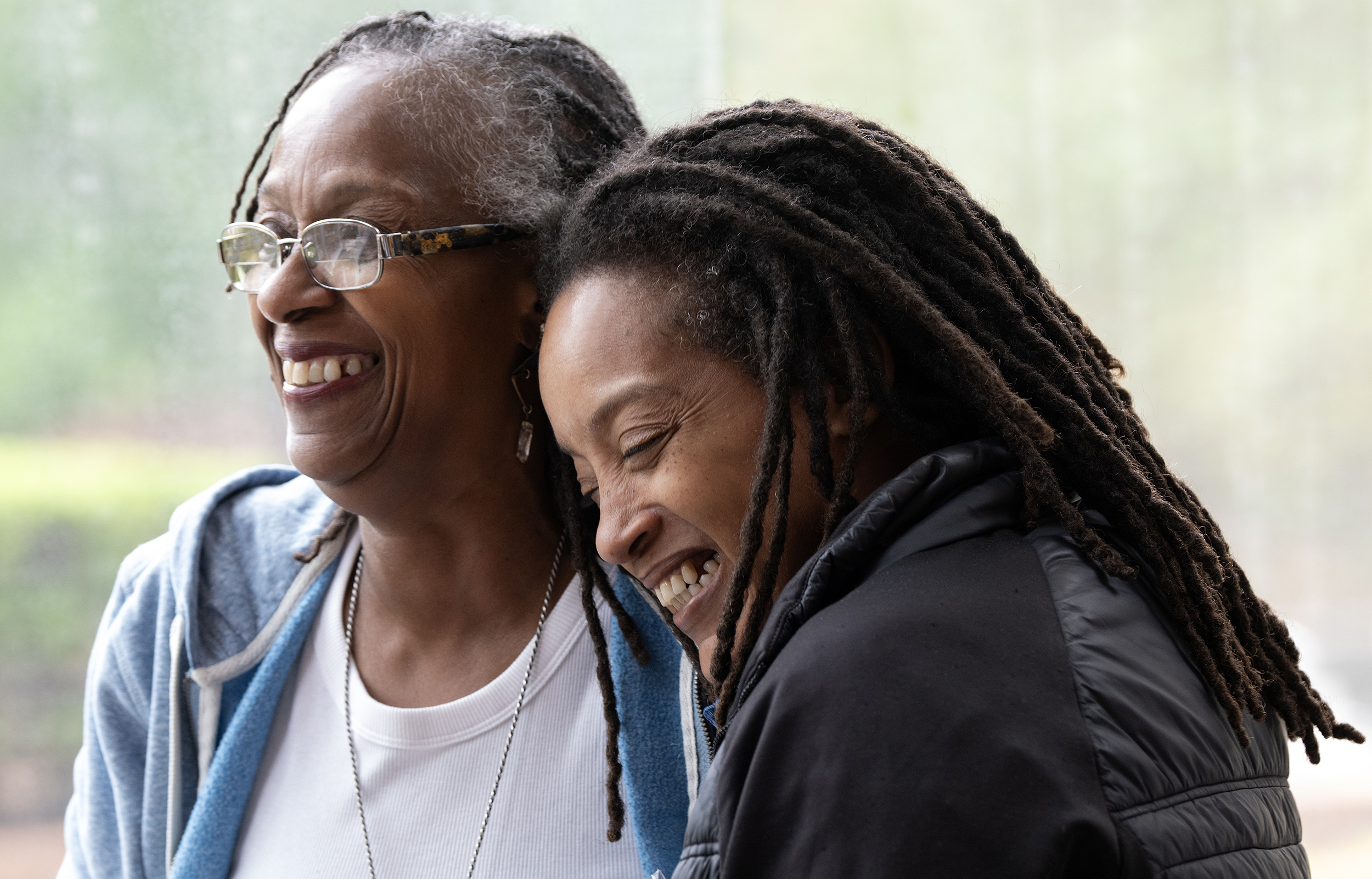
Donya Twyman didn’t really have a plan at first. She was grieving her mother. And she was angry — angry at what had happened to that vibrant, fearless woman who’d skied in Austria and vacationed in Brazil and ridden her motorcycle cross-country.
When loss loomed as deep and cold as the winter mornings, Twyman retreated to her basement studio in Woodbridge and lost herself in craft: cutting cardboard and fabric and patterned paper she turned into cards.
On a screen nearby, her favorite political pundits delivered the day’s news, and everything felt oversized, out of control. Except for these — the things she made with her hands.
Twyman passed hours and days this way, and soon the cards began to pile up, dozens of them she painted and slipped into plastic sleeves. A pattern emerged.
Most of the cards were for her mother, acts of love with nowhere to go.
A force of will
The woman Twyman mourned had spent her life defying expectations.
Born Artha Jean Washington in 1938, she was the only daughter of Arthur and Mary Washington, who grew up in Spotsylvania County during Jim Crow before relocating to Washington, D.C.
Washington attended public schools in D.C., where she met and married Benjamin Twyman. While raising three daughters, she continued her education at Federal City College — D.C.’s first four-year public college and a predominantly Black institution that opened in 1968 — then attended the USDA Graduate School for federal employees.
She worked for the Army Map Service before becoming one of the first Black women in air traffic control during the Civil Rights era and belonged to the National Black Coalition of Federal Aviation Employees.
In August 1981, when more than 13,000 air traffic controllers went on strike, Washington crossed the picket line and went to work. She had spent too many years fighting for opportunities that had long been denied to Black women.
Washington made all of her own clothes — often with matching shoes — and wore her nails painted and her hair impeccably styled. She never stepped outside their three-story townhome in southwest D.C. looking any other way, including for her night shift at the airport, which earned her the nickname “Hook” from neighbors.
It was years before Twyman understood why.
“This was a Black woman leaving the house at 11 at night and rolling in when the sun came up,” she said.
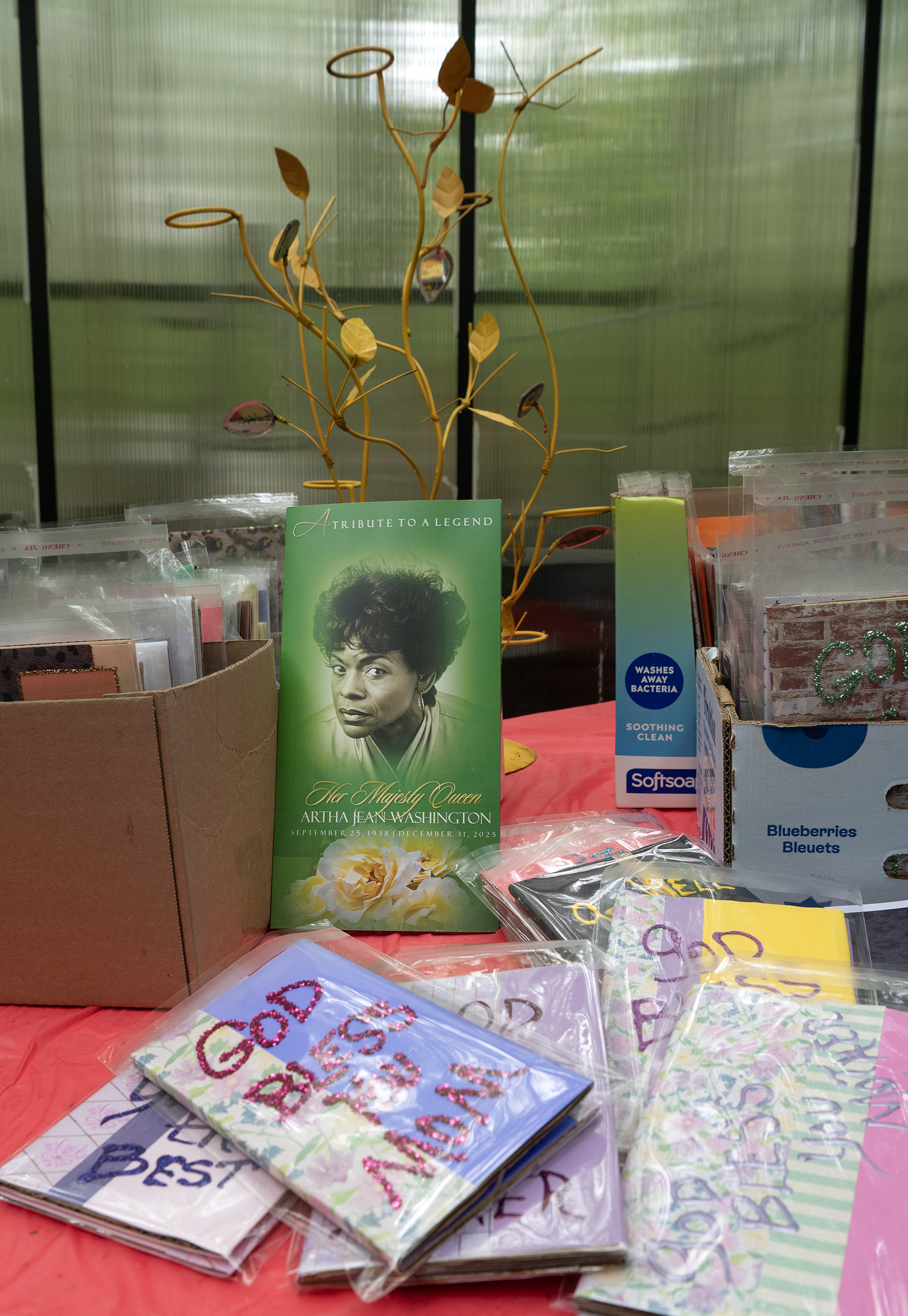
Donya Twyman, a.k.a. Momma D, displays her assortment of cards made with recycled materials. What started as an art therapy to cope with the loss of her mother has blossomed into a way to thank staff and visitors at Mary Washington Hospital in honor of Mother’s Day. (Photos by Jeff Kearney.)
In 1978, at the age of 40, she rode her motorcycle from D.C. to Los Angeles. She also belonged to Black Ski, a ski club for people of color, traveling to slopes across Europe. Washington loved to entertain; their home was often full of people from different backgrounds.
She was unusually good at math and insisted that Twyman earn an associate’s degree in accounting — Washington wanted her daughters to understand money and balance their checkbooks.
When Twyman worked briefly as a flight attendant for Braniff International Airways, mother and daughter would meet up in South America and the Caribbean. She retired to Florida in 1999, where she had a house built.
For most of Twyman’s life, her mother had seemed indestructible.
Coming home
Three years before Washington’s death on Dec. 31, 2025, she fell ill and began to show signs of dementia. Her family rallied around her. About a year and a half later, Twyman lost touch with her mother.
Twyman later learned that her mother’s home and vehicle had been signed over to a relative and sold, she said. “I spent 18 months looking for Mom. I was met with excuses.”
In October 2025, Twyman said, her mother — who was experiencing cognitive decline — found her cellular phone and called from the relative’s home. “She said, ‘Come get me. They are holding me against my will.’”
Twyman reached out to local police to request a wellness check. The request further strained family relationships, she said.
Efforts to involve Adult Protective Services became tangled across multiple jurisdictions — Florida, where her mother was a resident; the locality where she was staying with relatives; and Woodbridge, where Twyman lived.
“With so many moving parts and people,” she said, “there was no coordination.”
Finally, on Thanksgiving night around 6:30 p.m., the relative dropped her mother off in Twyman’s driveway, she said.
“It was cold as Christmas. She was confused, but happy to see me. She was wearing a summer hat, summer shoes.”
She walked with a rollator — a mobility aid with a built-in seat. Except for a few adult diapers tucked inside it, Washington had nothing else with her, Twyman said. Two weeks later, she suffered a stroke.
Washington improved enough to enter a rehabilitation center but then suffered another stroke. She died at Mary Washington Hospital on Dec. 31, 2025.
Twyman remembers the call from a woman she knew only as Nurse Erin, who told her she’d be there waiting when she arrived. She was, and Twyman could tell the nurse had made sure her mother looked OK before she saw her.
“Nurse Erin hugged me. It was the most genuine hug. She held my hand. I could feel the empathy. Nurses don’t have to do that,” Twyman said. “We didn’t have a lot going for us. She made such a profound impact.”
Twyman later mentioned Nurse Erin and the hospital’s 4N care team in her mother’s obituary.
“Mary Washington was her mother’s name,” Twyman said. “She died in the bosom of Mary Washington.”
Full circle
On a recent May afternoon, Twyman sat at her campsite at Indian Acres Club of Thornburg, where she likes to spend the spring and summer months waking to the trees tapping against her camper window.
All around the campsite were things she’d salvaged — benches and tables and chairs, an antique cauldron, even a greenhouse a neighbor no longer wanted. Everything here had been painted and repurposed. There were wind chimes and statuary and little garden plots.
Twyman brought the cards with her — big stacks of them tilting precariously on a card table. She had begun making them to honor her mother, to sort through the complexities of grief that, over the months, had transformed into something closer to gratitude.
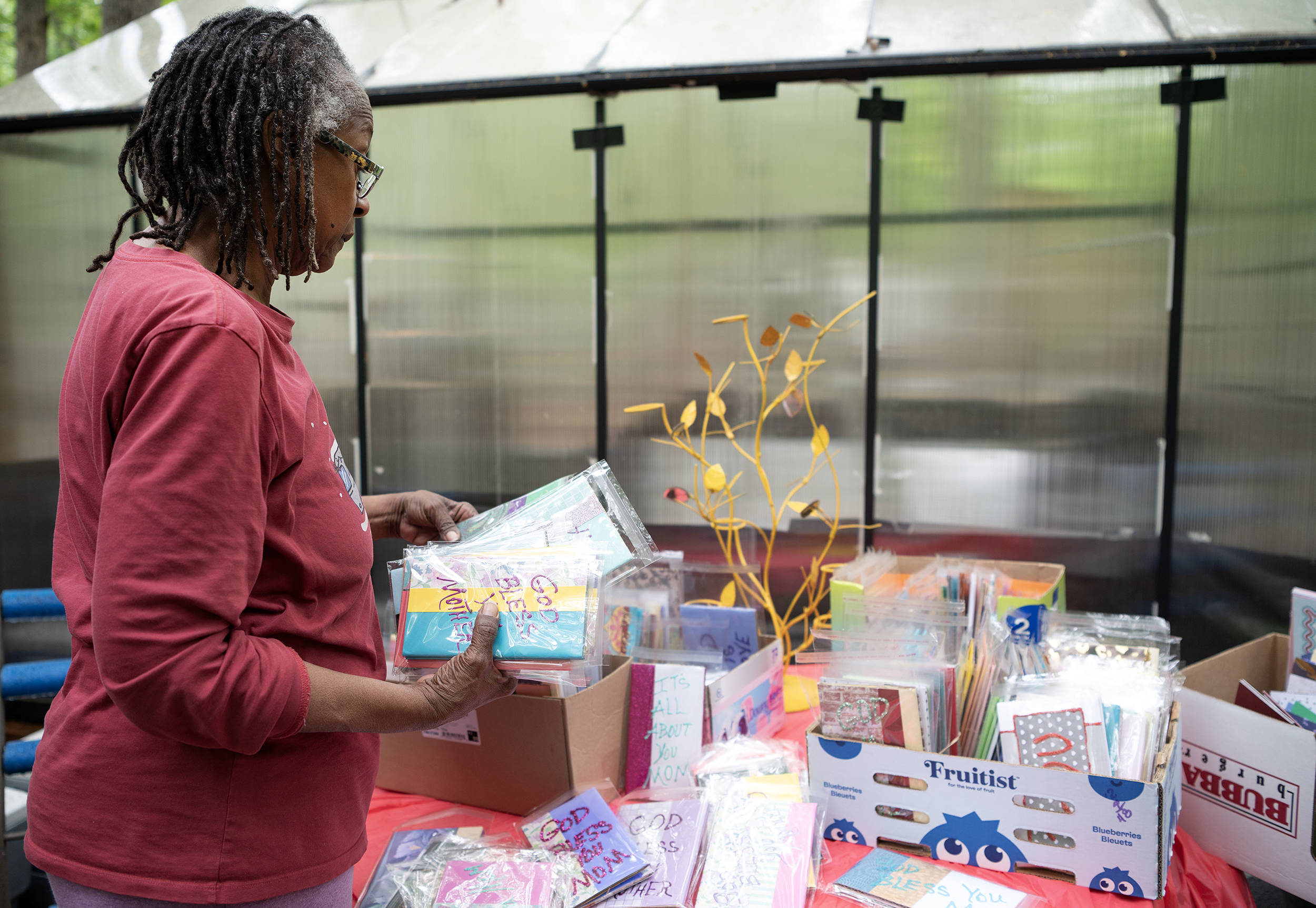
Donya Twyman, a.k.a. Momma D, displays her assortment of cards made with recycled materials. What started as an art therapy to cope with the loss of her mother has blossomed into a way to thank staff and visitors at Mary Washington Hospital in honor of Mother’s Day.
She was grateful for those final weeks with her mother, for the meals they shared, for the night Twyman put on music and they danced.
“You think bad things happen to you. You think, ‘Why me?’” Twyman said.
Like the time years earlier when her 16-year-old daughter gave birth to twin girls she helped raise. “At the end of the day, they were the best thing that ever happened to me. Everything bad is not bad.”
Where Twyman’s creative outlet had once dead-ended in grief, it now had a destination. Three days before Mother’s Day, she packed up 60 of her handmade cards and delivered them to Mary Washington Hospital for mothers who would spend the holiday hospitalized.
By the time she arrived, news of Twyman’s visit had already made its way through the hospital, during Nurses Week, no less.
Her story, said Tonja Thigpen, DHA, senior vice president and chief nursing officer for Mary Washington Healthcare, “reminds us that healing is about much more than medicine — it’s about compassion, presence, and human connection.”